 Add to Chrome
 Add to Firefox
 Add to Edge
Hope for the Best, Prepare for the Worst: Occlusion-Aware Contingency Planning for Autonomous Vehicles
Jul 03, 2026
The deployment of autonomous vehicles in urban environments introduces significant safety challenges, particularly in scenarios with occlusions, where critical traffic participants may be hidden from view. Recent accidents involving driverless vehicles highlight the importance of motion planners that explicitly addresses the risks posed by occlusions. In this work, we propose a formal, occlusion-aware trajectory planning framework that guarantees collision avoidance even when there are possible hidden traffic participants. Building on our previous methods that apply reachability analysis to sequentially determine the possible states of hidden traffic participants, we integrate a tree-based motion planner capable of reasoning over future observations and the absence thereof. This approach reduces conservativeness while maintaining safety guarantees. We demonstrate the effectiveness of our framework in a challenging simulated occluded scenario, showing that it pro-actively and efficiently guarantees collision-avoidance.

Robust MITL planning under uncertain navigation times
Mar 06, 2024
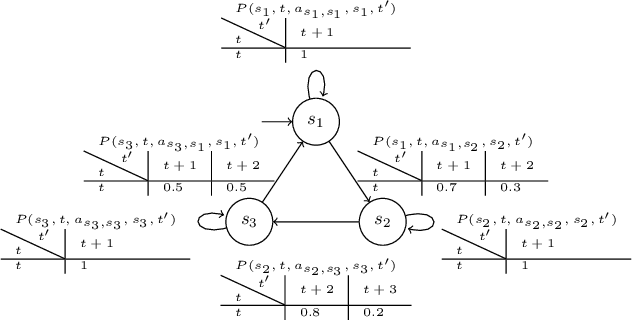


In environments like offices, the duration of a robot's navigation between two locations may vary over time. For instance, reaching a kitchen may take more time during lunchtime since the corridors are crowded with people heading the same way. In this work, we address the problem of routing in such environments with tasks expressed in Metric Interval Temporal Logic (MITL) - a rich robot task specification language that allows us to capture explicit time requirements. Our objective is to find a strategy that maximizes the temporal robustness of the robot's MITL task. As the first step towards a solution, we define a Mixed-integer linear programming approach to solving the task planning problem over a Varying Weighted Transition System, where navigation durations are deterministic but vary depending on the time of day. Then, we apply this planner to optimize for MITL temporal robustness in Markov Decision Processes, where the navigation durations between physical locations are uncertain, but the time-dependent distribution over possible delays is known. Finally, we develop a receding horizon planner for Markov Decision Processes that preserves guarantees over MITL temporal robustness. We show the scalability of our planning algorithms in simulations of robotic tasks.