 Add to Chrome
 Add to Firefox
 Add to Edge
Poster: Camera Tampering Detection for Outdoor IoT Systems
Feb 05, 2026
Recently, the use of smart cameras in outdoor settings has grown to improve surveillance and security. Nonetheless, these systems are susceptible to tampering, whether from deliberate vandalism or harsh environmental conditions, which can undermine their monitoring effectiveness. In this context, detecting camera tampering is more challenging when a camera is capturing still images rather than video as there is no sequence of continuous frames over time. In this study, we propose two approaches for detecting tampered images: a rule-based method and a deep-learning-based method. The aim is to evaluate how each method performs in terms of accuracy, computational demands, and the data required for training when applied to real-world scenarios. Our results show that the deep-learning model provides higher accuracy, while the rule-based method is more appropriate for scenarios where resources are limited and a prolonged calibration phase is impractical. We also offer publicly available datasets with normal, blurred, and rotated images to support the development and evaluation of camera tampering detection methods, addressing the need for such resources.

Precise Low-Current Measurement Techniques for IoT Devices: A Case Study on MoleNet
Jan 23, 2026Power consumption is a crucial aspect of IoT devices which often have to run on a battery for an extended period of time. Therefore, supply current measurements are crucial before deploying a device in the field. Multimeters and oscilloscopes are not well suited when it comes to measuring very small currents which occur e.g. when an IoT device is in sleep mode. In this report, we compare dedicated source measurement units (SMUs) which allow to measure very small currents with high precision. As an application example, we demonstrate current measurements on our MoleNet IoT sensor board.
Using LoRa communication for Urban VANETs: Feasibility and Challenges
Nov 29, 2023Vehicular Ad-Hoc Networks (VANETs) were introduced mainly to increase vehicular safety by enabling communication between vehicles and infrastructure to improve overall awareness. The vehicles in a VANET are expected to exchange numerous messages generated by multiple applications, but mainly, these applications can be subdivided into safety and non-safety. The main communication technologies designed for VANETs, DSRC (Dedicated Short Range Communication) and C-V2X (Cellular V2X), mainly focus on delay-sensitive safety-related applications. However, sharing the same bandwidth for safety and non-safety applications will increase the burden on the communication channel and can cause an increase in the overall latencies. Therefore, this work analyses the feasibility of using LoRa communication for non-safety-related urban VANET applications. We conducted multiple real-world experiments to analyse the performance of LoRa communication in various urban VANET scenarios. Our results show that LoRa communication handles the Dopper shifts caused by the urban VANET speeds with both Spreading Factor (SF) 7 and 12. However, higher SF was more vulnerable to Doppler shifts than lower SF. Furthermore, the results illustrate that the Line-of-Sight (LoS) condition significantly affects the LoRa communication, especially in the case of lower SF.
Machine Learning based Soil VWC and Field Capacity Estimation Using Low Cost Sensors
Jan 27, 2021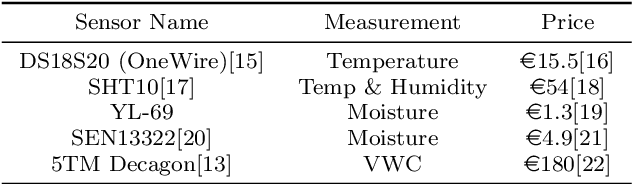

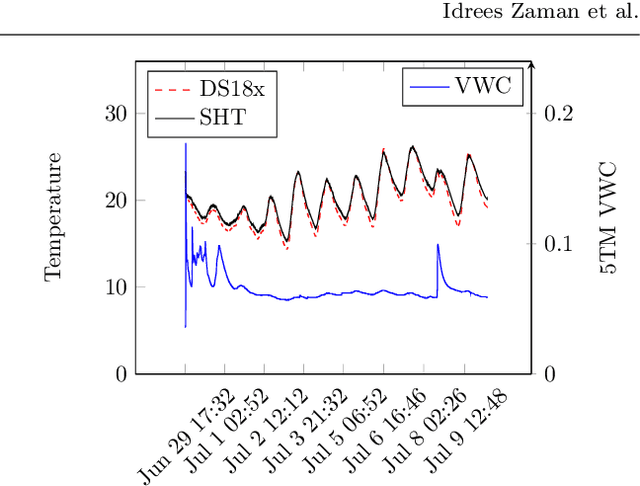

The amount of water present in soil is measured in terms of a parameter commonly referred to as Volumetric Water Content (VWC) and is used for determining the field capacity of any soil. It is an important parameter accounting for ensuring proper irrigation at plantation sites for farming as well as for afforestation activities. The current work is an extension to already going on research in the area of wireless underground sensor networks (WUSNs). Sensor nodes equipped with Decagon 5TM volumetric water content (VWC) and temperature sensor are deployed underground to understand the properties of soil for agricultural activities. The major hindrances in the deployment of such networks over a large field are the cost of VWC sensors and the credibility of the data being collected by these sensors. In this paper, we analyze the use of low-cost moisture and temperature sensors that can either be used to estimate the VWC values and field capacity or cross-validate the data of expensive VWC sensors before the actual deployment. Machine learning algorithms, namely Neural Networks and Random Forests are investigated for predicting the VWC value from low-cost moisture sensors. Several field experiments are carried out to examine the proposed hypothesis. The results showed that low-cost moisture sensors can assist in estimating the VWC and field capacity with a minor trade-off.