 Add to Chrome
 Add to Firefox
 Add to Edge
Mimicking Human Visual Development for Learning Robust Image Representations
Dec 16, 2025
The human visual system is remarkably adept at adapting to changes in the input distribution; a capability modern convolutional neural networks (CNNs) still struggle to match. Drawing inspiration from the developmental trajectory of human vision, we propose a progressive blurring curriculum to improve the generalization and robustness of CNNs. Human infants are born with poor visual acuity, gradually refining their ability to perceive fine details. Mimicking this process, we begin training CNNs on highly blurred images during the initial epochs and progressively reduce the blur as training advances. This approach encourages the network to prioritize global structures over high-frequency artifacts, improving robustness against distribution shifts and noisy inputs. Challenging prior claims that blurring in the initial training epochs imposes a stimulus deficit and irreversibly harms model performance, we reveal that early-stage blurring enhances generalization with minimal impact on in-domain accuracy. Our experiments demonstrate that the proposed curriculum reduces mean corruption error (mCE) by up to 8.30% on CIFAR-10-C and 4.43% on ImageNet-100-C datasets, compared to standard training without blurring. Unlike static blur-based augmentation, which applies blurred images randomly throughout training, our method follows a structured progression, yielding consistent gains across various datasets. Furthermore, our approach complements other augmentation techniques, such as CutMix and MixUp, and enhances both natural and adversarial robustness against common attack methods. Code is available at https://github.com/rajankita/Visual_Acuity_Curriculum.

Backdoor Attacks on Open Vocabulary Object Detectors via Multi-Modal Prompt Tuning
Nov 16, 2025Open-vocabulary object detectors (OVODs) unify vision and language to detect arbitrary object categories based on text prompts, enabling strong zero-shot generalization to novel concepts. As these models gain traction in high-stakes applications such as robotics, autonomous driving, and surveillance, understanding their security risks becomes crucial. In this work, we conduct the first study of backdoor attacks on OVODs and reveal a new attack surface introduced by prompt tuning. We propose TrAP (Trigger-Aware Prompt tuning), a multi-modal backdoor injection strategy that jointly optimizes prompt parameters in both image and text modalities along with visual triggers. TrAP enables the attacker to implant malicious behavior using lightweight, learnable prompt tokens without retraining the base model weights, thus preserving generalization while embedding a hidden backdoor. We adopt a curriculum-based training strategy that progressively shrinks the trigger size, enabling effective backdoor activation using small trigger patches at inference. Experiments across multiple datasets show that TrAP achieves high attack success rates for both object misclassification and object disappearance attacks, while also improving clean image performance on downstream datasets compared to the zero-shot setting.
Assessing Risk of Stealing Proprietary Models for Medical Imaging Tasks
Jun 24, 2025The success of deep learning in medical imaging applications has led several companies to deploy proprietary models in diagnostic workflows, offering monetized services. Even though model weights are hidden to protect the intellectual property of the service provider, these models are exposed to model stealing (MS) attacks, where adversaries can clone the model's functionality by querying it with a proxy dataset and training a thief model on the acquired predictions. While extensively studied on general vision tasks, the susceptibility of medical imaging models to MS attacks remains inadequately explored. This paper investigates the vulnerability of black-box medical imaging models to MS attacks under realistic conditions where the adversary lacks access to the victim model's training data and operates with limited query budgets. We demonstrate that adversaries can effectively execute MS attacks by using publicly available datasets. To further enhance MS capabilities with limited query budgets, we propose a two-step model stealing approach termed QueryWise. This method capitalizes on unlabeled data obtained from a proxy distribution to train the thief model without incurring additional queries. Evaluation on two medical imaging models for Gallbladder Cancer and COVID-19 classification substantiates the effectiveness of the proposed attack. The source code is available at https://github.com/rajankita/QueryWise.
Identifying Physically Realizable Triggers for Backdoored Face Recognition Networks
Jun 24, 2025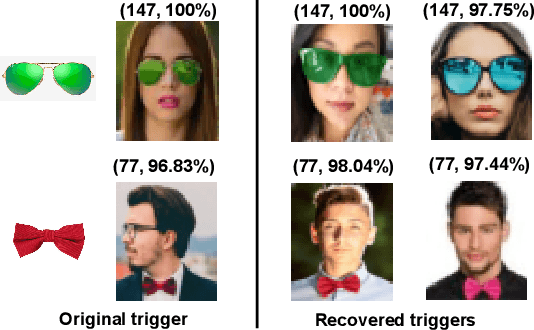
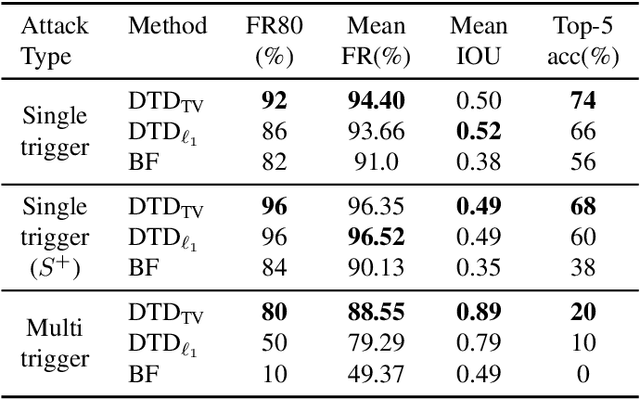
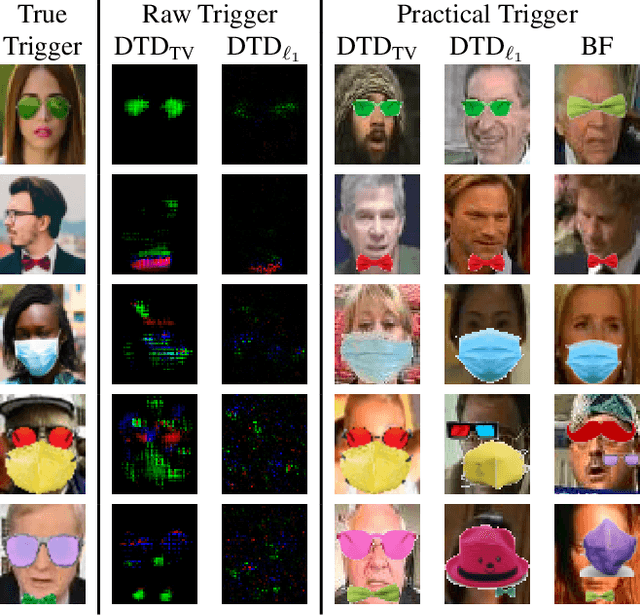
Backdoor attacks embed a hidden functionality into deep neural networks, causing the network to display anomalous behavior when activated by a predetermined pattern in the input Trigger, while behaving well otherwise on public test data. Recent works have shown that backdoored face recognition (FR) systems can respond to natural-looking triggers like a particular pair of sunglasses. Such attacks pose a serious threat to the applicability of FR systems in high-security applications. We propose a novel technique to (1) detect whether an FR network is compromised with a natural, physically realizable trigger, and (2) identify such triggers given a compromised network. We demonstrate the effectiveness of our methods with a compromised FR network, where we are able to identify the trigger (e.g., green sunglasses or red hat) with a top-5 accuracy of 74%, whereas a naive brute force baseline achieves 56% accuracy.
Examining the Threat Landscape: Foundation Models and Model Stealing
Feb 25, 2025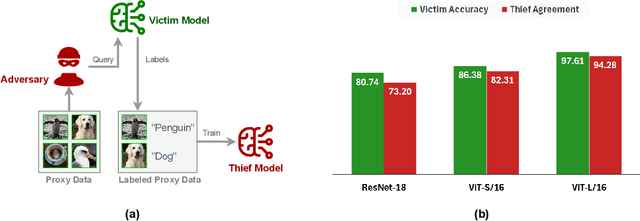
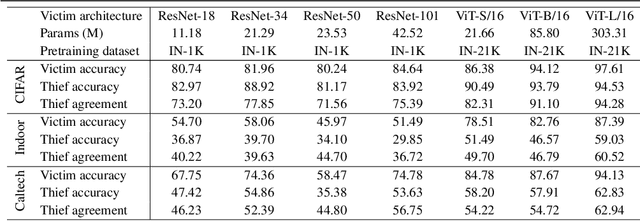
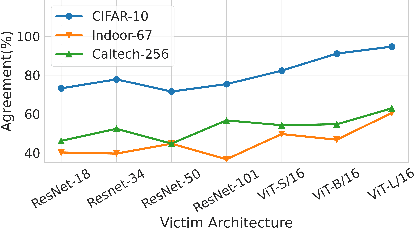
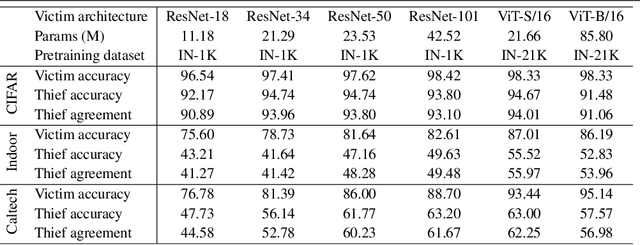
Foundation models (FMs) for computer vision learn rich and robust representations, enabling their adaptation to task/domain-specific deployments with little to no fine-tuning. However, we posit that the very same strength can make applications based on FMs vulnerable to model stealing attacks. Through empirical analysis, we reveal that models fine-tuned from FMs harbor heightened susceptibility to model stealing, compared to conventional vision architectures like ResNets. We hypothesize that this behavior is due to the comprehensive encoding of visual patterns and features learned by FMs during pre-training, which are accessible to both the attacker and the victim. We report that an attacker is able to obtain 94.28% agreement (matched predictions with victim) for a Vision Transformer based victim model (ViT-L/16) trained on CIFAR-10 dataset, compared to only 73.20% agreement for a ResNet-18 victim, when using ViT-L/16 as the thief model. We arguably show, for the first time, that utilizing FMs for downstream tasks may not be the best choice for deployment in commercial APIs due to their susceptibility to model theft. We thereby alert model owners towards the associated security risks, and highlight the need for robust security measures to safeguard such models against theft. Code is available at https://github.com/rajankita/foundation_model_stealing.