 Add to Chrome
 Add to Firefox
 Add to Edge
Eye-Tracking-Driven Control in Daily Task Assistance for Assistive Robotic Arms
Jan 24, 2026
Shared control improves Human-Robot Interaction by reducing the user's workload and increasing the robot's autonomy. It allows robots to perform tasks under the user's supervision. Current eye-tracking-driven approaches face several challenges. These include accuracy issues in 3D gaze estimation and difficulty interpreting gaze when differentiating between multiple tasks. We present an eye-tracking-driven control framework, aimed at enabling individuals with severe physical disabilities to perform daily tasks independently. Our system uses task pictograms as fiducial markers combined with a feature matching approach that transmits data of the selected object to accomplish necessary task related measurements with an eye-in-hand configuration. This eye-tracking control does not require knowledge of the user's position in relation to the object. The framework correctly interpreted object and task selection in up to 97.9% of measurements. Issues were found in the evaluation, that were improved and shared as lessons learned. The open-source framework can be adapted to new tasks and objects due to the integration of state-of-the-art object detection models.

Eye-tracking-Driven Shared Control for Robotic Arms:Wizard of Oz Studies to Assess Design Choices
May 29, 2025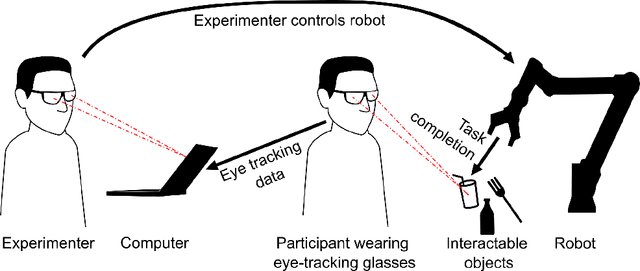
Advances in eye-tracking control for assistive robotic arms provide intuitive interaction opportunities for people with physical disabilities. Shared control has gained interest in recent years by improving user satisfaction through partial automation of robot control. We present an eye-tracking-guided shared control design based on insights from state-of-the-art literature. A Wizard of Oz setup was used in which automation was simulated by an experimenter to evaluate the concept without requiring full implementation. This approach allowed for rapid exploration of user needs and expectations to inform future iterations. Two studies were conducted to assess user experience, identify design challenges, and find improvements to ensure usability and accessibility. The first study involved people with disabilities by providing a survey, and the second study used the Wizard of Oz design in person to gain technical insights, leading to a comprehensive picture of findings.