 Add to Chrome
 Add to Firefox
 Add to Edge
DART: A Vision-Language Foundation Model for Comprehensive Rope Condition Monitoring
May 06, 2026
The condition monitoring (CM) of synthetic fibre ropes (SFRs) used in offshore, maritime, and industrial settings demands more than a classifier: inspectors need continuous severity estimates, maintenance recommendations, anomaly flags, deterioration timelines, and automated reports, all from a single inspection image. We present DART (Damage Assessment via Rope Transformer), a vision-language foundation model that addresses the full rope inspection workflow through a unified multi-task architecture. DART extends the Joint-Embedding Predictive Architecture (JEPA) to the cross-modal domain by coupling a Vision Transformer (ViT-H/14) with Llama-3.2-3B-Instruct via a Severity-Conditioned Cross-Modal Fusion (SC-CMF) module. Three architectural innovations drive the model's versatility: (1) HD-MASK, a saliency-guided masking strategy that focuses self-supervised reconstruction on damage-dense patches; (2) per-class learnable severity gates that adaptively weight language grounding by damage category; and (3) a Contrastive Damage Disentanglement (CDD) loss that shapes the embedding space to simultaneously encode damage type, severity ordering, and cross-modal semantics. Trained once on 4,270 images spanning 14 fine-grained rope damage classes, the frozen DART backbone supports downstream tasks without any task-specific fine-tuning: damage classification (93.22 % accuracy, 91.04 % macro-F1, +38.5 pp over a vision-only baseline), continuous severity regression (Spearman rho = 0.94, within-1-ordinal accuracy 99.6 %), few-shot recognition (89.2 % macro-F1 at 20 shots). These results demonstrate that DART functions as a general-purpose CM backbone that goes well beyond classification, providing actionable inspection intelligence from a single shared representation.

Imagery Dataset for Remaining Useful Life Estimation of Synthetic Fibre Ropes
May 05, 2026Remaining useful life (RUL) estimation of synthetic fibre ropes (SFRs) is critical for safe operation in offshore-crane, wind turbine installation, and heavy-load handling applications, where rope failure can result in catastrophic safety incidents and costly downtime. Despite growing research interest in data-driven condition monitoring, there is no publicly available image dataset that captures the complete degradation lifecycle of SFRs under controlled cyclic fatigue loading. To address this gap, we present a novel image dataset comprising approximately 34,700 high-resolution images of eleven Dyneema SK75/78 high-modulus polyethylene (HMPE) rope samples subjected to cyclic fatigue on a sheave-bend test stand at seven distinct axial load levels ranging from 60 kN to 280 kN. Ropes were loaded until mechanical failure, with fatigue lifetimes ranging from 695 cycles to 8,340 cycles. After every fixed number of sheave cycles (an inspection burst), ten images were captured at different cross-sectional positions along the rope, providing spatially representative sampling of surface degradation throughout the rope's entire service life. The images obtained from each load are annotated with the corresponding elapsed cycle count, enabling a direct computation of RUL for any rope in the sequence. This dataset aims to support a broad range of machine learning (ML) tasks including RUL regression, damage progression modelling, anomaly detection, and load-conditioned prognostics. The dataset is intended to serve as a benchmark resource for the development and comparison of vision-based condition monitoring (CM) and prognostics algorithms for SFRs.
FungalZSL: Zero-Shot Fungal Classification with Image Captioning Using a Synthetic Data Approach
Feb 26, 2025The effectiveness of zero-shot classification in large vision-language models (VLMs), such as Contrastive Language-Image Pre-training (CLIP), depends on access to extensive, well-aligned text-image datasets. In this work, we introduce two complementary data sources, one generated by large language models (LLMs) to describe the stages of fungal growth and another comprising a diverse set of synthetic fungi images. These datasets are designed to enhance CLIPs zero-shot classification capabilities for fungi-related tasks. To ensure effective alignment between text and image data, we project them into CLIPs shared representation space, focusing on different fungal growth stages. We generate text using LLaMA3.2 to bridge modality gaps and synthetically create fungi images. Furthermore, we investigate knowledge transfer by comparing text outputs from different LLM techniques to refine classification across growth stages.
Wastewater Treatment Plant Data for Nutrient Removal System
Jul 07, 2024This paper introduces the Agtrup (BlueKolding) dataset, collected from Denmark's Agtrup wastewater treatment plant, specifically designed to enhance phosphorus removal via chemical and biological methods. This rich dataset is assembled through a high-frequency Supervisory Control and Data Acquisition (SCADA) system data collection process, which captures a wide range of variables related to the operational dynamics of nutrient removal. It comprises time-series data featuring measurements sampled to a frequency of two minutes across various control, process, and environmental variables. The comprehensive dataset aims to foster significant advancements in wastewater management by supporting the development of sophisticated predictive models and optimizing operational strategies. By providing detailed insights into the interactions and efficiencies of chemical and biological phosphorus removal processes, the dataset serves as a vital resource for environmental researchers and engineers focused on improving the sustainability and effectiveness of wastewater treatment operations. The ultimate goal of this dataset is to facilitate the creation of digital twins and the application of machine learning techniques, such as deep reinforcement learning, to predict and enhance system performance under varying operational conditions.
Advancements in Point Cloud-Based 3D Defect Detection and Classification for Industrial Systems: A Comprehensive Survey
Feb 20, 2024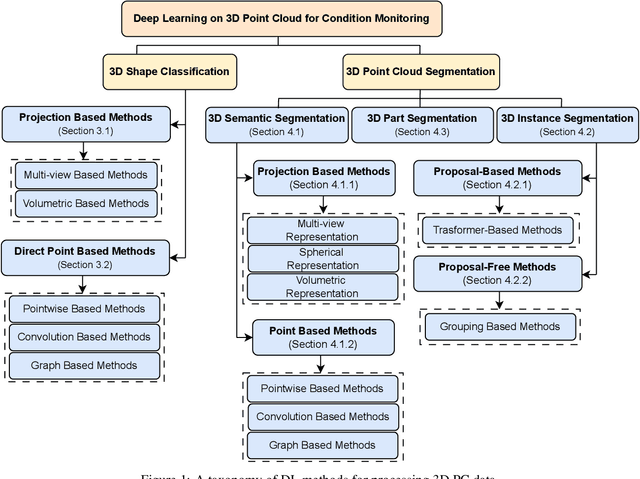
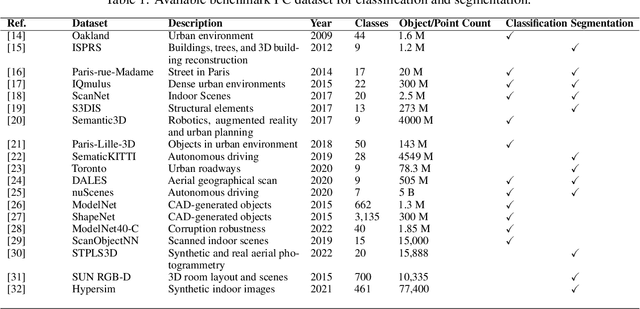
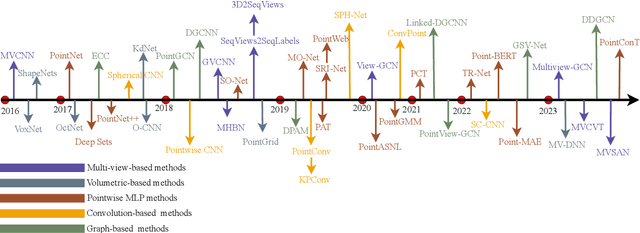
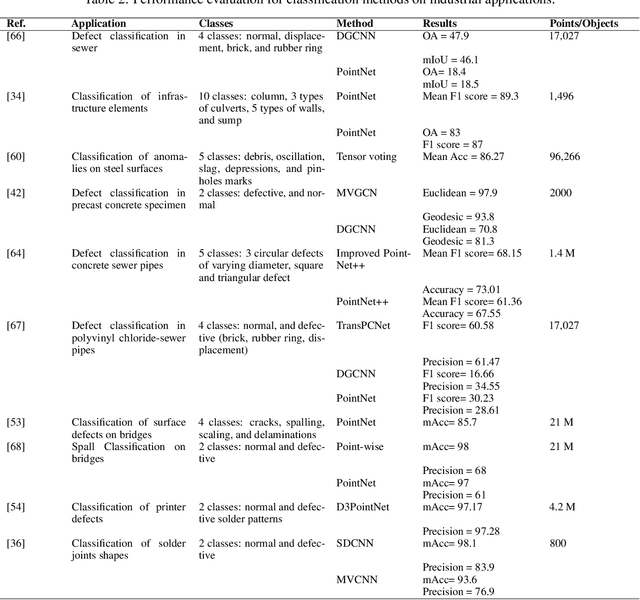
In recent years, 3D point clouds (PCs) have gained significant attention due to their diverse applications across various fields such as computer vision (CV), condition monitoring, virtual reality, robotics, autonomous driving etc. Deep learning (DL) has proven effective in leveraging 3D PCs to address various challenges previously encountered in 2D vision. However, the application of deep neural networks (DNN) to process 3D PCs presents its own set of challenges. To address these challenges, numerous methods have been proposed. This paper provides an in-depth review of recent advancements in DL-based condition monitoring (CM) using 3D PCs, with a specific focus on defect shape classification and segmentation within industrial applications for operational and maintenance purposes. Recognizing the crucial role of these aspects in industrial maintenance, the paper provides insightful observations that offer perspectives on the strengths and limitations of the reviewed DL-based PC processing methods. This synthesis of knowledge aims to contribute to the understanding and enhancement of CM processes, particularly within the framework of remaining useful life (RUL), in industrial systems.
Imagery Dataset for Condition Monitoring of Synthetic Fibre Ropes
Sep 29, 2023Automatic visual inspection of synthetic fibre ropes (SFRs) is a challenging task in the field of offshore, wind turbine industries, etc. The presence of any defect in SFRs can compromise their structural integrity and pose significant safety risks. Due to the large size and weight of these ropes, it is often impractical to detach and inspect them frequently. Therefore, there is a critical need to develop efficient defect detection methods to assess their remaining useful life (RUL). To address this challenge, a comprehensive dataset has been generated, comprising a total of 6,942 raw images representing both normal and defective SFRs. The dataset encompasses a wide array of defect scenarios which may occur throughout their operational lifespan, including but not limited to placking defects, cut strands, chafings, compressions, core outs and normal. This dataset serves as a resource to support computer vision applications, including object detection, classification, and segmentation, aimed at detecting and analyzing defects in SFRs. The availability of this dataset will facilitate the development and evaluation of robust defect detection algorithms. The aim of generating this dataset is to assist in the development of automated defect detection systems that outperform traditional visual inspection methods, thereby paving the way for safer and more efficient utilization of SFRs across a wide range of applications.
Defect Detection in Synthetic Fibre Ropes using Detectron2 Framework
Sep 04, 2023Fibre ropes with the latest technology have emerged as an appealing alternative to steel ropes for offshore industries due to their lightweight and high tensile strength. At the same time, frequent inspection of these ropes is essential to ensure the proper functioning and safety of the entire system. The development of deep learning (DL) models in condition monitoring (CM) applications offers a simpler and more effective approach for defect detection in synthetic fibre ropes (SFRs). The present paper investigates the performance of Detectron2, a state-of-the-art library for defect detection and instance segmentation. Detectron2 with Mask R-CNN architecture is used for segmenting defects in SFRs. Mask R-CNN with various backbone configurations has been trained and tested on an experimentally obtained dataset comprising 1,803 high-dimensional images containing seven damage classes (loop high, loop medium, loop low, compression, core out, abrasion, and normal respectively) for SFRs. By leveraging the capabilities of Detectron2, this study aims to develop an automated and efficient method for detecting defects in SFRs, enhancing the inspection process, and ensuring the safety of the fibre ropes.