 Add to Chrome
 Add to Firefox
 Add to Edge
Real-time Reconstruction of Human Visual Perception from fMRI
Jul 23, 2026
Real-time closed-loop neurofeedback based on functional magnetic resonance imaging (fMRI) has led to important scientific and clinical advances. However, the sophistication of the analysis methods used in real-time fMRI lags behind the state-of-the-art in fMRI decoding, largely due to computational factors: Most advanced decoding pipelines do not fit within the envelope of real-time processing, where the analysis needs to be conducted in a matter of seconds and without leveraging data acquired later in the session. Here, we present a real-time compatible adaptation of a computationally intensive state-of-the-art pipeline for reconstructing perceived natural images (MindEye2), and we demonstrate that reliable fine-grained decoding is still achievable in this setting. Using RT-Cloud, an open-source, scalable cloud-based platform, we performed a real-time scan where we decoded single-trial visual perception within seconds after an image was shown to the participant. Finally, we use simulated analyses to document the factors driving changes in performance from offline to real-time analysis. This work serves as a proof-of-concept that it is feasible to deploy these powerful fMRI decoding pipelines in real-time analysis, paving the way for their use in brain-computer interfaces for scientific discovery and clinical treatment.

On the Feasibility of Machine Learning Augmented Magnetic Resonance for Point-of-Care Identification of Disease
Feb 02, 2023

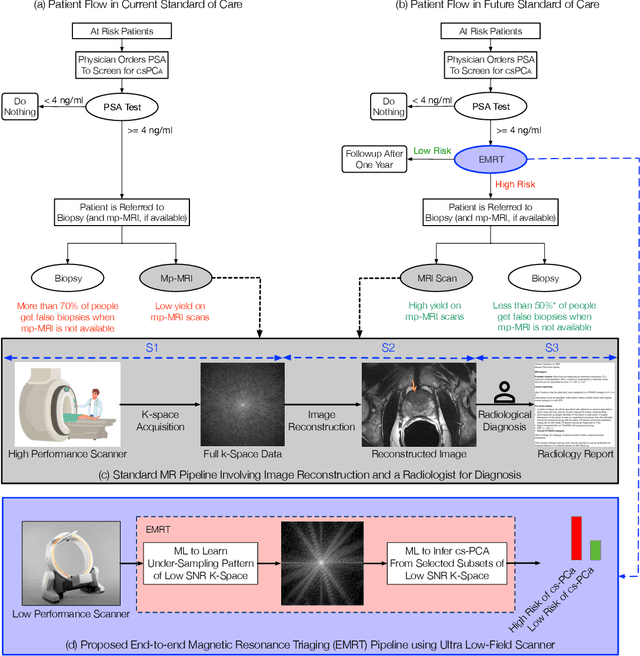

Early detection of many life-threatening diseases (e.g., prostate and breast cancer) within at-risk population can improve clinical outcomes and reduce cost of care. While numerous disease-specific "screening" tests that are closer to Point-of-Care (POC) are in use for this task, their low specificity results in unnecessary biopsies, leading to avoidable patient trauma and wasteful healthcare spending. On the other hand, despite the high accuracy of Magnetic Resonance (MR) imaging in disease diagnosis, it is not used as a POC disease identification tool because of poor accessibility. The root cause of poor accessibility of MR stems from the requirement to reconstruct high-fidelity images, as it necessitates a lengthy and complex process of acquiring large quantities of high-quality k-space measurements. In this study we explore the feasibility of an ML-augmented MR pipeline that directly infers the disease sidestepping the image reconstruction process. We hypothesise that the disease classification task can be solved using a very small tailored subset of k-space data, compared to image reconstruction. Towards that end, we propose a method that performs two tasks: 1) identifies a subset of the k-space that maximizes disease identification accuracy, and 2) infers the disease directly using the identified k-space subset, bypassing the image reconstruction step. We validate our hypothesis by measuring the performance of the proposed system across multiple diseases and anatomies. We show that comparable performance to image-based classifiers, trained on images reconstructed with full k-space data, can be achieved using small quantities of data: 8% of the data for detecting multiple abnormalities in prostate and brain scans, and 5% of the data for knee abnormalities. To better understand the proposed approach and instigate future research, we provide an extensive analysis and release code.