 Add to Chrome
 Add to Firefox
 Add to Edge
UPLiFT: Efficient Pixel-Dense Feature Upsampling with Local Attenders
Jan 25, 2026
The space of task-agnostic feature upsampling has emerged as a promising area of research to efficiently create denser features from pre-trained visual backbones. These methods act as a shortcut to achieve dense features for a fraction of the cost by learning to map low-resolution features to high-resolution versions. While early works in this space used iterative upsampling approaches, more recent works have switched to cross-attention-based methods, which risk falling into the same efficiency scaling problems of the backbones they are upsampling. In this work, we demonstrate that iterative upsampling methods can still compete with cross-attention-based methods; moreover, they can achieve state-of-the-art performance with lower inference costs. We propose UPLiFT, an architecture for Universal Pixel-dense Lightweight Feature Transforms. We also propose an efficient Local Attender operator to overcome the limitations of prior iterative feature upsampling methods. This operator uses an alternative attentional pooling formulation defined fully locally. We show that our Local Attender allows UPLiFT to maintain stable features throughout upsampling, enabling state-of-the-art performance with lower inference costs than existing pixel-dense feature upsamplers. In addition, we apply UPLiFT to generative downstream tasks and show that it achieves competitive performance with state-of-the-art Coupled Flow Matching models for VAE feature upsampling. Altogether, UPLiFT offers a versatile and efficient approach to creating denser features.

Evolutionary Caching to Accelerate Your Off-the-Shelf Diffusion Model
Jun 18, 2025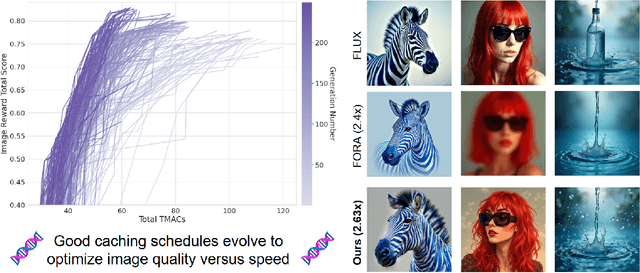
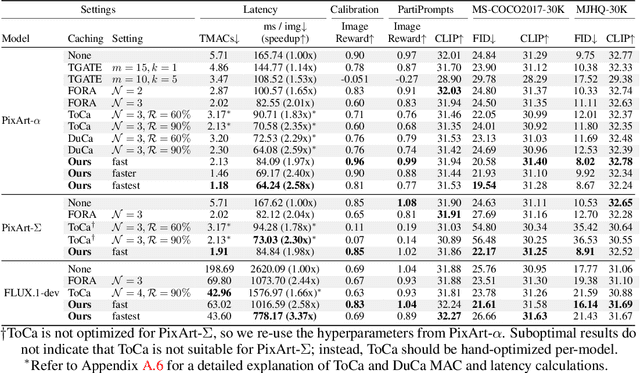
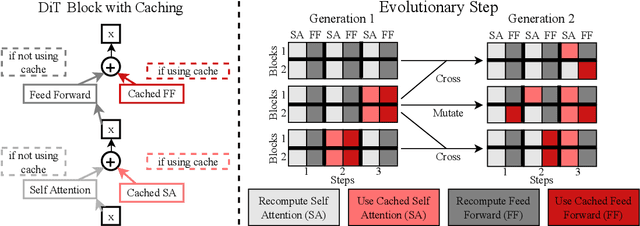
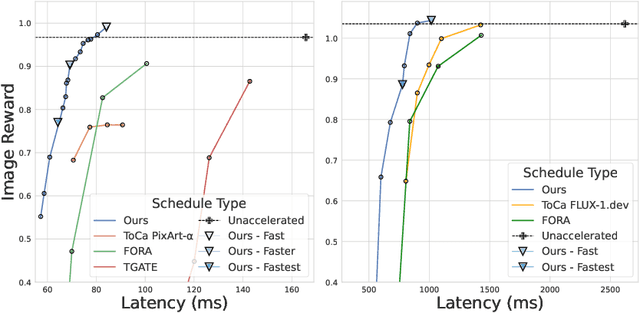
Diffusion-based image generation models excel at producing high-quality synthetic content, but suffer from slow and computationally expensive inference. Prior work has attempted to mitigate this by caching and reusing features within diffusion transformers across inference steps. These methods, however, often rely on rigid heuristics that result in limited acceleration or poor generalization across architectures. We propose Evolutionary Caching to Accelerate Diffusion models (ECAD), a genetic algorithm that learns efficient, per-model, caching schedules forming a Pareto frontier, using only a small set of calibration prompts. ECAD requires no modifications to network parameters or reference images. It offers significant inference speedups, enables fine-grained control over the quality-latency trade-off, and adapts seamlessly to different diffusion models. Notably, ECAD's learned schedules can generalize effectively to resolutions and model variants not seen during calibration. We evaluate ECAD on PixArt-alpha, PixArt-Sigma, and FLUX-1.dev using multiple metrics (FID, CLIP, Image Reward) across diverse benchmarks (COCO, MJHQ-30k, PartiPrompts), demonstrating consistent improvements over previous approaches. On PixArt-alpha, ECAD identifies a schedule that outperforms the previous state-of-the-art method by 4.47 COCO FID while increasing inference speedup from 2.35x to 2.58x. Our results establish ECAD as a scalable and generalizable approach for accelerating diffusion inference. Our project website is available at https://aniaggarwal.github.io/ecad and our code is available at https://github.com/aniaggarwal/ecad.