 Add to Chrome
 Add to Firefox
 Add to Edge
Weighted Conformal Clustering
May 29, 2026
Clustering is a central tool for discovering latent structure in unlabeled data; yet modern clustering pipelines often end with a hard assignment of each observation to a cluster without rigorous measures of assignment uncertainty. We propose a novel weighted conformal approach for constructing valid confidence sets for cluster labels. The key difficulty is that the labels available for calibration are not observed ground-truth labels, but synthetic labels produced by a data-dependent clustering algorithm. Our method develops a conformal inference algorithm that corrects the resulting mismatch with the latent target labels through weights by formulating conformal clustering as a conditional label-distribution shift problem. We first derive an oracle procedure that attains finite-sample marginal coverage and then develop a computationally tractable and implementable version using estimated conditional label probabilities and novel augmented calibration. We show that the coverage of the estimated-weight procedure depends on the estimator, giving an explicit bound on the loss relative to the nominal level. Empirical studies demonstrate that the proposed weighted approach offers improvements over the recently proposed split conformal clustering procedure in terms of informative confidence set size, especially in nonlinear and high-dimensional clustering applications.

Concentration inequalities for correlated network-valued processes with applications to community estimation and changepoint analysis
Aug 02, 2022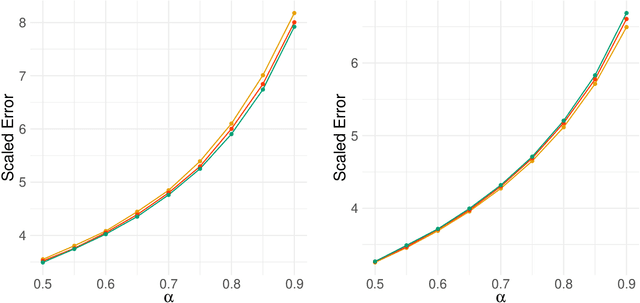
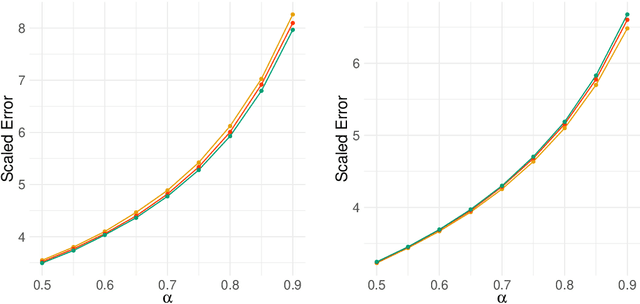
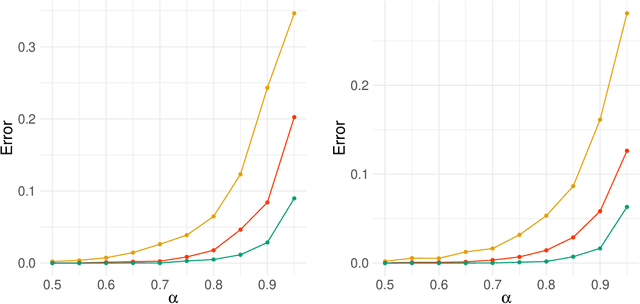
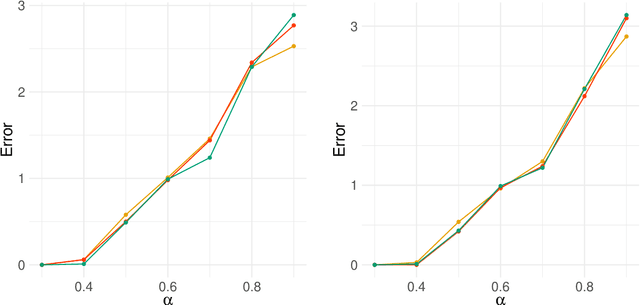
Network-valued time series are currently a common form of network data. However, the study of the aggregate behavior of network sequences generated from network-valued stochastic processes is relatively rare. Most of the existing research focuses on the simple setup where the networks are independent (or conditionally independent) across time, and all edges are updated synchronously at each time step. In this paper, we study the concentration properties of the aggregated adjacency matrix and the corresponding Laplacian matrix associated with network sequences generated from lazy network-valued stochastic processes, where edges update asynchronously, and each edge follows a lazy stochastic process for its updates independent of the other edges. We demonstrate the usefulness of these concentration results in proving consistency of standard estimators in community estimation and changepoint estimation problems. We also conduct a simulation study to demonstrate the effect of the laziness parameter, which controls the extent of temporal correlation, on the accuracy of community and changepoint estimation.