 Add to Chrome
 Add to Firefox
 Add to Edge
How Much is Too Much? Exploring LoRA Rank Trade-offs for Retaining Knowledge and Domain Robustness
Dec 17, 2025
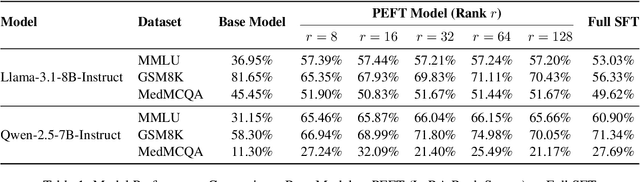
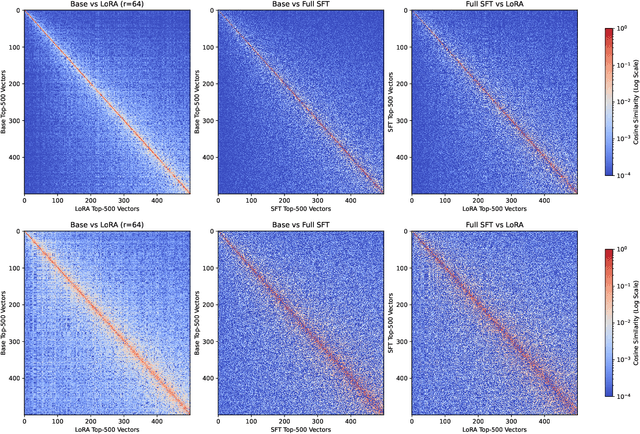
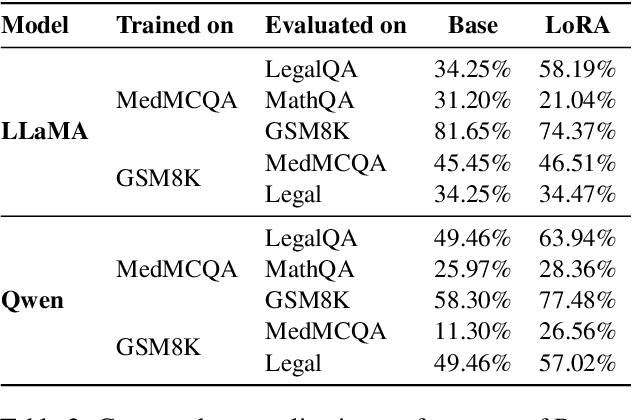
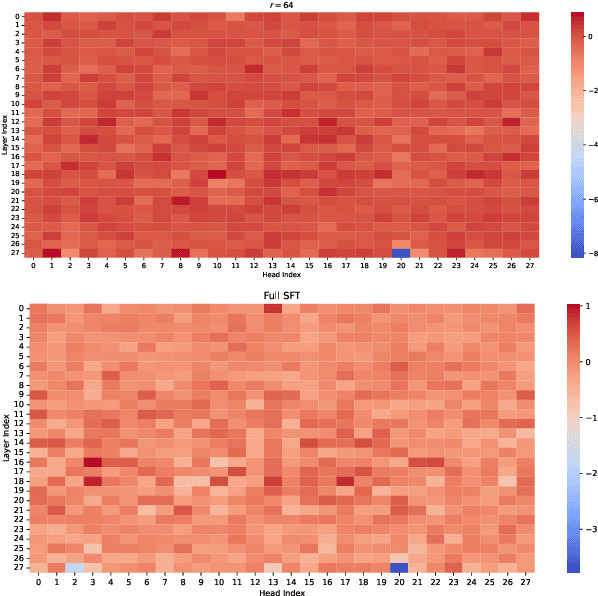
Large language models are increasingly adapted to downstream tasks through fine-tuning. Full supervised fine-tuning (SFT) and parameter-efficient fine-tuning (PEFT) methods, such as Low-Rank Adaptation (LoRA), are two dominant approaches. While PEFT methods are widely used for their computational efficiency, the implications of their configurations (e.g., rank) remain under-explored in downstream Q&A tasks and generalisation. In this work, we perform a comprehensive evaluation across multiple reasoning and recall datasets, conducting a rank sweep to quantify the trade-off between SFT and PEFT. We also compare the accuracy of PEFT and SFT models across in-domain and out-of-domain adaptation, highlighting distinct generalisation behaviour and task-specific forgetting. We demonstrate that LoRA achieves competitive and in some cases superior performance compared to SFT, particularly on reasoning tasks at specific rank values. Additionally, we analyze the internal representations via spectral features and layer-wise attention structures, offering insights into representational drift and structural changes in attention patterns.

Genicious: Contextual Few-shot Prompting for Insights Discovery
Mar 15, 2025Data and insights discovery is critical for decision-making in modern organizations. We present Genicious, an LLM-aided interface that enables users to interact with tabular datasets and ask complex queries in natural language. By benchmarking various prompting strategies and language models, we have developed an end-to-end tool that leverages contextual few-shot prompting, achieving superior performance in terms of latency, accuracy, and scalability. Genicious empowers stakeholders to explore, analyze and visualize their datasets efficiently while ensuring data security through role-based access control and a Text-to-SQL approach.