 Add to Chrome
 Add to Firefox
 Add to Edge
REVERE: Reflective Evolving Research Engineer for Scientific Workflows
Mar 21, 2026
Existing prompt-optimization techniques rely on local signals to update behavior, often neglecting broader and recurring patterns across tasks, leading to poor generalization; they further rely on full-prompt rewrites or unstructured merges, resulting in knowledge loss. These limitations are magnified in research-coding workflows, which involve heterogeneous repositories, underspecified environments, and weak feedback, where reproducing results from public codebases is an established evaluation regime. We introduce Reflective Evolving Research Engineer (REVERE), a framework that continuously learns from Global Training Context, recognizes recurring failure modes in cross-repository execution trajectories, distills them into reusable heuristics, and performs targeted edits across three configurable fields: the system prompt, a task-prompt template, and a cumulative cheatsheet. REVERE, via this reflective optimization framework, improves performance over prior state-of-the-art expert-crafted instructions on research coding tasks by 4.50% on SUPER, 3.51% on ResearchCodeBench, and 4.89% on ScienceAgentBench across their respective metrics. These results demonstrate that agents equipped with mechanisms for continual learning and global memory consolidation can meaningfully evolve their capabilities over time.

ResearchGym: Evaluating Language Model Agents on Real-World AI Research
Feb 16, 2026We introduce ResearchGym, a benchmark and execution environment for evaluating AI agents on end-to-end research. To instantiate this, we repurpose five oral and spotlight papers from ICML, ICLR, and ACL. From each paper's repository, we preserve the datasets, evaluation harness, and baseline implementations but withhold the paper's proposed method. This results in five containerized task environments comprising 39 sub-tasks in total. Within each environment, agents must propose novel hypotheses, run experiments, and attempt to surpass strong human baselines on the paper's metrics. In a controlled evaluation of an agent powered by GPT-5, we observe a sharp capability--reliability gap. The agent improves over the provided baselines from the repository in just 1 of 15 evaluations (6.7%) by 11.5%, and completes only 26.5% of sub-tasks on average. We identify recurring long-horizon failure modes, including impatience, poor time and resource management, overconfidence in weak hypotheses, difficulty coordinating parallel experiments, and hard limits from context length. Yet in a single run, the agent surpasses the solution of an ICML 2025 Spotlight task, indicating that frontier agents can occasionally reach state-of-the-art performance, but do so unreliably. We additionally evaluate proprietary agent scaffolds including Claude Code (Opus-4.5) and Codex (GPT-5.2) which display a similar gap. ResearchGym provides infrastructure for systematic evaluation and analysis of autonomous agents on closed-loop research.
IRIS: Interactive Research Ideation System for Accelerating Scientific Discovery
Apr 23, 2025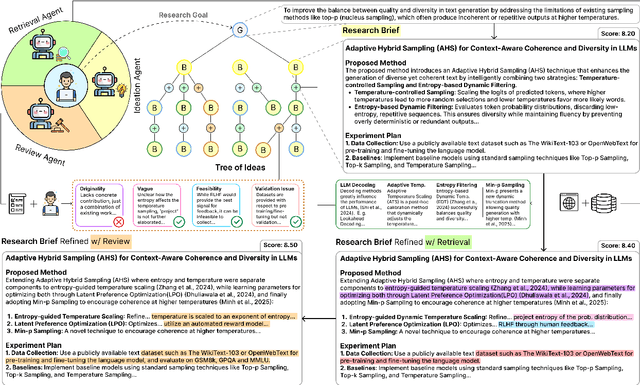
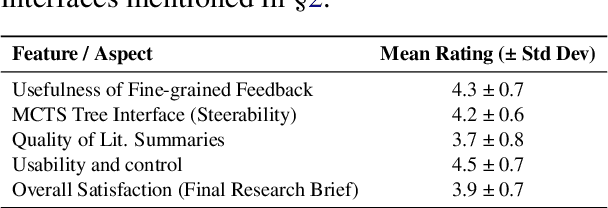
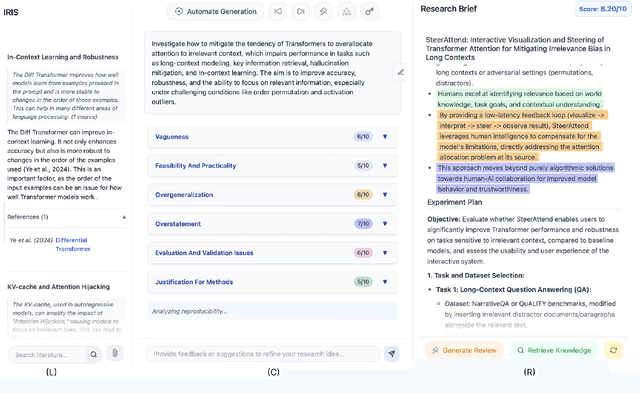
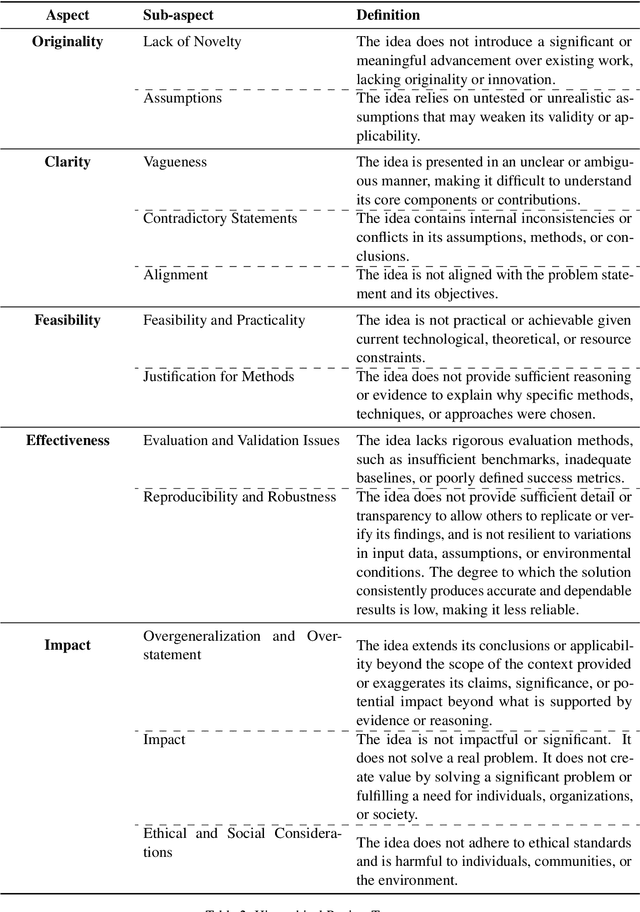
The rapid advancement in capabilities of large language models (LLMs) raises a pivotal question: How can LLMs accelerate scientific discovery? This work tackles the crucial first stage of research, generating novel hypotheses. While recent work on automated hypothesis generation focuses on multi-agent frameworks and extending test-time compute, none of the approaches effectively incorporate transparency and steerability through a synergistic Human-in-the-loop (HITL) approach. To address this gap, we introduce IRIS: Interactive Research Ideation System, an open-source platform designed for researchers to leverage LLM-assisted scientific ideation. IRIS incorporates innovative features to enhance ideation, including adaptive test-time compute expansion via Monte Carlo Tree Search (MCTS), fine-grained feedback mechanism, and query-based literature synthesis. Designed to empower researchers with greater control and insight throughout the ideation process. We additionally conduct a user study with researchers across diverse disciplines, validating the effectiveness of our system in enhancing ideation. We open-source our code at https://github.com/Anikethh/IRIS-Interactive-Research-Ideation-System