 Add to Chrome
 Add to Firefox
 Add to Edge
TextEconomizer: Enhancing Lossy Text Compression with Denoising Transformers and Entropy Coding
Jun 06, 2026
Lossy text compression reduces data size while preserving core meaning, making it well-suited for summarization, automated analysis, and digital archives. Despite the dominance of transformer-based models in language modeling, integrating context vectors and entropy coding into Sequence-to-Sequence (Seq2Seq) generation remains underexplored. A key challenge lies in identifying the most informative context vectors from encoder output and incorporating entropy coding to enhance storage efficiency while maintaining high-quality outputs, even under noisy text. We introduce TextEconomizer, an encoder-decoder framework paired with a transformer neural network that reduces variable-sized inputs by 50% to 80% without prior knowledge of dataset dimensions. Our model achieves competitive compression ratios via entropy coding while delivering near-perfect text quality, assessed by BLEU, ROUGE, METEOR, and semantic similarity scores. TextEconomizer operates with approximately 153x fewer parameters than comparable models, achieving a 5.39x compression ratio without sacrificing semantic quality. We also evaluate an LSTM-based autoencoder achieving a state-of-the-art 67x compression ratio with 196x fewer parameters, and LLaMAFormer, a modified transformer with 263x fewer parameters than ICAE while maintaining competitive text quality. TextEconomizer significantly surpasses existing transformer-based models in balancing memory efficiency and high-fidelity outputs, marking a breakthrough in lossy compression with optimal space utilization.
* Published in Neural Networks (Elsevier), Vol. 203, 2026

An Enhanced Text Compression Approach Using Transformer-based Language Models
Dec 15, 2024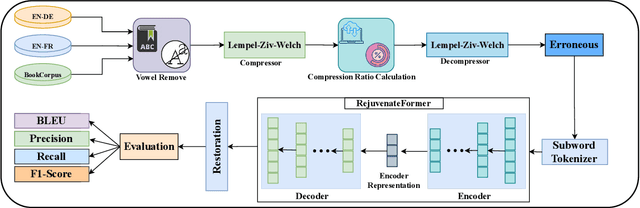

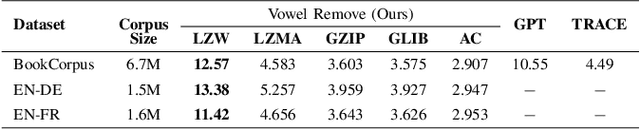
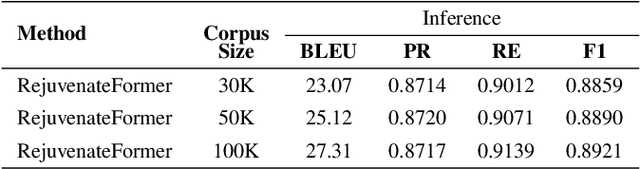
Text compression shrinks textual data while keeping crucial information, eradicating constraints on storage, bandwidth, and computational efficacy. The integration of lossless compression techniques with transformer-based text decompression has received negligible attention, despite the increasing volume of English text data in communication. The primary barrier in advancing text compression and restoration involves optimizing transformer-based approaches with efficient pre-processing and integrating lossless compression algorithms, that remained unresolved in the prior attempts. Here, we propose a transformer-based method named RejuvenateForme for text decompression, addressing prior issues by harnessing a new pre-processing technique and a lossless compression method. Our meticulous pre-processing technique incorporating the Lempel-Ziv-Welch algorithm achieves compression ratios of 12.57, 13.38, and 11.42 on the BookCorpus, EN-DE, and EN-FR corpora, thus showing state-of-the-art compression ratios compared to other deep learning and traditional approaches. Furthermore, the RejuvenateForme achieves a BLEU score of 27.31, 25.78, and 50.45 on the EN-DE, EN-FR, and BookCorpus corpora, showcasing its comprehensive efficacy. In contrast, the pre-trained T5-Small exhibits better performance over prior state-of-the-art models.