 Add to Chrome
 Add to Firefox
 Add to Edge
Testing the Limits of Truth Directions in LLMs
Apr 04, 2026
Large language models (LLMs) have been shown to encode truth of statements in their activation space along a linear truth direction. Previous studies have argued that these directions are universal in certain aspects, while more recent work has questioned this conclusion drawing on limited generalization across some settings. In this work, we identify a number of limits of truth-direction universality that have not been previously understood. We first show that truth directions are highly layer-dependent, and that a full understanding of universality requires probing at many layers in the model. We then show that truth directions depend heavily on task type, emerging in earlier layers for factual and later layers for reasoning tasks; they also vary in performance across levels of task complexity. Finally, we show that model instructions dramatically affect truth directions; simple correctness evaluation instructions significantly affect the generalization ability of truth probes. Our findings indicate that universality claims for truth directions are more limited than previously known, with significant differences observable for various model layers, task difficulties, task types, and prompt templates.

Reasoning over Description Logic-based Contexts with Transformers
Nov 15, 2023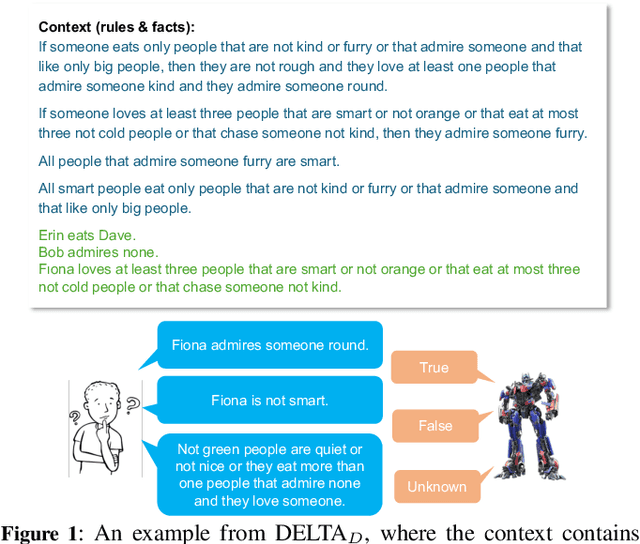
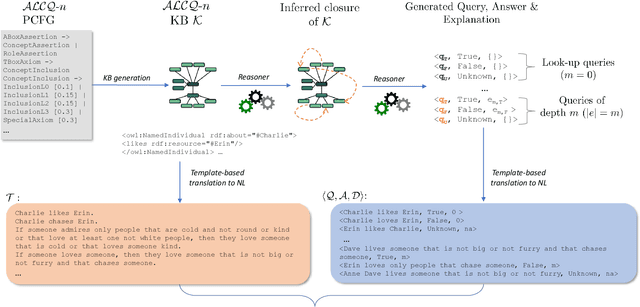
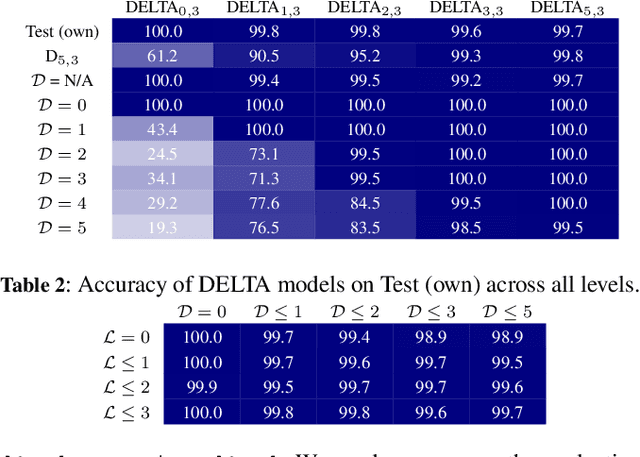
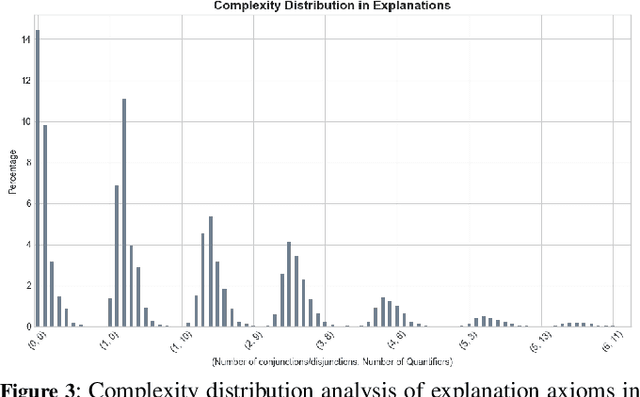
One way that the current state of the art measures the reasoning ability of transformer-based models is by evaluating accuracy in downstream tasks like logical question answering or proof generation over synthetic contexts expressed in natural language. However, most of the contexts used are in practice very simple; in most cases, they are generated from short first-order logic sentences with only a few logical operators and quantifiers. In this work, we seek to answer the question how well a transformer-based model will perform reasoning over expressive contexts. For this purpose, we construct a synthetic natural language question-answering dataset, generated by description logic knowledge bases. For the generation of the knowledge bases, we use the expressive language $\mathcal{ALCQ}$. The resulting dataset contains 384K examples, and increases in two dimensions: i) reasoning depth, and ii) length of sentences. We show that the performance of our DeBERTa-based model, DELTA$_M$, is marginally affected when the reasoning depth is increased and it is not affected at all when the length of the sentences is increasing. We also evaluate the generalization ability of the model on reasoning depths unseen at training, both increasing and decreasing, revealing interesting insights into the model's adaptive generalization abilities.