 Add to Chrome
 Add to Firefox
 Add to Edge
Jump-Start Reinforcement Learning with Vision-Language-Action Regularization
Apr 15, 2026
Reinforcement learning (RL) enables high-frequency, closed-loop control for robotic manipulation, but scaling to long-horizon tasks with sparse or imperfect rewards remains difficult due to inefficient exploration and poor credit assignment. Vision-Language-Action (VLA) models leverage large-scale multimodal pretraining to provide generalist, task-level reasoning, but current limitations hinder their direct use in fast and precise manipulation. In this paper, we propose Vision-Language-Action Jump-Starting (VLAJS), a method that bridges sparse VLA guidance with on-policy RL to improve exploration and learning efficiency. VLAJS treats VLAs as transient sources of high-level action suggestions that bias early exploration and improve credit assignment, while preserving the high-frequency, state-based control of RL. Our approach augments Proximal Policy Optimization (PPO) with a directional action-consistency regularization that softly aligns the RL agent's actions with VLA guidance during early training, without enforcing strict imitation, requiring demonstrations, or relying on continuous teacher queries. VLA guidance is applied sparsely and annealed over time, allowing the agent to adapt online and ultimately surpass the guiding policy. We evaluate VLAJS on six challenging manipulation tasks: lifting, pick-and-place, peg reorientation, peg insertion, poking, and pushing in simulation, and validate a subset on a real Franka Panda robot. VLAJS consistently outperforms PPO and distillation-style baselines in sample efficiency, reducing required environment interactions by over 50% in several tasks. Real-world experiments demonstrate zero-shot sim-to-real transfer and robust execution under clutter, object variation, and external perturbations.

Diffusion Sequence Models for Generative In-Context Meta-Learning of Robot Dynamics
Apr 15, 2026Accurate modeling of robot dynamics is essential for model-based control, yet remains challenging under distributional shifts and real-time constraints. In this work, we formulate system identification as an in-context meta-learning problem and compare deterministic and generative sequence models for forward dynamics prediction. We take a Transformer-based meta-model, as a strong deterministic baseline, and introduce to this setting two complementary diffusion-based approaches: (i) inpainting diffusion (Diffuser), which learns the joint input-observation distribution, and (ii) conditioned diffusion models (CNN and Transformer), which generate future observations conditioned on control inputs. Through large-scale randomized simulations, we analyze performance across in-distribution and out-of-distribution regimes, as well as computational trade-offs relevant for control. We show that diffusion models significantly improve robustness under distribution shift, with inpainting diffusion achieving the best performance in our experiments. Finally, we demonstrate that warm-started sampling enables diffusion models to operate within real-time constraints, making them viable for control applications. These results highlight generative meta-models as a promising direction for robust system identification in robotics.
Integrating Reinforcement Learning with Foundation Models for Autonomous Robotics: Methods and Perspectives
Oct 21, 2024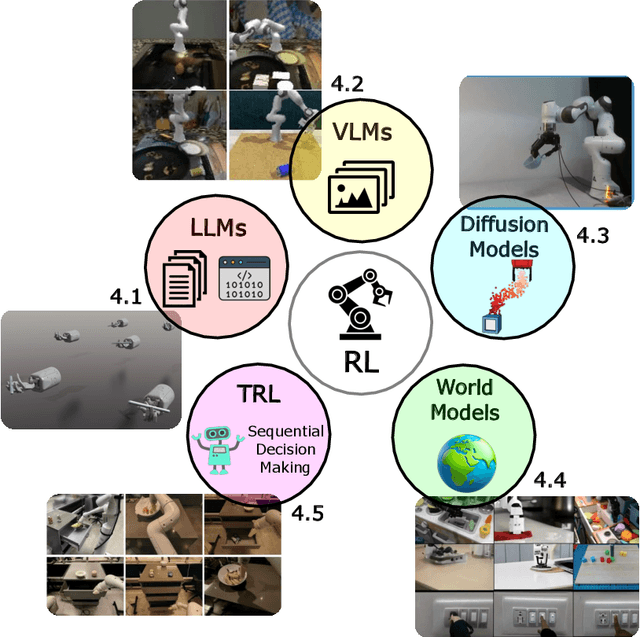
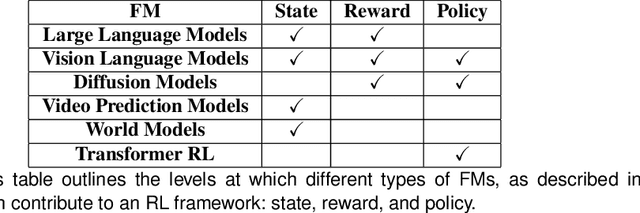
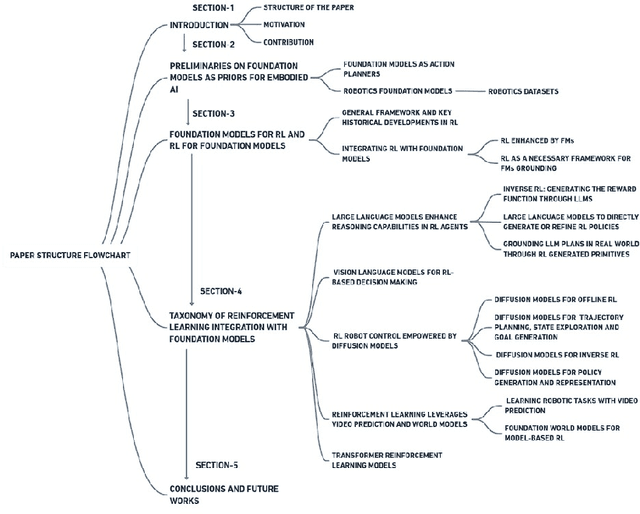
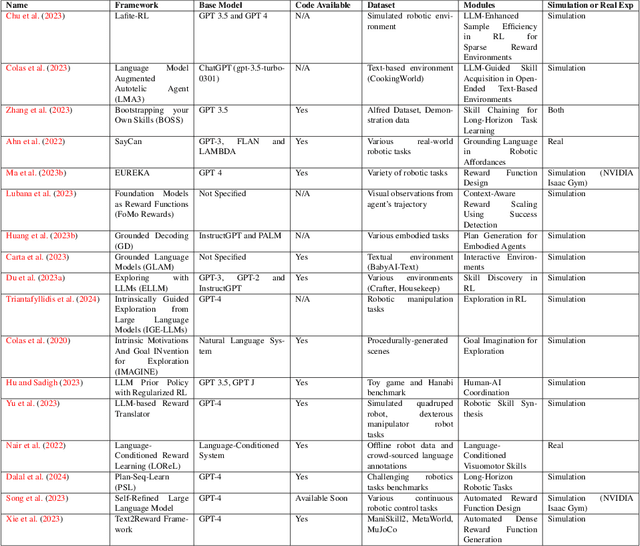
Foundation models (FMs), large deep learning models pre-trained on vast, unlabeled datasets, exhibit powerful capabilities in understanding complex patterns and generating sophisticated outputs. However, they often struggle to adapt to specific tasks. Reinforcement learning (RL), which allows agents to learn through interaction and feedback, offers a compelling solution. Integrating RL with FMs enables these models to achieve desired outcomes and excel at particular tasks. Additionally, RL can be enhanced by leveraging the reasoning and generalization capabilities of FMs. This synergy is revolutionizing various fields, including robotics. FMs, rich in knowledge and generalization, provide robots with valuable information, while RL facilitates learning and adaptation through real-world interactions. This survey paper comprehensively explores this exciting intersection, examining how these paradigms can be integrated to advance robotic intelligence. We analyze the use of foundation models as action planners, the development of robotics-specific foundation models, and the mutual benefits of combining FMs with RL. Furthermore, we present a taxonomy of integration approaches, including large language models, vision-language models, diffusion models, and transformer-based RL models. We also explore how RL can utilize world representations learned from FMs to enhance robotic task execution. Our survey aims to synthesize current research and highlight key challenges in robotic reasoning and control, particularly in the context of integrating FMs and RL--two rapidly evolving technologies. By doing so, we seek to spark future research and emphasize critical areas that require further investigation to enhance robotics. We provide an updated collection of papers based on our taxonomy, accessible on our open-source project website at: https://github.com/clmoro/Robotics-RL-FMs-Integration.