 Add to Chrome
 Add to Firefox
 Add to Edge
Dynestyx: A Probabilistic Programming Library for Dynamical Systems
Jun 15, 2026
State-space models (SSMs) are the standard formalism for Bayesian treatment of dynamical systems, with natural applications in statistics, signal processing, and machine learning. Despite their importance in both theory and application, dynamical systems have proven difficult to incorporate in modern probabilistic programming languages (PPLs), making state-of-the-art methods less accessible to practitioners and introducing friction in following the "Bayesian workflow." We introduce dynestyx, a probabilistic programming library with first-class support for SSMs, including state-of-the-art methods in the estimation of both states and parameters. Through a single, unified interface, users may specify arbitrary priors for discrete-time or continuous-time dynamical systems, perform inference over mixed-effect data, and make state and parameter estimates with principled uncertainty quantification.

Automated Efficient Estimation using Monte Carlo Efficient Influence Functions
Mar 08, 2024
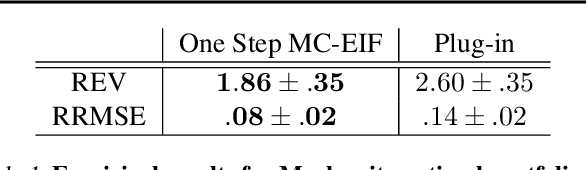
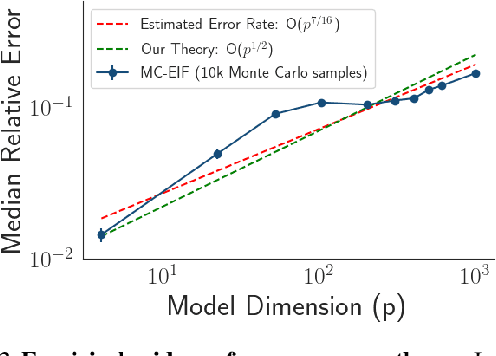
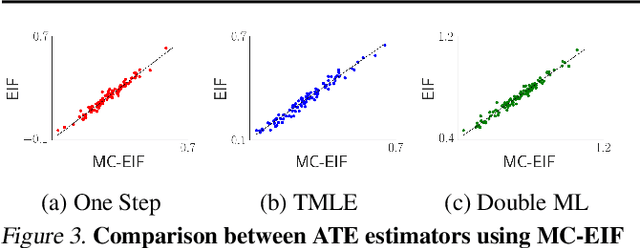
Many practical problems involve estimating low dimensional statistical quantities with high-dimensional models and datasets. Several approaches address these estimation tasks based on the theory of influence functions, such as debiased/double ML or targeted minimum loss estimation. This paper introduces \textit{Monte Carlo Efficient Influence Functions} (MC-EIF), a fully automated technique for approximating efficient influence functions that integrates seamlessly with existing differentiable probabilistic programming systems. MC-EIF automates efficient statistical estimation for a broad class of models and target functionals that would previously require rigorous custom analysis. We prove that MC-EIF is consistent, and that estimators using MC-EIF achieve optimal $\sqrt{N}$ convergence rates. We show empirically that estimators using MC-EIF are at parity with estimators using analytic EIFs. Finally, we demonstrate a novel capstone example using MC-EIF for optimal portfolio selection.