 Add to Chrome
 Add to Firefox
 Add to Edge
IndoBERT-Sentiment: Context-Conditioned Sentiment Classification for Indonesian Text
Apr 08, 2026
Existing Indonesian sentiment analysis models classify text in isolation, ignoring the topical context that often determines whether a statement is positive, negative, or neutral. We introduce IndoBERT-Sentiment, a context-conditioned sentiment classifier that takes both a topical context and a text as input, producing sentiment predictions grounded in the topic being discussed. Built on IndoBERT Large (335M parameters) and trained on 31,360 context-text pairs labeled across 188 topics, the model achieves an F1 macro of 0.856 and accuracy of 88.1%. In a head-to-head evaluation against three widely used general-purpose Indonesian sentiment models on the same test set, IndoBERT-Sentiment outperforms the best baseline by 35.6 F1 points. We show that context-conditioning, previously demonstrated for relevancy classification, transfers effectively to sentiment analysis and enables the model to correctly classify texts that are systematically misclassified by context-free approaches.

IndoBERT-Relevancy: A Context-Conditioned Relevancy Classifier for Indonesian Text
Mar 27, 2026Determining whether a piece of text is relevant to a given topic is a fundamental task in natural language processing, yet it remains largely unexplored for Bahasa Indonesia. Unlike sentiment analysis or named entity recognition, relevancy classification requires the model to reason about the relationship between two inputs simultaneously: a topical context and a candidate text. We introduce IndoBERT-Relevancy, a context-conditioned relevancy classifier built on IndoBERT Large (335M parameters) and trained on a novel dataset of 31,360 labeled pairs spanning 188 topics. Through an iterative, failure-driven data construction process, we demonstrate that no single data source is sufficient for robust relevancy classification, and that targeted synthetic data can effectively address specific model weaknesses. Our final model achieves an F1 score of 0.948 and an accuracy of 96.5%, handling both formal and informal Indonesian text. The model is publicly available at HuggingFace.
SocialX: A Modular Platform for Multi-Source Big Data Research in Indonesia
Mar 27, 2026Big data research in Indonesia is constrained by a fundamental fragmentation: relevant data is scattered across social media, news portals, e-commerce platforms, review sites, and academic databases, each with different formats, access methods, and noise characteristics. Researchers must independently build collection pipelines, clean heterogeneous data, and assemble separate analysis tools, a process that often overshadows the research itself. We present SocialX, a modular platform for multi-source big data research that integrates heterogeneous data collection, language-aware preprocessing, and pluggable analysis into a unified, source-agnostic pipeline. The platform separates concerns into three independent layers (collection, preprocessing, and analysis) connected by a lightweight job-coordination mechanism. This modularity allows each layer to grow independently: new data sources, preprocessing methods, or analysis tools can be added without modifying the existing pipeline. We describe the design principles that enable this extensibility, detail the preprocessing methodology that addresses challenges specific to Indonesian text across registers, and demonstrate the platform's utility through a walkthrough of a typical research workflow. SocialX is publicly accessible as a web-based platform at https://www.socialx.id.
Hotel Preference Rank based on Online Customer Review
Oct 10, 2021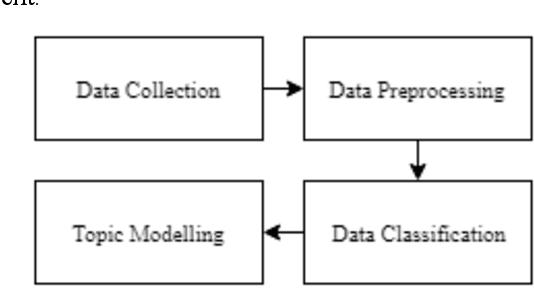
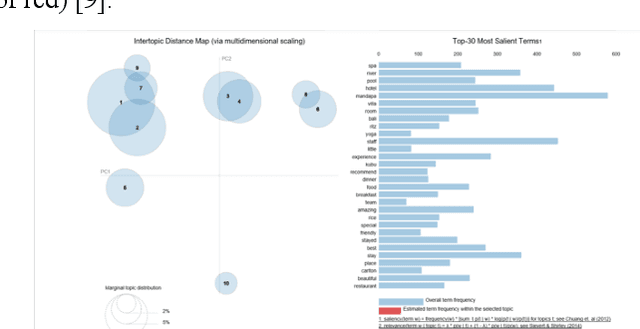
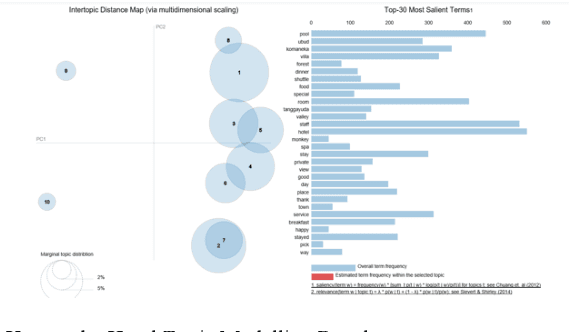
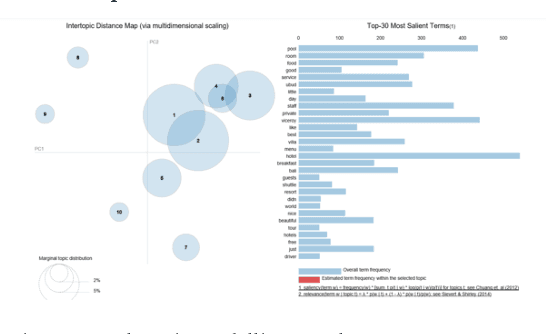
Topline hotels are now shifting into the digital way in how they understand their customers to maintain and ensuring satisfaction. Rather than the conventional way which uses written reviews or interviews, the hotel is now heavily investing in Artificial Intelligence particularly Machine Learning solutions. Analysis of online customer reviews changes the way companies make decisions in a more effective way than using conventional analysis. The purpose of this research is to measure hotel service quality. The proposed approach emphasizes service quality dimensions reviews of the top-5 luxury hotel in Indonesia that appear on the online travel site TripAdvisor based on section Best of 2018. In this research, we use a model based on a simple Bayesian classifier to classify each customer review into one of the service quality dimensions. Our model was able to separate each classification properly by accuracy, kappa, recall, precision, and F-measure measurements. To uncover latent topics in the customer's opinion we use Topic Modeling. We found that the common issue that occurs is about responsiveness as it got the lowest percentage compared to others. Our research provides a faster outlook of hotel rank based on service quality to end customers based on a summary of the previous online review.
* 5 pages, 6 figures, 5 tables
An Effort to Measure Customer Relationship Performance in Indonesia's Fintech Industry
Feb 16, 2021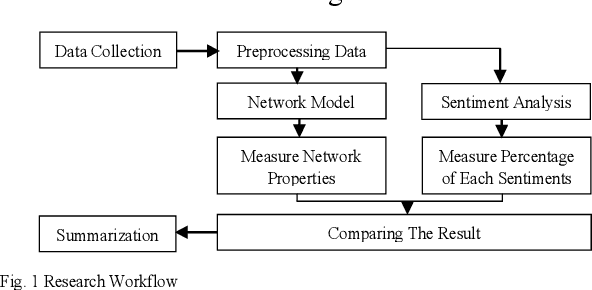
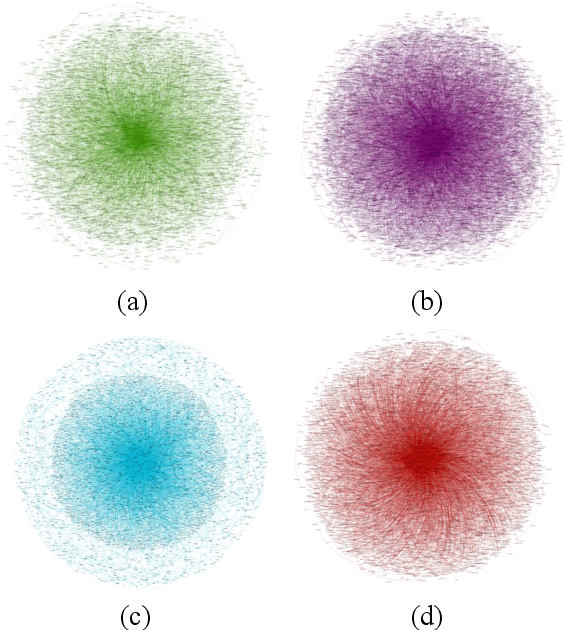
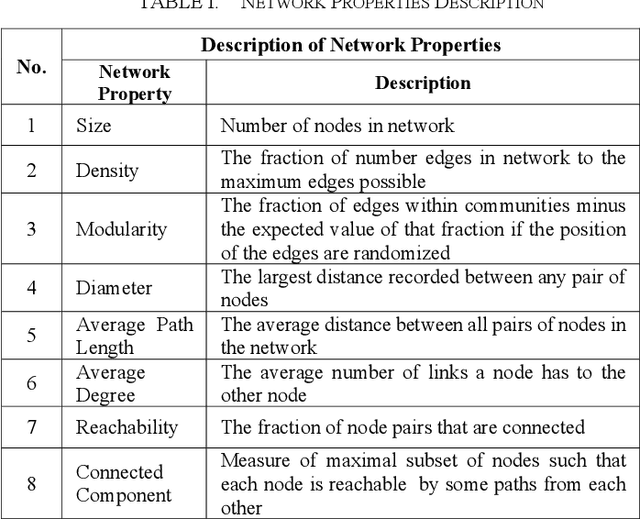
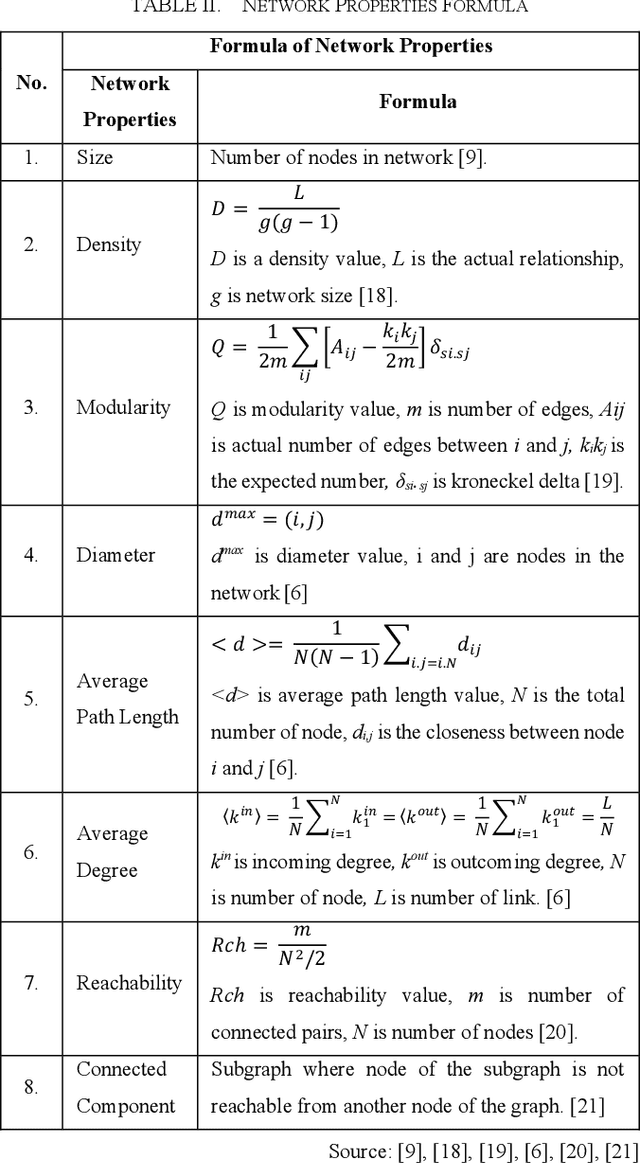
The availability of social media simplifies the companies-customers relationship. An effort to engage customers in conversation networks using social media is called Social Customer Relationship Management (SCRM). Social Network Analysis helps to understand network characteristics and how active the conversation network on social media. Calculating its network properties is beneficial for measuring customer relationship performance. Financial Technology, a new emerging industry that provides digital-based financial services utilize social media to interact with its customers. Measuring SCRM performance is needed in order to stay competitive among others. Therefore, we aim to explore the SCRM performance of the Indonesia Fintech company. In terms of discovering the market majority thought in conversation networks, we perform sentiment analysis by classifying into positive and negative opinion. As case studies, we investigate Twitter conversations about GoPay, OVO, Dana, and LinkAja during the observation period from 1st October until 1st November 2019. The result of this research is beneficial for business intelligence purposes especially in managing relationships with customers.
* 5 pages, 2 figures, 5 tables