 Add to Chrome
 Add to Firefox
 Add to Edge
Relevance-Based Embeddings: Lightweight Candidate Retrieval via Heavy-Ranker Calls
Jul 03, 2026
In many machine learning applications, the most relevant items for a query should be efficiently retrieved. The relevance function is usually an expensive similarity model, making the exhaustive search infeasible. A typical solution is to train another model that separately embeds queries and items to a vector space, where similarity is defined via the dot product or cosine similarity. This allows one to search the relevant items through fast approximate nearest neighbor search at the cost of some reduction in quality. To compensate for this reduction, the found items (candidates) are re-ranked by the expensive ranking model. In this paper, we investigate an alternative approach to candidate selection that utilizes the scores of the expensive model to improve the representations of queries and items. The idea is to describe each query (item) by its relevance to a set of support items (queries) and use these new representations to obtain query (item) embeddings. We theoretically prove that such embeddings are powerful enough to approximate any complex similarity model (under mild conditions). We also investigate the choice of support items, which is a crucial ingredient of the proposed approach. The experiments on diverse academic and production datasets illustrate the power of our method.

Shifts: A Dataset of Real Distributional Shift Across Multiple Large-Scale Tasks
Jul 23, 2021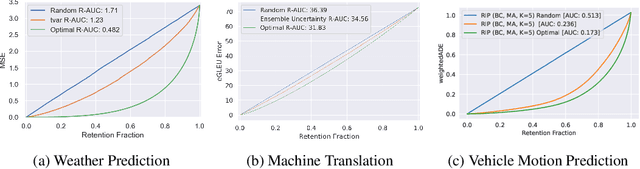
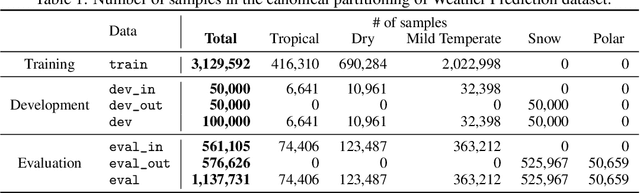
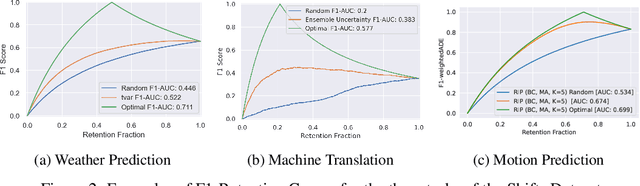
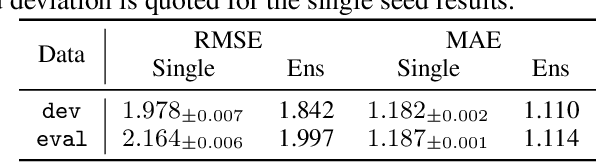
There has been significant research done on developing methods for improving robustness to distributional shift and uncertainty estimation. In contrast, only limited work has examined developing standard datasets and benchmarks for assessing these approaches. Additionally, most work on uncertainty estimation and robustness has developed new techniques based on small-scale regression or image classification tasks. However, many tasks of practical interest have different modalities, such as tabular data, audio, text, or sensor data, which offer significant challenges involving regression and discrete or continuous structured prediction. Thus, given the current state of the field, a standardized large-scale dataset of tasks across a range of modalities affected by distributional shifts is necessary. This will enable researchers to meaningfully evaluate the plethora of recently developed uncertainty quantification methods, as well as assessment criteria and state-of-the-art baselines. In this work, we propose the \emph{Shifts Dataset} for evaluation of uncertainty estimates and robustness to distributional shift. The dataset, which has been collected from industrial sources and services, is composed of three tasks, with each corresponding to a particular data modality: tabular weather prediction, machine translation, and self-driving car (SDC) vehicle motion prediction. All of these data modalities and tasks are affected by real, `in-the-wild' distributional shifts and pose interesting challenges with respect to uncertainty estimation. In this work we provide a description of the dataset and baseline results for all tasks.