 Add to Chrome
 Add to Firefox
 Add to Edge
A 3D-Printable Dataset for Fair Testing and Comparisons of Tactile Sensors
Jun 24, 2026
Existing texture datasets for tactile sensing primarily consist of sensor readings from a specific sensor interacting with available surfaces/objects rather than describing the textures themselves, limiting fair comparison between tactile sensors and hindering reproducible research. In this work, we introduce a 3D-printable dataset of mathematically defined textures designed to be fabricated reliably across different printers and filament types. The dataset consists of six parametrically generated surface patterns derived from combinations of sine-wave and Fourier-based functions, giving controlled variation in spatial frequency, amplitude, and directional structure. We evaluate the reproducibility of these textures across three popular 3D printers and multiple filament types by measuring variance in images captured using an optical TacTip sensor under controlled contact conditions. Our results show that print quality, particularly peak sharpness and stringing, affects tactile variance, with higher-end printers producing significantly more consistent signatures. Classification experiments using neural networks and PCA-based models further demonstrate that high-quality prints support strong within-printer generalisation, while cross-printer generalisation remains challenging due to geometric inconsistencies. This work establishes the first openly available, physically reproducible 3D-printed texture benchmark, providing a foundation for fair comparison of tactile sensors.

EchoVPR: Echo State Networks for Visual Place Recognition
Oct 11, 2021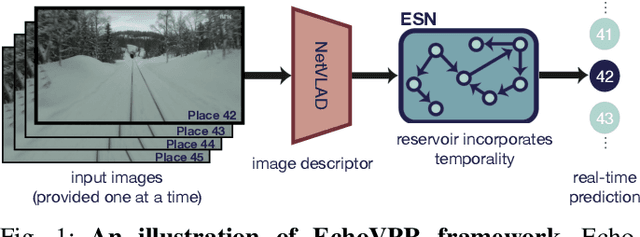
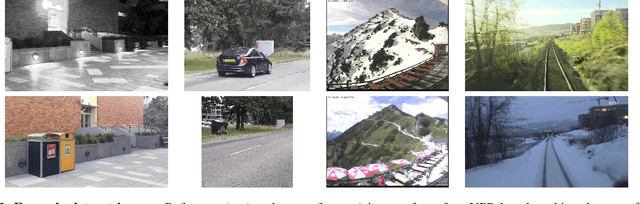
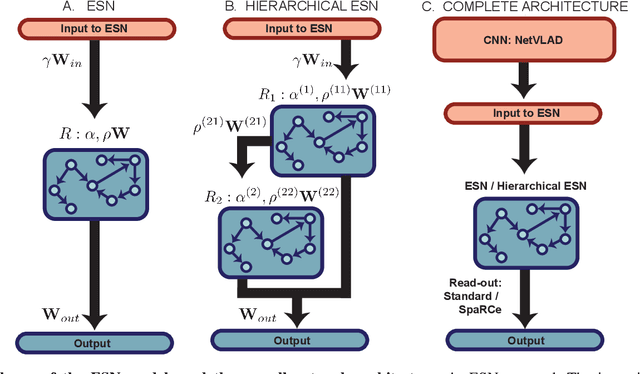
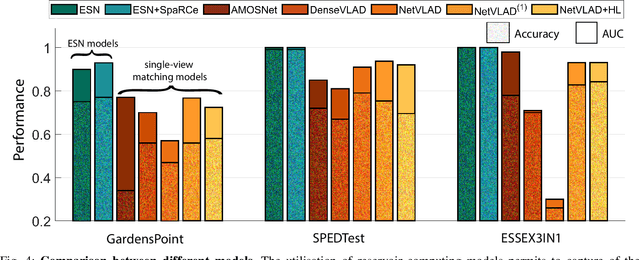
Recognising previously visited locations is an important, but unsolved, task in autonomous navigation. Current visual place recognition (VPR) benchmarks typically challenge models to recover the position of a query image (or images) from sequential datasets that include both spatial and temporal components. Recently, Echo State Network (ESN) varieties have proven particularly powerful at solving machine learning tasks that require spatio-temporal modelling. These networks are simple, yet powerful neural architectures that -- exhibiting memory over multiple time-scales and non-linear high-dimensional representations -- can discover temporal relations in the data while still maintaining linearity in the learning. In this paper, we present a series of ESNs and analyse their applicability to the VPR problem. We report that the addition of ESNs to pre-processed convolutional neural networks led to a dramatic boost in performance in comparison to non-recurrent networks in four standard benchmarks (GardensPoint, SPEDTest, ESSEX3IN1, Nordland) demonstrating that ESNs are able to capture the temporal structure inherent in VPR problems. Moreover, we show that ESNs can outperform class-leading VPR models which also exploit the sequential dynamics of the data. Finally, our results demonstrate that ESNs also improve generalisation abilities, robustness, and accuracy further supporting their suitability to VPR applications.