 Add to Chrome
 Add to Firefox
 Add to Edge
Quantum-like cognition and decision making in the light of quantum measurement theory
Mar 07, 2025
We characterize the class of quantum measurements that matches the applications of quantum theory to cognition (and decision making) - quantum-like modeling. Projective measurements describe the canonical measurements of the basic observables of quantum physics. However, the combinations of the basic cognitive effects, such as the question order and response replicability effects, cannot be described by projective measurements. We motivate the use of the special class of quantum measurements, namely {\it sharp repeatable non-projective measurements} - ${\cal SR\bar{P}}. $ This class is practically unused in quantum physics. Thus, physics and cognition explore different parts of quantum measurement theory. Quantum-like modeling isn't automatic borrowing of the quantum formalism. Exploring the class ${\cal SR\bar{P}}$ highlights the role of {\it noncommutativity of the state update maps generated by measurement back action.} Thus, ``non-classicality'' in quantum physics as well as quantum-like modeling for cognition is based on two different types of noncommutativity, of operators (observables) and instruments (state update maps): {\it observable-noncommutativity} vs. {\it state update-noncommutativity}. We speculate that distinguishing quantum-like properties of the cognitive effects are the expressions of the latter, or possibly both.

Coupling quantum-like cognition with the neuronal networks within generalized probability theory
Oct 29, 2024The recent years are characterized by intensive applications of the methodology and mathematical apparatus of quantum theory, quantum-like modeling, in cognition, psychology, and decision making. In spite of the successful applications of this approach to a variety of psychological effects, e.g., the order, conjunction, disjunction, and response replicability effects, one may (but need not) feel dissatisfaction due to the absence of clear coupling to the neurophysiological processes in the brain. For the moment, this is just a phenomenological approach. In this paper we construct the quantum-like representation of the networks of communicating neurons. It is based not on standard quantum theory, but on generalized probability theory (GPT) with the emphasis of the operational measurement approach. We employ GPT's version which is based on ordered linear state space (instead of complex Hilbert space). A network of communicating neurons is described as a weighted ordered graph that in turn is encoded by its weight matrix. The state space of weight matrices is embedded in GPT with effect-observables and state updates within measurement instruments theory. The latter plays the crucial role. This GPT based model shows the basic quantum-like effects, as e.g. the order, non-repeatability, and disjunction effects; the latter is also known as interference of decisions. This GPT coupling also supports quantum-like modeling in medical diagnostic for neurological diseases, as depression and epilepsy. Although the paper is concentrated on cognition and neuronal networks, the formalism and methodology can be straightforwardly applied to a variety of biological and social networks.
Toward Psycho-robots
Sep 13, 2007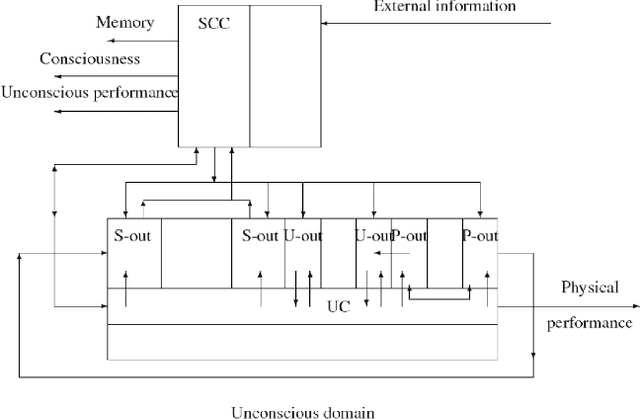
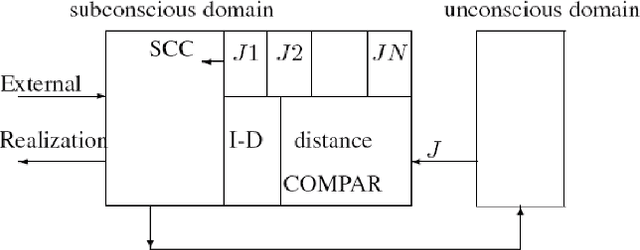
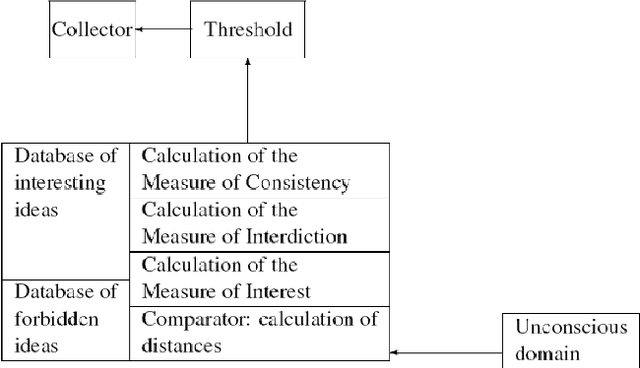
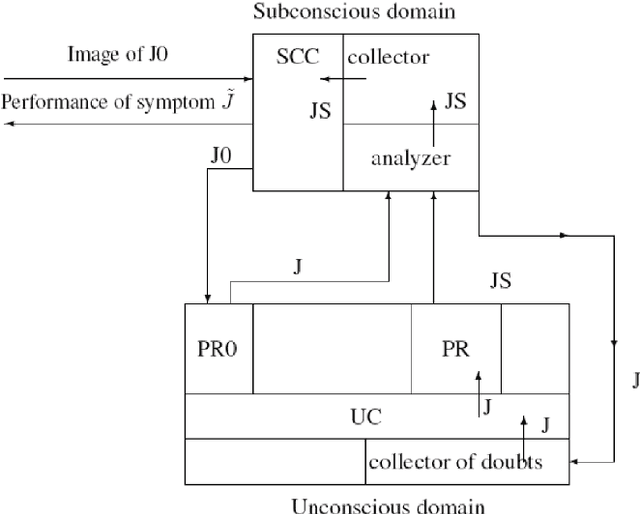
We try to perform geometrization of psychology by representing mental states, <<ideas>>, by points of a metric space, <<mental space>>. Evolution of ideas is described by dynamical systems in metric mental space. We apply the mental space approach for modeling of flows of unconscious and conscious information in the human brain. In a series of models, Models 1-4, we consider cognitive systems with increasing complexity of psychological behavior determined by structure of flows of ideas. Since our models are in fact models of the AI-type, one immediately recognizes that they can be used for creation of AI-systems, which we call psycho-robots, exhibiting important elements of human psyche. Creation of such psycho-robots may be useful improvement of domestic robots. At the moment domestic robots are merely simple working devices (e.g. vacuum cleaners or lawn mowers) . However, in future one can expect demand in systems which be able not only perform simple work tasks, but would have elements of human self-developing psyche. Such AI-psyche could play an important role both in relations between psycho-robots and their owners as well as between psycho-robots. Since the presence of a huge numbers of psycho-complexes is an essential characteristic of human psychology, it would be interesting to model them in the AI-framework.