 Add to Chrome
 Add to Firefox
 Add to Edge
TF3-RO-50M: Training Compact Romanian Language Models from Scratch on Synthetic Moral Microfiction
Jan 15, 2026
Recent advances in synthetic data generation have shown that compact language models can be trained effectively when the underlying corpus is structurally controlled and linguistically coherent. However, for morphologically rich and computationally under-resourced languages such as Romanian, there is still no openly documented, end-to-end pipeline that unifies tokenizer design, preprocessing, pretraining, compression, evaluation, and large-scale synthetic data generation in a reproducible framework. Building on TF1, a three-million-story English fable dataset, and TF2, which extends TF1 through high-quality Romanian translations, we introduce TF3-RO, a Romanian-centric language modeling pipeline spanning tokenizer training, from-scratch model development, and Romanian-native dataset generation. TF3-RO constructs Romanian-specific BPE and Unigram tokenizers from a linguistically informed corpus to mitigate token inflation induced by Romanian morphology. Using long-sequence packed training, we pretrain a 51.65M-parameter LLaMA-style Transformer entirely from scratch. The model is subsequently optimized through quantization, structured pruning, and logit-based knowledge distillation, yielding a compact 26.45M-parameter student model with tied embeddings and strong deployment characteristics. Using this distilled model, TF3-RO generates three million Romanian-native synthetic fables via a controlled combinatorial prompting framework. Across all stages, the pipeline integrates a comprehensive evaluation suite combining intrinsic metrics, Romanian agreement probes, entity coherence, rule-based grammar checking, and LLM-based assessment. TF3-RO provides a reproducible and linguistically grounded framework for training compact Romanian language models and producing large-scale synthetic narrative corpora.

Small Open Models Achieve Near Parity with Large Models in Low Resource Literary Translation at a Fraction of the Cost
Sep 09, 2025
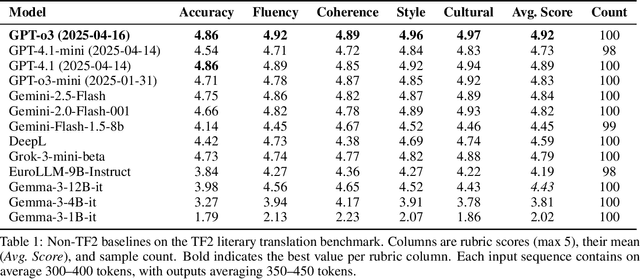
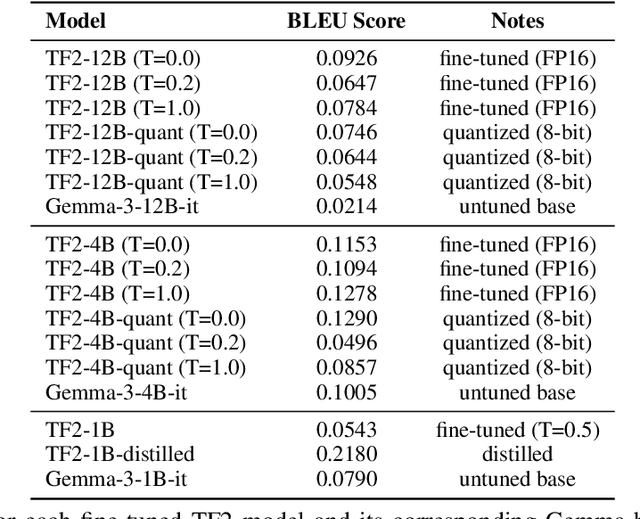
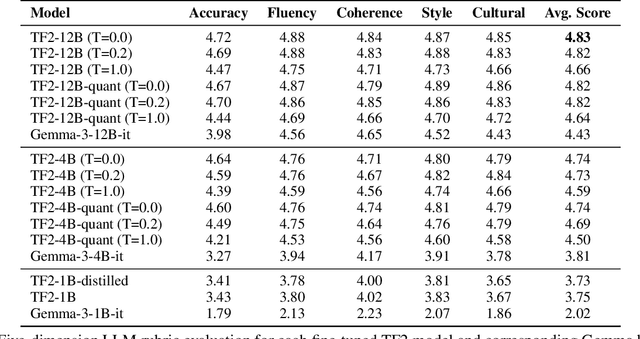
Literary translation has recently gained attention as a distinct and complex task in machine translation research. However, the translation by small open models remains an open problem. We contribute to this ongoing research by introducing TINYFABULIST TRANSLATION FRAMEWORK (TF2), a unified framework for dataset creation, fine tuning, and evaluation in English-Romanian literary translations, centred on the creation and open release of both a compact, fine tuned language model (TF2-12B) and large scale synthetic parallel datasets (DS-TF2-EN-RO-3M and DS-TF2-EN-RO-15K). Building on DS-TF1-EN-3M (TF1), the largest collection of synthetic English fables to date, we address the need for rich, high quality literary datasets in low resource languages such as Romanian. Our pipeline first generates 15k high quality Romanian references from the TF1 pool using a high performing LLM. We then apply a two stage fine tuning process to a 12B parameter open weight model: (i) instruction tuning to capture genre specific narrative style, and (ii) adapter compression for efficient deployment. Evaluation combines corpus level BLEU and a five dimension LLM based rubric (accuracy, fluency, coherence, style, cultural adaptation) to provide a nuanced assessment of translation quality. Results show that our fine tuned model achieves fluency and adequacy competitive with top performing large proprietary models, while being open, accessible, and significantly more cost effective. Alongside the fine tuned model and both datasets, we publicly release all scripts and evaluation prompts. TF2 thus provides an end-to-end, reproducible pipeline for research on cost efficient translation, cross lingual narrative generation, and the broad adoption of open models for culturally significant literary content in low resource settings.
TF1-EN-3M: Three Million Synthetic Moral Fables for Training Small, Open Language Models
Apr 29, 2025Moral stories are a time-tested vehicle for transmitting values, yet modern NLP lacks a large, structured corpus that couples coherent narratives with explicit ethical lessons. We close this gap with TF1-EN-3M, the first open dataset of three million English-language fables generated exclusively by instruction-tuned models no larger than 8B parameters. Each story follows a six-slot scaffold (character -> trait -> setting -> conflict -> resolution -> moral), produced through a combinatorial prompt engine that guarantees genre fidelity while covering a broad thematic space. A hybrid evaluation pipeline blends (i) a GPT-based critic that scores grammar, creativity, moral clarity, and template adherence with (ii) reference-free diversity and readability metrics. Among ten open-weight candidates, an 8B-parameter Llama-3 variant delivers the best quality-speed trade-off, producing high-scoring fables on a single consumer GPU (<24 GB VRAM) at approximately 13.5 cents per 1,000 fables. We release the dataset, generation code, evaluation scripts, and full metadata under a permissive license, enabling exact reproducibility and cost benchmarking. TF1-EN-3M opens avenues for research in instruction following, narrative intelligence, value alignment, and child-friendly educational AI, demonstrating that large-scale moral storytelling no longer requires proprietary giant models.
Synthetic Data Generation Using Large Language Models: Advances in Text and Code
Mar 18, 2025Large language models (LLMs) have unlocked new possibilities for generating synthetic training data in both natural language and code. By producing artificial but task-relevant examples, these models can significantly augment or even replace real-world datasets, especially when labeled data is scarce or sensitive. This paper surveys recent advances in using LLMs to create synthetic text and code, emphasizing prompt-based generation, retrieval-augmented pipelines, and iterative self-refinement. We show how these methods enrich low-resource tasks such as classification and question answering, as well as code-centric applications such as instruction tuning, code translation, and bug repair, by enabling automated verification of functional correctness. Alongside potential benefits like cost-effectiveness, broad coverage, and controllable diversity, we address challenges such as factual inaccuracies in generated text, lack of stylistic realism, and the risk of bias amplification. Proposed mitigations include filtering and weighting outputs and reinforcement learning with execution feedback for code. We conclude with open research directions like automated prompt engineering, cross-modal data synthesis, and robust evaluation frameworks, highlighting the importance of LLM-generated synthetic data in advancing AI while emphasizing ethical and quality safeguards.