 Add to Chrome
 Add to Firefox
 Add to Edge
MTL-MAD: Multi-Task Learners are Effective Medical Anomaly Detectors
May 07, 2026
Anomaly detection in medical images is a challenging task, since anomalies are not typically available during training. Recent methods leverage a single pretext task coupled with a large-scale pre-trained model to reach state-of-the-art performance. Instead, we propose to learn multiple self-supervised and pseudo-labeling tasks from scratch, using a joint model based on Mixture-of-Experts (MoE). By carefully integrating multiple proxy tasks, the joint model effectively learns a robust representation of normal anatomical structures, so that anomaly scores can be derived based on how well the multi-task learner (MTL) solves each task during inference. We perform comprehensive experiments on BMAD, a recent benchmark that comprises a broad range of medical image modalities. The empirical results indicate that our multi-task learner is an effective anomaly detector, outperforming all state-of-the-art competitors on BMAD. Moreover, our model produces interpretable anomaly maps, potentially helping physicians in providing more accurate diagnoses.

Weight Copy and Low-Rank Adaptation for Few-Shot Distillation of Vision Transformers
Apr 17, 2024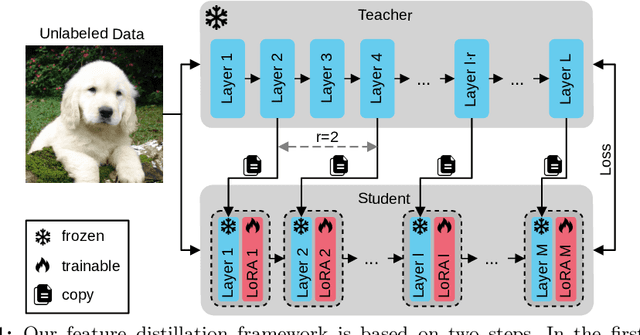
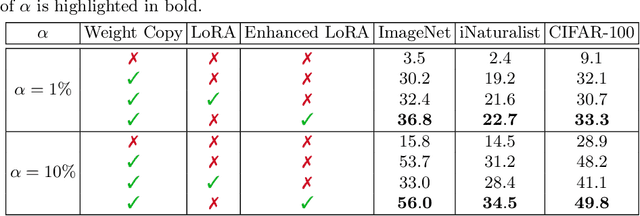
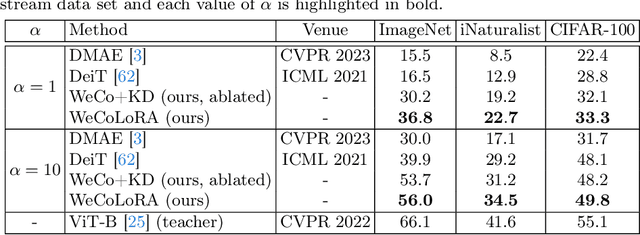
Few-shot knowledge distillation recently emerged as a viable approach to harness the knowledge of large-scale pre-trained models, using limited data and computational resources. In this paper, we propose a novel few-shot feature distillation approach for vision transformers. Our approach is based on two key steps. Leveraging the fact that vision transformers have a consistent depth-wise structure, we first copy the weights from intermittent layers of existing pre-trained vision transformers (teachers) into shallower architectures (students), where the intermittence factor controls the complexity of the student transformer with respect to its teacher. Next, we employ an enhanced version of Low-Rank Adaptation (LoRA) to distill knowledge into the student in a few-shot scenario, aiming to recover the information processing carried out by the skipped teacher layers. We present comprehensive experiments with supervised and self-supervised transformers as teachers, on five data sets from various domains, including natural, medical and satellite images. The empirical results confirm the superiority of our approach over competitive baselines. Moreover, the ablation results demonstrate the usefulness of each component of the proposed pipeline.