 Add to Chrome
 Add to Firefox
 Add to Edge
From Hybrid Mechanistic--Data-Driven Modeling Toward Neuro-Symbolic AI: What, Why, and How
Jul 24, 2026
Hybrid mechanistic/data-driven models, which combine first-principles with learned components, are increasingly used in process engineering and scientific machine learning. Common hybrid modeling designs are specified primarily through their architectures and training losses, which offers a limited basis for a shared semantic interface to compare or verify them across domains, with comparatively little attention paid to epistemic uncertainty in the mechanistic part. We bridge hybrid modeling and neuro-symbolic (NeSy) AI by reconstructing these designs as instances of NeSy interface. The resulting translation, Hybrid-to-NeSy (H2N), places mechanistic knowledge on the language side, learned modules on the belief side, and validity domains together with constraints on the logic side. For each design, H2N then yields an explicit NeSy inference functional and a logic-belief decomposition. From this decomposition we derive two metrics: structural violation rate (SVR), measuring whether the learned belief respects the mechanistic structure; and belief dispersion (BD), measuring how concentrated the learned plausibility is, serving as a hybrid model's epistemic uncertainty in its mechanistic part. We instantiate H2N on a case study of a structured hybrid model for binary classification under label noise and show that models with higher SVR and BD exhibit greater variability in held-out accuracy. Under structural distribution shift, H2N further quantifies a model's uncertainty during extrapolations, whereas test accuracy reveals the same shift only post hoc.

Smooth Kolmogorov Arnold networks enabling structural knowledge representation
May 18, 2024Kolmogorov-Arnold Networks (KANs) offer an efficient and interpretable alternative to traditional multi-layer perceptron (MLP) architectures due to their finite network topology. However, according to the results of Kolmogorov and Vitushkin, the representation of generic smooth functions by KAN implementations using analytic functions constrained to a finite number of cutoff points cannot be exact. Hence, the convergence of KAN throughout the training process may be limited. This paper explores the relevance of smoothness in KANs, proposing that smooth, structurally informed KANs can achieve equivalence to MLPs in specific function classes. By leveraging inherent structural knowledge, KANs may reduce the data required for training and mitigate the risk of generating hallucinated predictions, thereby enhancing model reliability and performance in computational biomedicine.
Tree-Based Learning on Amperometric Time Series Data Demonstrates High Accuracy for Classification
Feb 06, 2023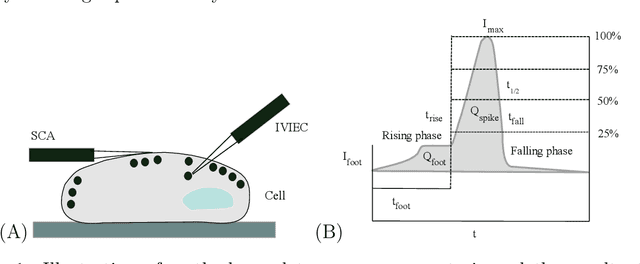
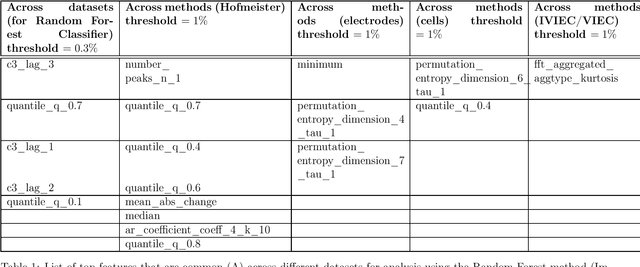
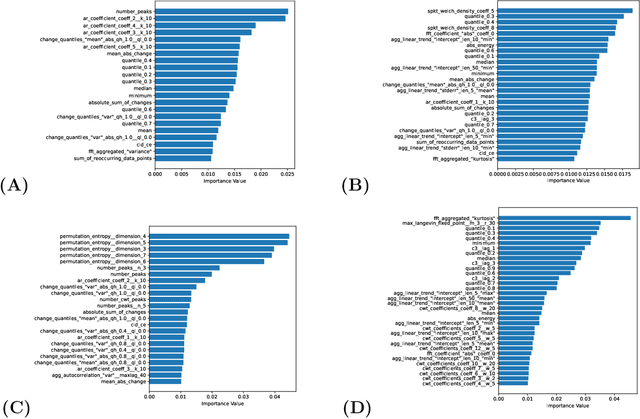
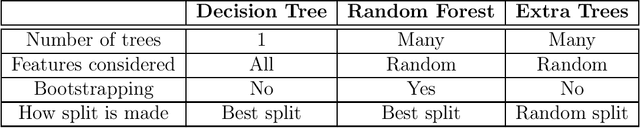
Elucidating exocytosis processes provide insights into cellular neurotransmission mechanisms, and may have potential in neurodegenerative diseases research. Amperometry is an established electrochemical method for the detection of neurotransmitters released from and stored inside cells. An important aspect of the amperometry method is the sub-millisecond temporal resolution of the current recordings which leads to several hundreds of gigabytes of high-quality data. In this study, we present a universal method for the classification with respect to diverse amperometric datasets using data-driven approaches in computational science. We demonstrate a very high prediction accuracy (greater than or equal to 95%). This includes an end-to-end systematic machine learning workflow for amperometric time series datasets consisting of pre-processing; feature extraction; model identification; training and testing; followed by feature importance evaluation - all implemented. We tested the method on heterogeneous amperometric time series datasets generated using different experimental approaches, chemical stimulations, electrode types, and varying recording times. We identified a certain overarching set of common features across these datasets which enables accurate predictions. Further, we showed that information relevant for the classification of amperometric traces are neither in the spiky segments alone, nor can it be retrieved from just the temporal structure of spikes. In fact, the transients between spikes and the trace baselines carry essential information for a successful classification, thereby strongly demonstrating that an effective feature representation of amperometric time series requires the full time series. To our knowledge, this is one of the first studies that propose a scheme for machine learning, and in particular, supervised learning on full amperometry time series data.