 Add to Chrome
 Add to Firefox
 Add to Edge
Guiding Sparse Neural Networks with Neurobiological Principles to Elicit Biologically Plausible Representations
Mar 03, 2026
While deep neural networks (DNNs) have achieved remarkable performance in tasks such as image recognition, they often struggle with generalization, learning from few examples, and continuous adaptation - abilities inherent in biological neural systems. These challenges arise due to DNNs' failure to emulate the efficient, adaptive learning mechanisms of biological networks. To address these issues, we explore the integration of neurobiologically inspired assumptions in neural network learning. This study introduces a biologically inspired learning rule that naturally integrates neurobiological principles, including sparsity, lognormal weight distributions, and adherence to Dale's law, without requiring explicit enforcement. By aligning with these core neurobiological principles, our model enhances robustness against adversarial attacks and demonstrates superior generalization, particularly in few-shot learning scenarios. Notably, integrating these constraints leads to the emergence of biologically plausible neural representations, underscoring the efficacy of incorporating neurobiological assumptions into neural network design. Preliminary results suggest that this approach could extend from feature-specific to task-specific encoding, potentially offering insights into neural resource allocation for complex tasks.

Energy-Efficient Information Representation in MNIST Classification Using Biologically Inspired Learning
Feb 28, 2026Efficient representation learning is essential for optimal information storage and classification. However, it is frequently overlooked in artificial neural networks (ANNs). This neglect results in networks that can become overparameterized by factors of up to 13, increasing redundancy and energy consumption. As the demand for large language models (LLMs) and their scale increase, these issues are further highlighted, raising significant ethical and environmental concerns. We analyze our previously developed biologically inspired learning rule using information-theoretic concepts, evaluating its efficiency on the MNIST classification task. The proposed rule, which emulates the brain's structural plasticity, naturally prevents overparameterization by optimizing synaptic usage and retaining only the essential number of synapses. Furthermore, it outperforms backpropagation (BP) in terms of efficiency and storage capacity. It also eliminates the need for pre-optimization of network architecture, enhances adaptability, and reflects the brain's ability to reserve 'space' for new memories. This approach advances scalable and energy-efficient AI and provides a promising framework for developing brain-inspired models that optimize resource allocation and adaptability.
Neural auto-association with optimal Bayesian learning
Dec 24, 2024Neural associative memories are single layer perceptrons with fast synaptic learning typically storing discrete associations between pairs of neural activity patterns. Previous works have analyzed the optimal networks under naive Bayes assumptions of independent pattern components and heteroassociation, where the task is to learn associations from input to output patterns. Here I study the optimal Bayesian associative network for auto-association where input and output layers are identical. In particular, I compare performance to different variants of approximate Bayesian learning rules, like the BCPNN (Bayesian Confidence Propagation Neural Network), and try to explain why sometimes the suboptimal learning rules achieve higher storage capacity than the (theoretically) optimal model. It turns out that performance can depend on subtle dependencies of input components violating the ``naive Bayes'' assumptions. This includes patterns with constant number of active units, iterative retrieval where patterns are repeatedly propagated through recurrent networks, and winners-take-all activation of the most probable units. Performance of all learning rules can improve significantly if they include a novel adaptive mechanism to estimate noise in iterative retrieval steps (ANE). The overall maximum storage capacity is achieved again by the Bayesian learning rule with ANE.
IVISIT: An Interactive Visual Simulation Tool for system simulation, visualization, optimization, and parameter management
Jul 22, 2024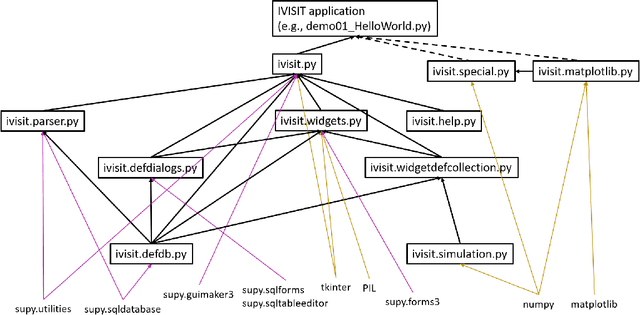
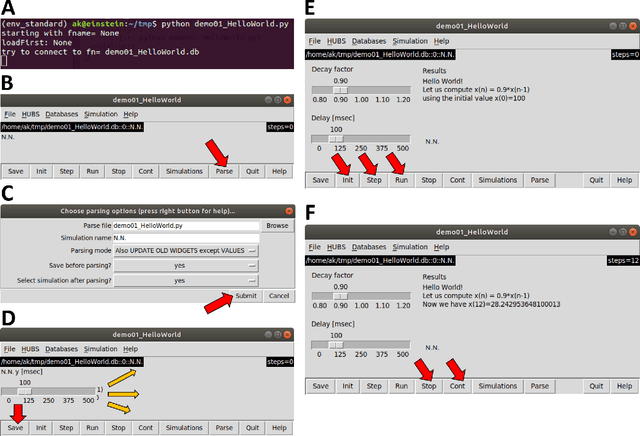
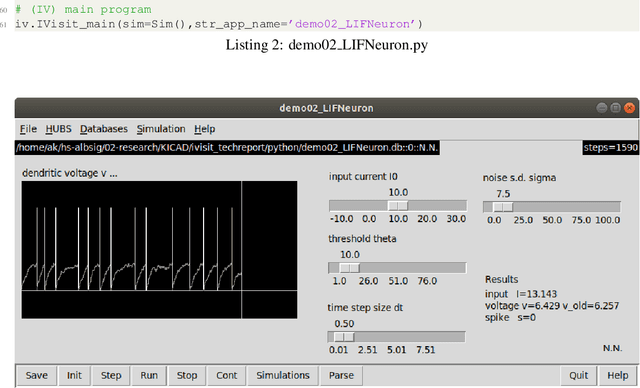
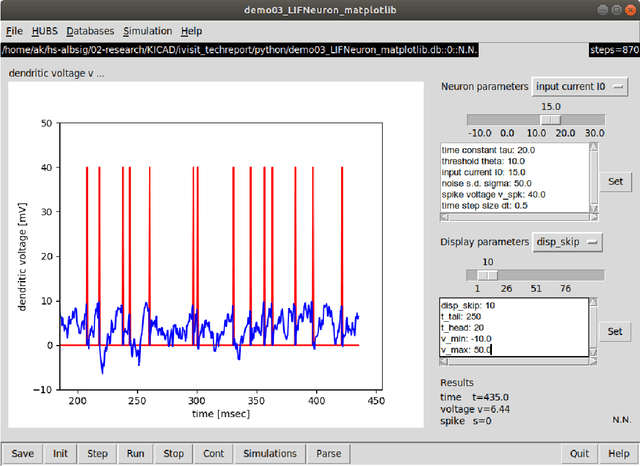
IVISIT is a generic interactive visual simulation tool that is based on Python/Numpy and can be used for system simulation, parameter optimization, parameter management, and visualization of system dynamics as required, for example,for developing neural network simulations, machine learning applications, or computer vision systems. It provides classes for rapid prototyping of applications and visualization and manipulation of system properties using interactive GUI elements like sliders, images, textboxes, option lists, checkboxes and buttons based on Tkinter and Matplotlib. Parameters and simulation configurations can be stored and managed based on SQLite database functions. This technical report describes the main architecture and functions of IVISIT, and provides easy examples how to rapidly implement interactive applications and manage parameter settings.