 Add to Chrome
 Add to Firefox
 Add to Edge
Robots that learn to evaluate models of collective behavior
Apr 08, 2026
Understanding and modeling animal behavior is essential for studying collective motion, decision-making, and bio-inspired robotics. Yet, evaluating the accuracy of behavioral models still often relies on offline comparisons to static trajectory statistics. Here we introduce a reinforcement-learning-based framework that uses a biomimetic robotic fish (RoboFish) to evaluate computational models of live fish behavior through closed-loop interaction. We trained policies in simulation using four distinct fish models-a simple constant-follow baseline, two rule-based models, and a biologically grounded convolutional neural network model-and transferred these policies to the real RoboFish setup, where they interacted with live fish. Policies were trained to guide a simulated fish to goal locations, enabling us to quantify how the response of real fish differs from the simulated fish's response. We evaluate the fish models by quantifying the sim-to-real gaps, defined as the Wasserstein distance between simulated and real distributions of behavioral metrics such as goal-reaching performance, inter-individual distances, wall interactions, and alignment. The neural network-based fish model exhibited the smallest gap across goal-reaching performance and most other metrics, indicating higher behavioral fidelity than conventional rule-based models under this benchmark. More importantly, this separation shows that the proposed evaluation can quantitatively distinguish candidate models under matched closed-loop conditions. Our work demonstrates how learning-based robotic experiments can uncover deficiencies in behavioral models and provides a general framework for evaluating animal behavior models through embodied interaction.

Continuous Value Iteration (CVI) Reinforcement Learning and Imaginary Experience Replay (IER) for learning multi-goal, continuous action and state space controllers
Aug 27, 2019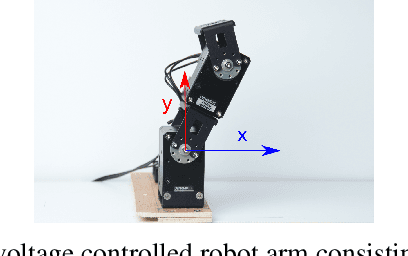
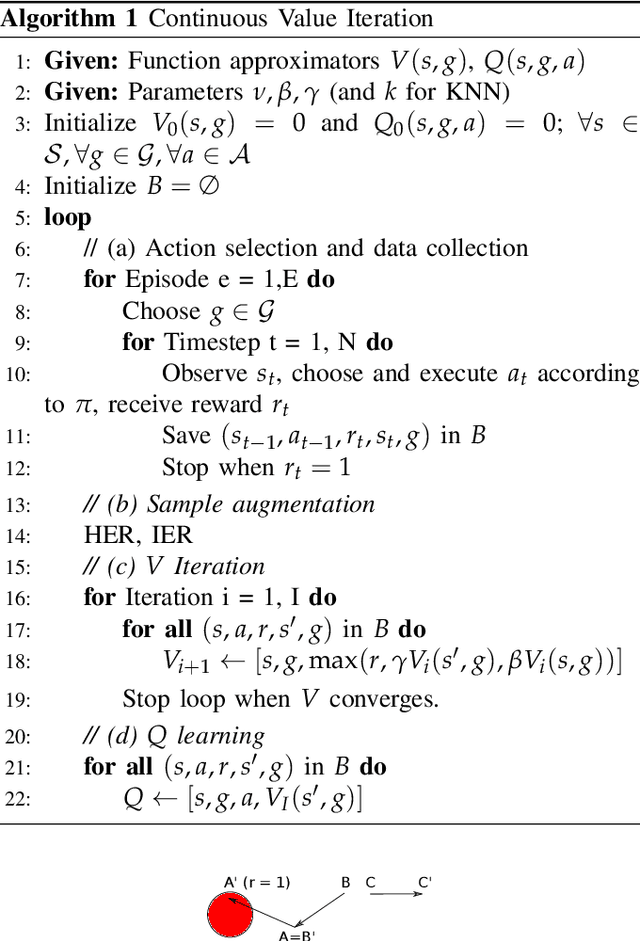
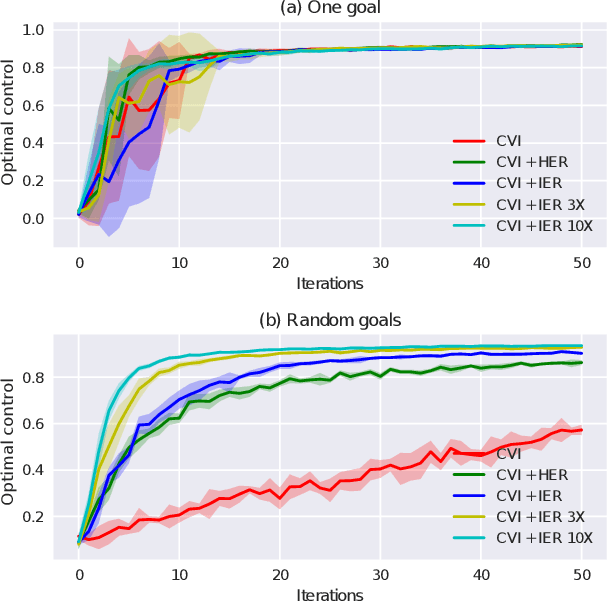
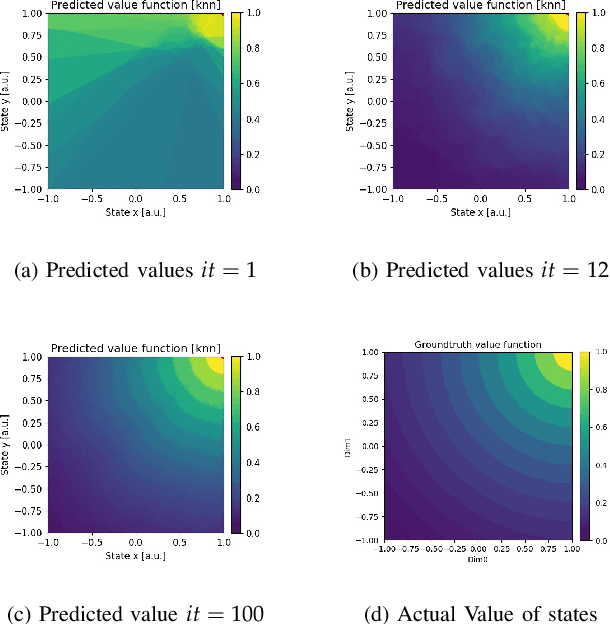
This paper presents a novel model-free Reinforcement Learning algorithm for learning behavior in continuous action, state, and goal spaces. The algorithm approximates optimal value functions using non-parametric estimators. It is able to efficiently learn to reach multiple arbitrary goals in deterministic and nondeterministic environments. To improve generalization in the goal space, we propose a novel sample augmentation technique. Using these methods, robots learn faster and overall better controllers. We benchmark the proposed algorithms using simulation and a real-world voltage controlled robot that learns to maneuver in a non-observable Cartesian task space.