 Add to Chrome
 Add to Firefox
 Add to Edge
Interpretable Link Prediction in AI-Driven Cancer Research: Uncovering Co-Authorship Patterns
Dec 19, 2025
Artificial intelligence (AI) is transforming cancer diagnosis and treatment. The intricate nature of this disease necessitates the collaboration of diverse stakeholders with varied expertise to ensure the effectiveness of cancer research. Despite its importance, forming effective interdisciplinary research teams remains challenging. Understanding and predicting collaboration patterns can help researchers, organizations, and policymakers optimize resources and foster impactful research. We examined co-authorship networks as a proxy for collaboration within AI-driven cancer research. Using 7,738 publications (2000-2017) from Scopus, we constructed 36 overlapping co-authorship networks representing new, persistent, and discontinued collaborations. We engineered both attribute-based and structure-based features and built four machine learning classifiers. Model interpretability was performed using Shapley Additive Explanations (SHAP). Random forest achieved the highest recall for all three types of examined collaborations. The discipline similarity score emerged as a crucial factor, positively affecting new and persistent patterns while negatively impacting discontinued collaborations. Additionally, high productivity and seniority were positively associated with discontinued links. Our findings can guide the formation of effective research teams, enhance interdisciplinary cooperation, and inform strategic policy decisions.

Decoding Funded Research: Comparative Analysis of Topic Models and Uncovering the Effect of Gender and Geographic Location
Oct 21, 2025Optimizing national scientific investment requires a clear understanding of evolving research trends and the demographic and geographical forces shaping them, particularly in light of commitments to equity, diversity, and inclusion. This study addresses this need by analyzing 18 years (2005-2022) of research proposals funded by the Natural Sciences and Engineering Research Council of Canada (NSERC). We conducted a comprehensive comparative evaluation of three topic modelling approaches: Latent Dirichlet Allocation (LDA), Structural Topic Modelling (STM), and BERTopic. We also introduced a novel algorithm, named COFFEE, designed to enable robust covariate effect estimation for BERTopic. This advancement addresses a significant gap, as BERTopic lacks a native function for covariate analysis, unlike the probabilistic STM. Our findings highlight that while all models effectively delineate core scientific domains, BERTopic outperformed by consistently identifying more granular, coherent, and emergent themes, such as the rapid expansion of artificial intelligence. Additionally, the covariate analysis, powered by COFFEE, confirmed distinct provincial research specializations and revealed consistent gender-based thematic patterns across various scientific disciplines. These insights offer a robust empirical foundation for funding organizations to formulate more equitable and impactful funding strategies, thereby enhancing the effectiveness of the scientific ecosystem.
Predicting Star Scientists in the Field of Artificial Intelligence: A Machine Learning Approach
Jul 18, 2024Star scientists are highly influential researchers who have made significant contributions to their field, gained widespread recognition, and often attracted substantial research funding. They are critical for the advancement of science and innovation, and they have a significant influence on the transfer of knowledge and technology to industry. Identifying potential star scientists before their performance becomes outstanding is important for recruitment, collaboration, networking, or research funding decisions. Using machine learning techniques, this study proposes a model to predict star scientists in the field of artificial intelligence while highlighting features related to their success. Our results confirm that rising stars follow different patterns compared to their non-rising stars counterparts in almost all the early-career features. We also found that certain features such as gender and ethnic diversity play important roles in scientific collaboration and that they can significantly impact an author's career development and success. The most important features in predicting star scientists in the field of artificial intelligence were the number of articles, group discipline diversity, and weighted degree centrality. The proposed approach offers valuable insights for researchers, practitioners, and funding agencies interested in identifying and supporting talented researchers.
Proximity Matters: Analyzing the Role of Geographical Proximity in Shaping AI Research Collaborations
Jun 10, 2024The role of geographical proximity in facilitating inter-regional or inter-organizational collaborations has been studied thoroughly in recent years. However, the effect of geographical proximity on forming scientific collaborations at the individual level still needs to be addressed. Using publication data in the field of artificial intelligence from 2001 to 2019, in this work, the effect of geographical proximity on the likelihood of forming future scientific collaborations among researchers is studied. In addition, the interaction between geographical and network proximities is examined to see whether network proximity can substitute geographical proximity in encouraging long-distance scientific collaborations. Employing conventional and machine learning techniques, our results suggest that geographical distance impedes scientific collaboration at the individual level despite the tremendous improvements in transportation and communication technologies during recent decades. Moreover, our findings show that the effect of network proximity on the likelihood of scientific collaboration increases with geographical distance, implying that network proximity can act as a substitute for geographical proximity.
Women, artificial intelligence, and key positions in collaboration networks: Towards a more equal scientific ecosystem
May 19, 2022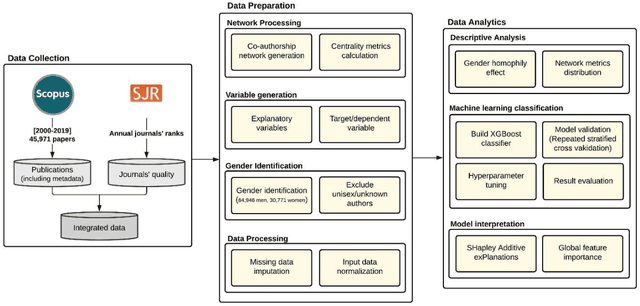
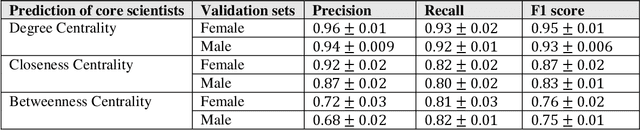
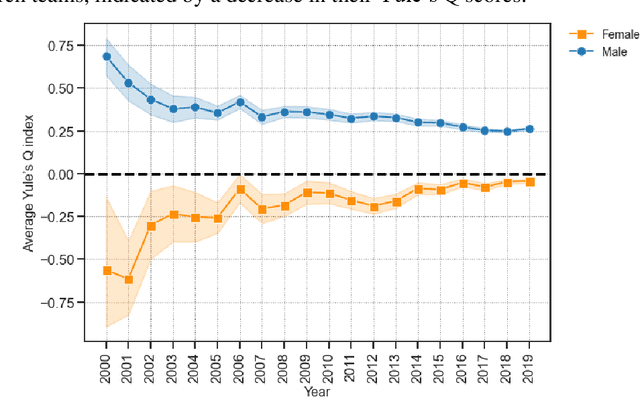
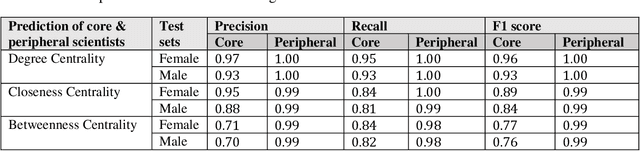
Scientific collaboration in almost every discipline is mainly driven by the need of sharing knowledge, expertise, and pooled resources. Science is becoming more complex which has encouraged scientists to involve more in collaborative research projects in order to better address the challenges. As a highly interdisciplinary field with a rapidly evolving scientific landscape, artificial intelligence calls for researchers with special profiles covering a diverse set of skills and expertise. Understanding gender aspects of scientific collaboration is of paramount importance, especially in a field such as artificial intelligence that has been attracting large investments. Using social network analysis, natural language processing, and machine learning and focusing on artificial intelligence publications for the period from 2000 to 2019, in this work, we comprehensively investigated the effects of several driving factors on acquiring key positions in scientific collaboration networks through a gender lens. It was found that, regardless of gender, scientific performance in terms of quantity and impact plays a crucial in possessing the "social researcher" in the network. However, subtle differences were observed between female and male researchers in acquiring the "local influencer" role.
Influence of cognitive, geographical, and collaborative proximity on knowledge production of Canadian nanotechnology
Jun 03, 2021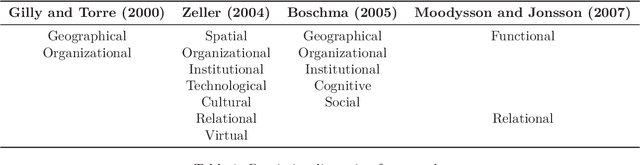
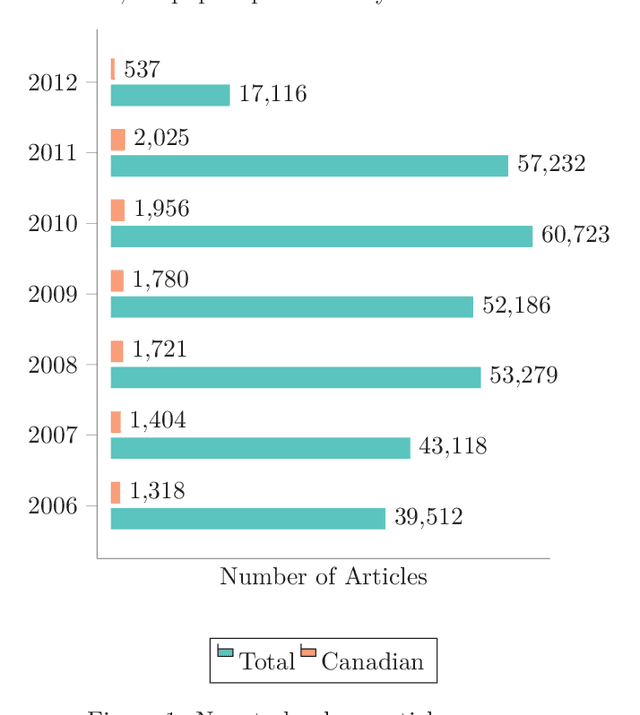
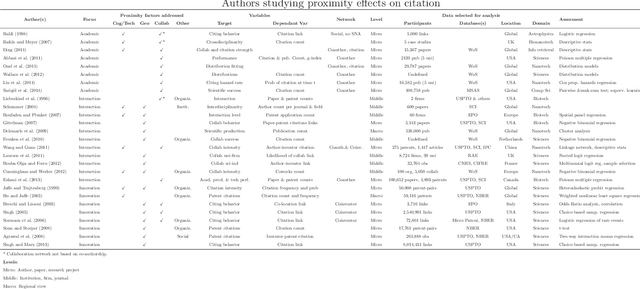
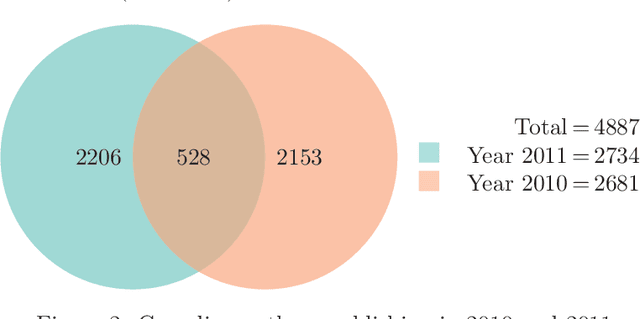
Incorporating existing knowledge is vital for innovating, discovering, and generating new ideas. Knowledge production through research and invention is the key to scientific and technological development. As an emerging technology, nanotechnology has already proved its great potential for the global economy, attracting considerable federal investments. Canada is reported as one of the major players in producing nanotechnology research. In this paper, we focused on the main drivers of knowledge production and diffusion by analyzing Canadian nanotechnology researchers. We hypothesized that knowledge production in Canadian nanotechnology is influenced by three key proximity factors, namely cognitive, geographical, and collaborative. Using statistical analysis, social network analysis, and machine learning techniques we comprehensively assessed the influence of the proximity factors on academic knowledge production. Our results not only prove a significant impact of the three key proximity factors but also their predictive potential.