 Add to Chrome
 Add to Firefox
 Add to Edge
From Nodes to Edges: Edge-Based Laplacians for Brain Signal Processing
Dec 15, 2025
Traditional graph signal processing (GSP) methods applied to brain networks focus on signals defined on the nodes. Thus, they are unable to capture potentially important dynamics occurring on the edges. In this work, we adopt an edge-centric GSP approach to analyze edge signals constructed from 100 unrelated subjects of the Human Connectome Project. Specifically, we describe structural connectivity through the lens of the 1-dimensional Hodge Laplacian, processing signals defined on edges to capture co-fluctuation information between brain regions. We demonstrate that edge-based approaches achieve superior task decoding accuracy in static and dynamic scenarios compared to conventional node-based techniques, thereby unveiling unique aspects of brain functional organization. These findings underscore the promise of edge-focused GSP strategies for deepening our understanding of brain connectivity and functional dynamics.

Simplex2Vec embeddings for community detection in simplicial complexes
Jun 21, 2019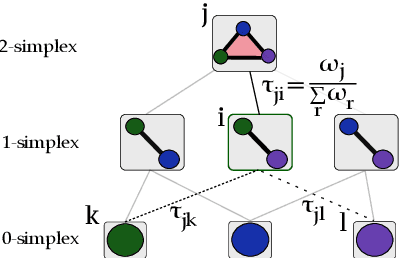
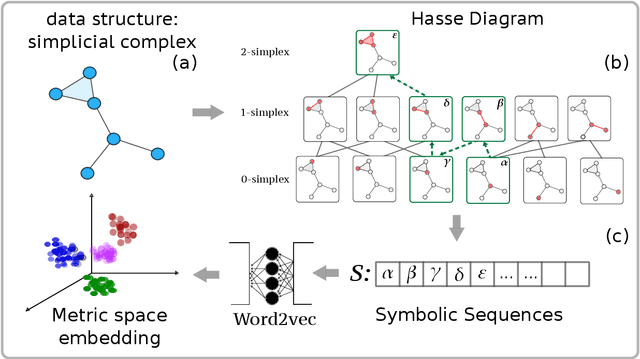
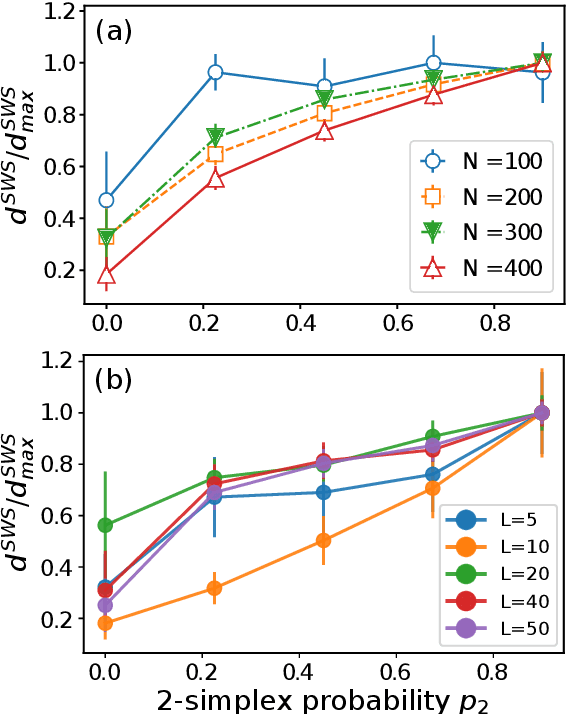
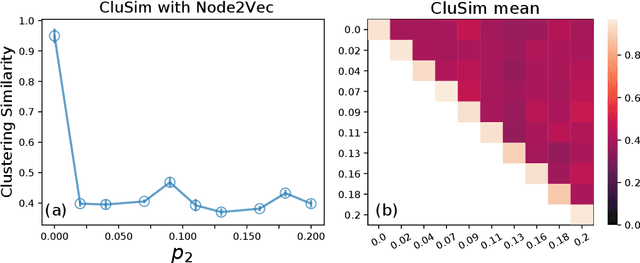
Topological representations are rapidly becoming a popular way to capture and encode higher-order interactions in complex systems. They have found applications in disciplines as different as cancer genomics, brain function, and computational social science, in representing both descriptive features of data and inference models. While intense research has focused on the connectivity and homological features of topological representations, surprisingly scarce attention has been given to the investigation of the community structures of simplicial complexes. To this end, we adopt recent advances in symbolic embeddings to compute and visualize the community structures of simplicial complexes. We first investigate the stability properties of embedding obtained for synthetic simplicial complexes to the presence of higher order interactions. We then focus on complexes arising from social and brain functional data and show how higher order interactions can be leveraged to improve clustering detection and assess the effect of higher order interaction on individual nodes. We conclude delineating limitations and directions for extension of this work.