 Add to Chrome
 Add to Firefox
 Add to Edge
AI-based Prediction of Biochemical Recurrence from Biopsy and Prostatectomy Samples
Jan 28, 2026
Biochemical recurrence (BCR) after radical prostatectomy (RP) is a surrogate marker for aggressive prostate cancer with adverse outcomes, yet current prognostic tools remain imprecise. We trained an AI-based model on diagnostic prostate biopsy slides from the STHLM3 cohort (n = 676) to predict patient-specific risk of BCR, using foundation models and attention-based multiple instance learning. Generalizability was assessed across three external RP cohorts: LEOPARD (n = 508), CHIMERA (n = 95), and TCGA-PRAD (n = 379). The image-based approach achieved 5-year time-dependent AUCs of 0.64, 0.70, and 0.70, respectively. Integrating clinical variables added complementary prognostic value and enabled statistically significant risk stratification. Compared with guideline-based CAPRA-S, AI incrementally improved postoperative prognostication. These findings suggest biopsy-trained histopathology AI can generalize across specimen types to support preoperative and postoperative decision making, but the added value of AI-based multimodal approaches over simpler predictive models should be critically scrutinized in further studies.

Ensemble Prediction of Time to Event Outcomes with Competing Risks: A Case Study of Surgical Complications in Crohn's Disease
Feb 07, 2019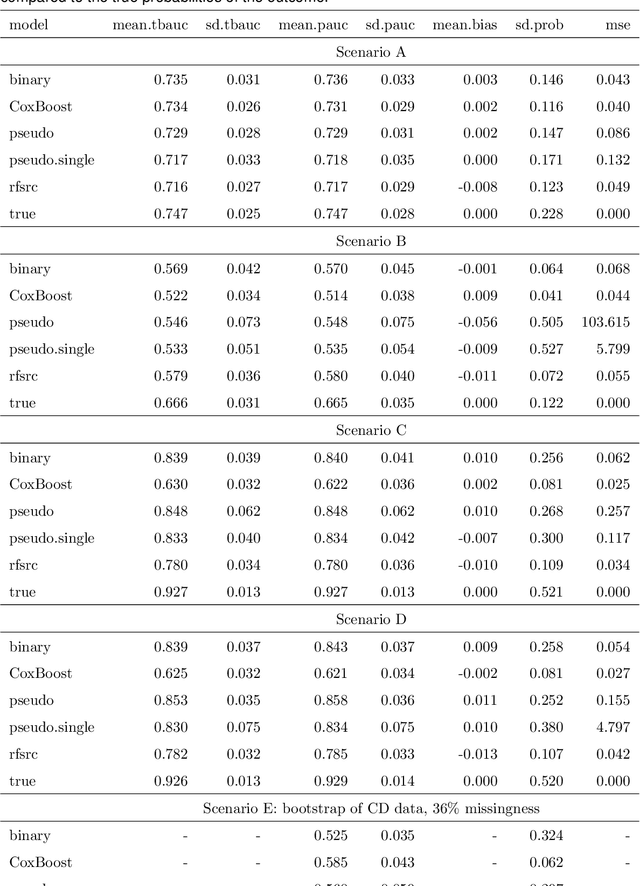
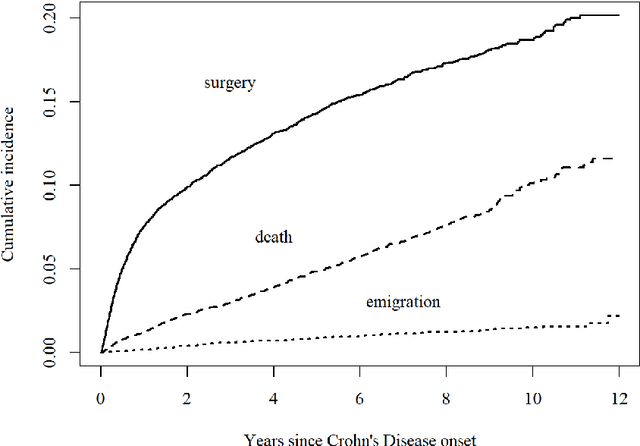
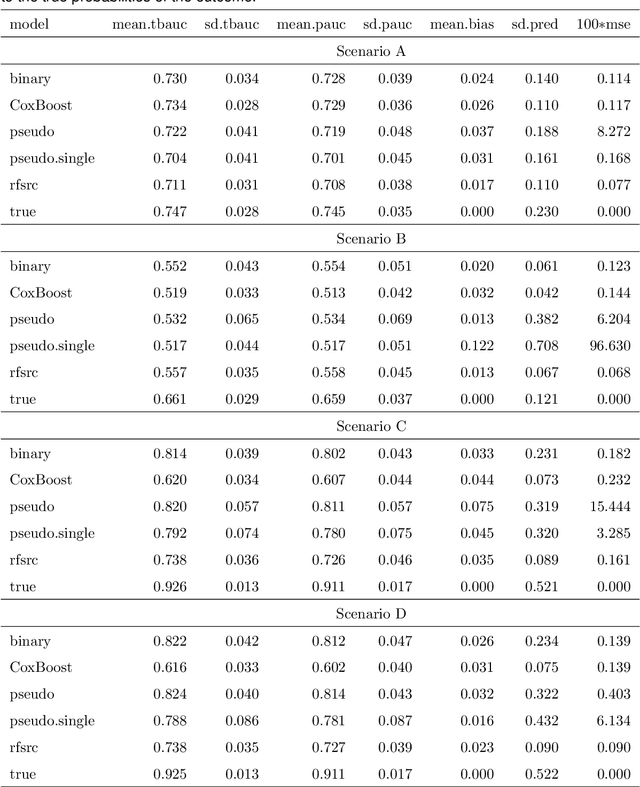
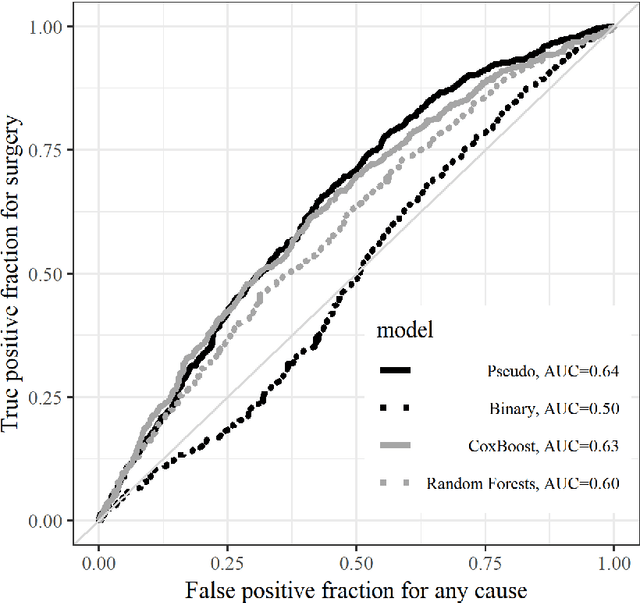
We develop a novel algorithm to predict the occurrence of major abdominal surgery within 5 years following Crohn's disease diagnosis using a panel of 29 baseline covariates from the Swedish population registers. We model pseudo-observations based on the Aalen-Johansen estimator of the cause-specific cumulative incidence with an ensemble of modern machine learning approaches. Pseudo-observation pre-processing easily extends all existing or new machine learning procedures to right-censored event history data. We propose pseudo-observation based estimators for the area under the time varying ROC curve, for optimizing the ensemble, and the predictiveness curve, for evaluating and summarizing predictive performance.