 Add to Chrome
 Add to Firefox
 Add to Edge
From Prediction to Incrementality: Causal Optimization for Large-Scale Targeting and Recommendation
Aug 10, 2026
Large-scale targeting and recommendation systems are typically built around predictive scores fed into heuristic or local allocation. When the business goal is incremental impact, as in marketing campaigns, incentives, and notifications, this paradigm systematically misallocates resources toward users who would have acted anyway. We present a decision-centric framework that instead optimizes causal effects under global constraints, aligning three components under a single objective: a causal neural network with a Transformer backbone for individual treatment-effect estimation, a Bayesian neural-bandit layer for uncertainty-aware exploration, and a dual-based large-scale linear-programming layer for constrained allocation. The framework also supports sequential context and multi-outcome, attribute-conditioned scoring through a Transformer encoder and outcome embeddings. We evaluate it with offline simulations on a public bandit dataset, targeted architectural ablations, and an online A/B test on LinkedIn Feed marketing traffic. We also distill production lessons on causal training-data construction and cost and delivery control, which were critical to successful deployment. The end-to-end treatment policy delivered a statistically significant $+7.20\%$ lift in the primary long-term-value metric, demonstrating the feasibility of production-scale causal optimization under business constraints.

Neural Optimization with Adaptive Heuristics for Intelligent Marketing System
May 17, 2024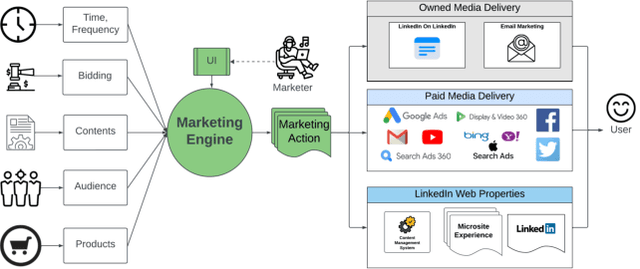
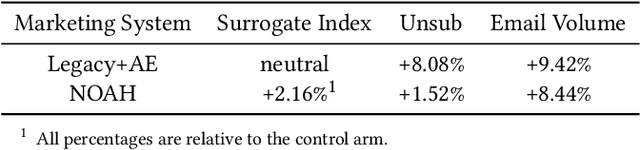
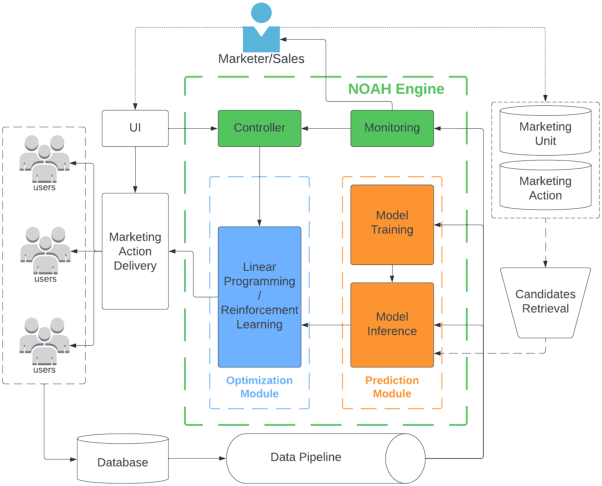

Computational marketing has become increasingly important in today's digital world, facing challenges such as massive heterogeneous data, multi-channel customer journeys, and limited marketing budgets. In this paper, we propose a general framework for marketing AI systems, the Neural Optimization with Adaptive Heuristics (NOAH) framework. NOAH is the first general framework for marketing optimization that considers both to-business (2B) and to-consumer (2C) products, as well as both owned and paid channels. We describe key modules of the NOAH framework, including prediction, optimization, and adaptive heuristics, providing examples for bidding and content optimization. We then detail the successful application of NOAH to LinkedIn's email marketing system, showcasing significant wins over the legacy ranking system. Additionally, we share details and insights that are broadly useful, particularly on: (i) addressing delayed feedback with lifetime value, (ii) performing large-scale linear programming with randomization, (iii) improving retrieval with audience expansion, (iv) reducing signal dilution in targeting tests, and (v) handling zero-inflated heavy-tail metrics in statistical testing.