 Add to Chrome
 Add to Firefox
 Add to Edge
Fun-TSG: A Function-Driven Multivariate Time Series Generator with Variable-Level Anomaly Labeling
Apr 14, 2026
Reliable evaluation of anomaly detection methods in multivariate time series remains an open challenge, largely due to the limitations of existing benchmark datasets. Current resources often lack fine-grained anomaly annotations, do not provide explicit intervariable and temporal dependencies, and offer little insight into the underlying generative mechanisms. These shortcomings hinder the development and rigorous comparison of detection models, especially those targeting interpretable and variable-specific outputs. To address this gap, we introduce Fun-TSG, a fully customizable time series generator designed to support high-quality evaluation of anomaly detection systems. Our tool enables both fully automated generation, based on randomly sampled dependency structures and anomaly types, and manual generation through user-defined equations and anomaly configurations. In both cases, it provides full transparency over the data generation process, including access to ground-truth anomaly labels at the variable and timestamp levels. Fun-TSG supports the creation of diverse, interpretable, and reproducible benchmarking scenarios, enabling fine-grained performance analysis for both classical and modern anomaly detection models.

Improving Vehicle Re-Identification using CNN Latent Spaces: Metrics Comparison and Track-to-track Extension
Oct 21, 2019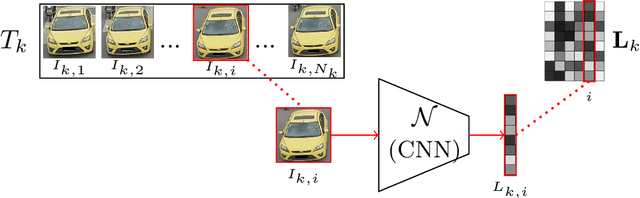
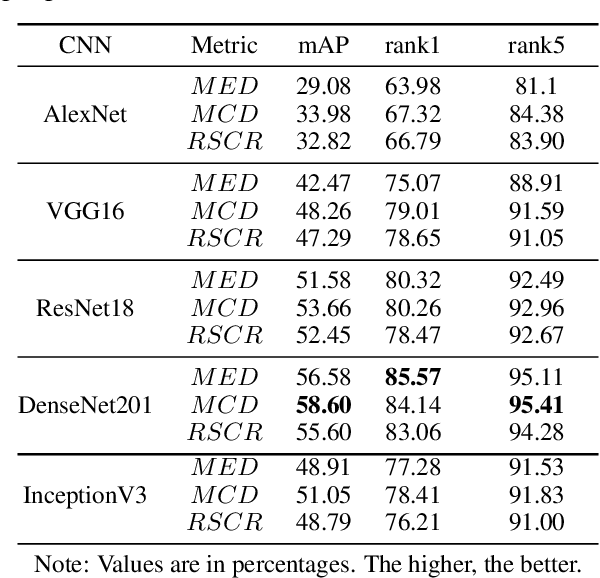
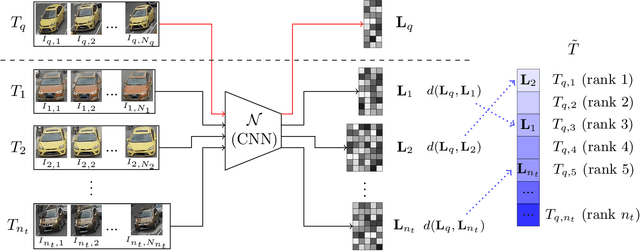
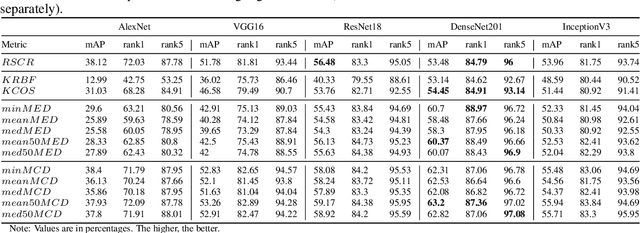
This paper addresses the problem of vehicle re-identification using distance comparison of images in CNN latent spaces. First, we study the impact of the distance metrics, comparing performances obtained with different metrics: the minimal Euclidean distance (MED), the minimal cosine distance (MCD), and the residue of the sparse coding reconstruction (RSCR). These metrics are applied using features extracted through five different CNN architectures, namely ResNet18, AlexNet, VGG16, InceptionV3 and DenseNet201. We use the specific vehicle re-identification dataset VeRI to fine-tune these CNNs and evaluate results. In overall, independently from the CNN used, MCD outperforms MED, commonly used in the literature. Secondly, the state-of-the-art image-to-track process (I2TP) is extended to a track-to-track process (T2TP) without using complementary metadata. Metrics are extended to measure distance between tracks, enabling the evaluation of T2TP and comparison with I2TP using the same CNN models. Results show that T2TP outperforms I2TP for MCD and RSCR. T2TP combining DenseNet201 and MCD-based metrics exhibits the best performances, outperforming the state-of-the-art I2TP models that use complementary metadata. Finally, our experiments highlight two main results: i) the importance of the metric choice for vehicle re-identification, and ii) T2TP improves the performances compared to I2TP, especially when coupled with MCD-based metrics.