 Add to Chrome
 Add to Firefox
 Add to Edge
Variational Encoder--Multi-Decoder (VE-MD) for Privacy-by-functional-design (Group) Emotion Recognition
Apr 02, 2026
Group Emotion Recognition (GER) aims to infer collective affect in social environments such as classrooms, crowds, and public events. Many existing approaches rely on explicit individual-level processing, including cropped faces, person tracking, or per-person feature extraction, which makes the analysis pipeline person-centric and raises privacy concerns in deployment scenarios where only group-level understanding is needed. This research proposes VE-MD, a Variational Encoder-Multi-Decoder framework for group emotion recognition under a privacy-aware functional design. Rather than providing formal anonymization or cryptographic privacy guarantees, VE-MD is designed to avoid explicit individual monitoring by constraining the model to predict only aggregate group-level affect, without identity recognition or per-person emotion outputs. VE-MD learns a shared latent representation jointly optimized for emotion classification and internal prediction of body and facial structural representations. Two structural decoding strategies are investigated: a transformer-based PersonQuery decoder and a dense Heatmap decoder that naturally accommodates variable group sizes. Experiments on six in-the-wild datasets, including two GER and four Individual Emotion Recognition (IER) benchmarks, show that structural supervision consistently improves representation learning. More importantly, the results reveal a clear distinction between GER and IER: optimizing the latent space alone is often insufficient for GER because it tends to attenuate interaction-related cues, whereas preserving explicit structural outputs improves collective affect inference. In contrast, projected structural representations seem to act as an effective denoising bottleneck for IER. VE-MD achieves state-of-the-art performance on GAF-3.0 (up to 90.06%) and VGAF (82.25% with multimodal fusion with audio). These results show that preserving interaction-related structural information is particularly beneficial for group-level affect modeling without relying on prior individual feature extraction. On IER datasets using multimodal fusion with audio modality, VE-MD outperforms SOTA on SamSemo (77.9%, adding text modality) while achieving competitive performances on MER-MULTI (63.8%), DFEW (70.7%) and EngageNet (69.0).

Exploring VQ-VAE with Prosody Parameters for Speaker Anonymization
Sep 24, 2024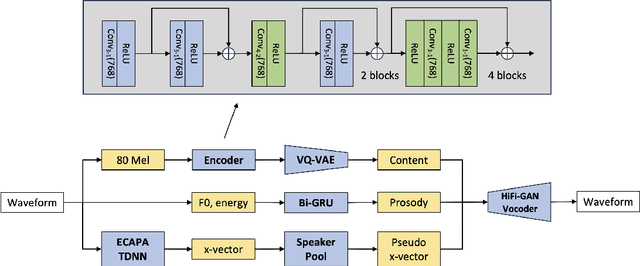


Human speech conveys prosody, linguistic content, and speaker identity. This article investigates a novel speaker anonymization approach using an end-to-end network based on a Vector-Quantized Variational Auto-Encoder (VQ-VAE) to deal with these speech components. This approach is designed to disentangle these components to specifically target and modify the speaker identity while preserving the linguistic and emotionalcontent. To do so, three separate branches compute embeddings for content, prosody, and speaker identity respectively. During synthesis, taking these embeddings, the decoder of the proposed architecture is conditioned on both speaker and prosody information, allowing for capturing more nuanced emotional states and precise adjustments to speaker identification. Findings indicate that this method outperforms most baseline techniques in preserving emotional information. However, it exhibits more limited performance on other voice privacy tasks, emphasizing the need for further improvements.
Multimodal Group Emotion Recognition In-the-wild Using Privacy-Compliant Features
Dec 06, 2023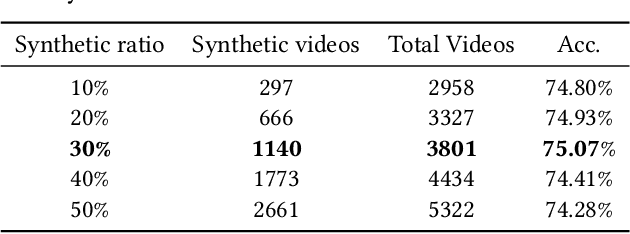
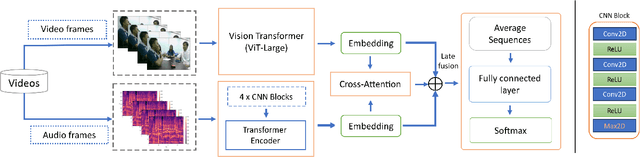
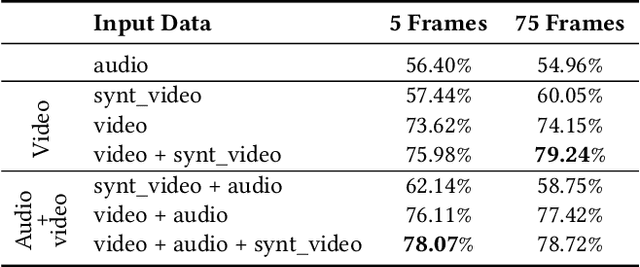
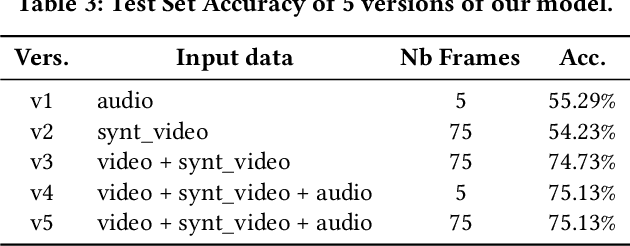
This paper explores privacy-compliant group-level emotion recognition ''in-the-wild'' within the EmotiW Challenge 2023. Group-level emotion recognition can be useful in many fields including social robotics, conversational agents, e-coaching and learning analytics. This research imposes itself using only global features avoiding individual ones, i.e. all features that can be used to identify or track people in videos (facial landmarks, body poses, audio diarization, etc.). The proposed multimodal model is composed of a video and an audio branches with a cross-attention between modalities. The video branch is based on a fine-tuned ViT architecture. The audio branch extracts Mel-spectrograms and feed them through CNN blocks into a transformer encoder. Our training paradigm includes a generated synthetic dataset to increase the sensitivity of our model on facial expression within the image in a data-driven way. The extensive experiments show the significance of our methodology. Our privacy-compliant proposal performs fairly on the EmotiW challenge, with 79.24% and 75.13% of accuracy respectively on validation and test set for the best models. Noticeably, our findings highlight that it is possible to reach this accuracy level with privacy-compliant features using only 5 frames uniformly distributed on the video.