 Add to Chrome
 Add to Firefox
 Add to Edge
hint$^2$: Hierarchical World Models for Inference-Time Temporal Logic Guidance
Aug 13, 2026
A central goal of robot learning is to enable robots to execute rich instructions specified at runtime. Large-scale language-conditioned policies have made substantial progress toward this goal, yet still struggle with temporal structure and safety constraints. Linear Temporal Logic (LTL) provides a powerful language to express complex, non-Markovian instructions. However, guiding learned manipulation policies toward LTL satisfaction remains challenging because modern policies generate short-horizon action chunks and replan in closed loop, while almost all LTL specifications are evaluated over long-horizon trajectories. In this paper, we introduce hint$^2$, a method for guiding short-horizon policies toward satisfying complex LTL specifications at inference time using hierarchical world models. Our key idea is to derive two separate guidance objectives using each world model's abstraction level. A high-level model predicts future action-induced transitions in task-relevant atomic propositions to guide progress through the LTL automaton, while a low-level dynamics model predicts immediate state evolution for accurate local safety guidance. Our results show that hint$^2$ overcomes the limitations of current LTL-guided diffusion methods, outperforms existing inference-time steering methods in CALVIN, and successfully completes instructions with complex liveness and safety constraints more elegantly than language-conditioned alternatives. Finally, we demonstrate that hint$^2$ can handle complex instructions on a real UR5e manipulator.

Temporal Logic Guidance for Action-Only Diffusion Policies with World Models
Jun 22, 2026Diffusion policies enable multimodal robot behavior but offer limited ability to choose among behavior modes at inference time, even though such control is desirable in human-robot settings. Prior solutions to this lack of control have utilized Signal Temporal Logic (STL) to express human intentions and provide corresponding guidance for diffusion policy inference. However, these approaches can only guide diffusion policies that jointly generate future actions and states, increasing both complexity and runtime. We propose a novel guidance method for action-only diffusion policies that uses a separate learned world model to enable differentiable evaluation of STL robustness, with its gradient then injected into the diffusion process. This steers behavior toward constraint satisfaction without retraining, improving constraint adherence while preserving task performance. On the Can Transport task from Robomimic, our method maintains 100% task success while reducing constraint violations from over 80% for baseline methods to 4%. We also discuss extensions toward improved robustness and more complex constraints.
Physics-informed Goal-Conditioned Reinforcement Learning under Hybrid Contact Dynamics
May 28, 2026Learning to reach arbitrary goals from sparse feedback requires agents to infer a rich notion of reachability across state--goal pairs. Goal-conditioned reinforcement learning (GCRL) tackles this challenge by learning policies that generalize across goals, but this generalization becomes increasingly difficult as the underlying dynamics become high-dimensional, hybrid, or contact-dependent. To address this issue, physics-informed GCRL (Pi-GCRL) introduces optimal-control-inspired inductive biases into goal-conditioned value learning. While Pi-GCRL methods have proven effective in navigation and object-free goal-reaching domains, their reliability in contact-rich tasks remains unclear, where contact interactions induce hybrid dynamics, mode-dependent controllability, and nonsmooth value landscapes. In this work, we show that these structural properties can cause existing Pi-GCRL methods to degrade when applied naively to contact-rich manipulation. Motivated by this analysis, we introduce contact-aware and hierarchical formulations that apply physics-informed inductive biases selectively across the manipulation problem. Our results provide a principled step toward extending Pi-GCRL to contact-rich manipulation.
Graph-of-Constraints Model Predictive Control for Reactive Multi-agent Task and Motion Planning
Mar 19, 2026Sequences of interdependent geometric constraints are central to many multi-agent Task and Motion Planning (TAMP) problems. However, existing methods for handling such constraint sequences struggle with partially ordered tasks and dynamic agent assignments. They typically assume static assignments and cannot adapt when disturbances alter task allocations. To overcome these limitations, we introduce Graph-of-Constraints Model Predictive Control (GoC-MPC), a generalized sequence-of-constraints framework integrated with MPC. GoC-MPC naturally supports partially ordered tasks, dynamic agent coordination, and disturbance recovery. By defining constraints over tracked 3D keypoints, our method robustly solves diverse multi-agent manipulation tasks-coordinating agents and adapting online from visual observations alone, without relying on training data or environment models. Experiments demonstrate that GoC-MPC achieves higher success rates, significantly faster TAMP computation, and shorter overall paths compared to recent baselines, establishing it as an efficient and robust solution for multi-agent manipulation under real-world disturbances. Our supplementary video and code can be found at https://sites.google.com/view/goc-mpc/home .
Automaton Constrained Q-Learning
Oct 06, 2025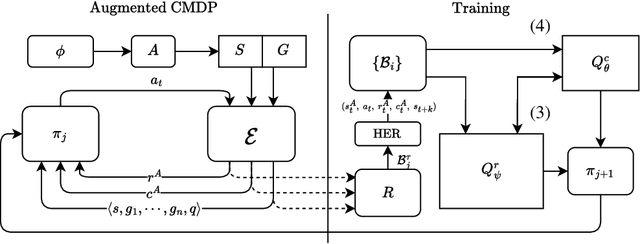
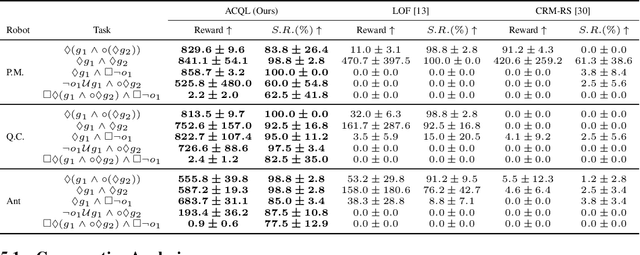
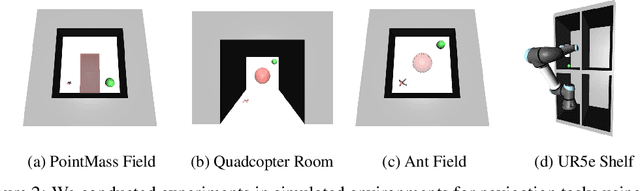
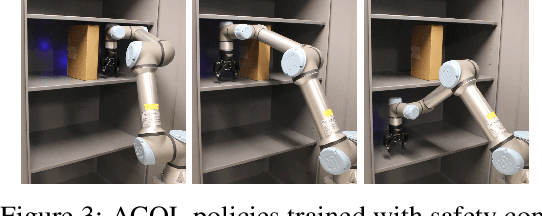
Real-world robotic tasks often require agents to achieve sequences of goals while respecting time-varying safety constraints. However, standard Reinforcement Learning (RL) paradigms are fundamentally limited in these settings. A natural approach to these problems is to combine RL with Linear-time Temporal Logic (LTL), a formal language for specifying complex, temporally extended tasks and safety constraints. Yet, existing RL methods for LTL objectives exhibit poor empirical performance in complex and continuous environments. As a result, no scalable methods support both temporally ordered goals and safety simultaneously, making them ill-suited for realistic robotics scenarios. We propose Automaton Constrained Q-Learning (ACQL), an algorithm that addresses this gap by combining goal-conditioned value learning with automaton-guided reinforcement. ACQL supports most LTL task specifications and leverages their automaton representation to explicitly encode stage-wise goal progression and both stationary and non-stationary safety constraints. We show that ACQL outperforms existing methods across a range of continuous control tasks, including cases where prior methods fail to satisfy either goal-reaching or safety constraints. We further validate its real-world applicability by deploying ACQL on a 6-DOF robotic arm performing a goal-reaching task in a cluttered, cabinet-like space with safety constraints. Our results demonstrate that ACQL is a robust and scalable solution for learning robotic behaviors according to rich temporal specifications.