 Add to Chrome
 Add to Firefox
 Add to Edge
Enhancing Debugging Skills with AI-Powered Assistance: A Real-Time Tool for Debugging Support
Jan 05, 2026
Debugging is a crucial skill in programming education and software development, yet it is often overlooked in CS curricula. To address this, we introduce an AI-powered debugging assistant integrated into an IDE. It offers real-time support by analyzing code, suggesting breakpoints, and providing contextual hints. Using RAG with LLMs, program slicing, and custom heuristics, it enhances efficiency by minimizing LLM calls and improving accuracy. A three-level evaluation - technical analysis, UX study, and classroom tests - highlights its potential for teaching debugging.

Understanding Student Interaction with AI-Powered Next-Step Hints: Strategies and Challenges
Nov 09, 2025Automated feedback generation plays a crucial role in enhancing personalized learning experiences in computer science education. Among different types of feedback, next-step hint feedback is particularly important, as it provides students with actionable steps to progress towards solving programming tasks. This study investigates how students interact with an AI-driven next-step hint system in an in-IDE learning environment. We gathered and analyzed a dataset from 34 students solving Kotlin tasks, containing detailed hint interaction logs. We applied process mining techniques and identified 16 common interaction scenarios. Semi-structured interviews with 6 students revealed strategies for managing unhelpful hints, such as adapting partial hints or modifying code to generate variations of the same hint. These findings, combined with our publicly available dataset, offer valuable opportunities for future research and provide key insights into student behavior, helping improve hint design for enhanced learning support.
One Step at a Time: Combining LLMs and Static Analysis to Generate Next-Step Hints for Programming Tasks
Oct 11, 2024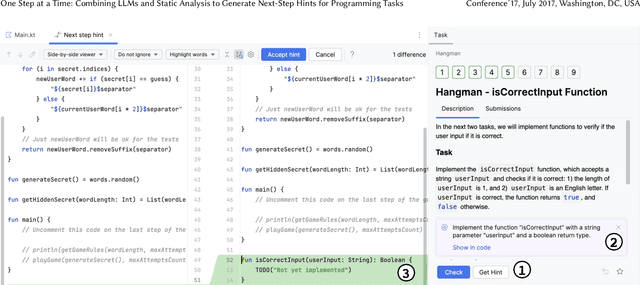
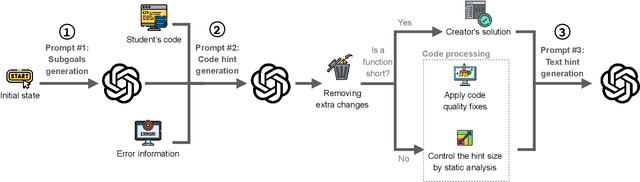
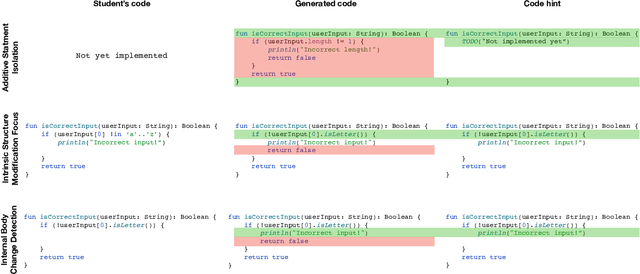
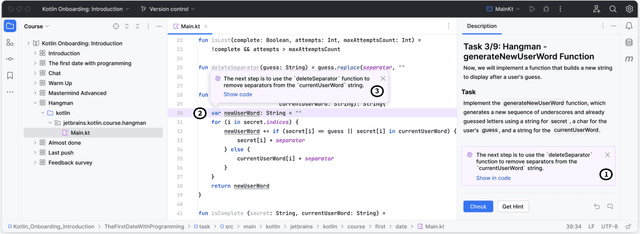
Students often struggle with solving programming problems when learning to code, especially when they have to do it online, with one of the most common disadvantages of working online being the lack of personalized help. This help can be provided as next-step hint generation, i.e., showing a student what specific small step they need to do next to get to the correct solution. There are many ways to generate such hints, with large language models (LLMs) being among the most actively studied right now. While LLMs constitute a promising technology for providing personalized help, combining them with other techniques, such as static analysis, can significantly improve the output quality. In this work, we utilize this idea and propose a novel system to provide both textual and code hints for programming tasks. The pipeline of the proposed approach uses a chain-of-thought prompting technique and consists of three distinct steps: (1) generating subgoals - a list of actions to proceed with the task from the current student's solution, (2) generating the code to achieve the next subgoal, and (3) generating the text to describe this needed action. During the second step, we apply static analysis to the generated code to control its size and quality. The tool is implemented as a modification to the open-source JetBrains Academy plugin, supporting students in their in-IDE courses. To evaluate our approach, we propose a list of criteria for all steps in our pipeline and conduct two rounds of expert validation. Finally, we evaluate the next-step hints in a classroom with 14 students from two universities. Our results show that both forms of the hints - textual and code - were helpful for the students, and the proposed system helped them to proceed with the coding tasks.