 Add to Chrome
 Add to Firefox
 Add to Edge
BONSAI: Evolvability-Guided Tree Search over Skills
Aug 07, 2026
A skill is a naturallanguage document that steers a frozen agent whose weights cannot be updated so any capability the agent lacks must be supplied in prose Optimising a skill is therefore optimising text against a score and the standard recipe which keeps any edit that raises a heldout score is blind in a specific way a single score cannot tell a document perched on a narrow overfit spike from one resting on a broad plateau even though only the second can still be improved We introduce BONSAI a novel skilloptimisation framework that steers instead by evolvability the capacity of a region of documentspace to keep producing viable variation under further mutation a property biology treats as separate from present fitness BONSAI grows skills as a MonteCarlo search tree in which every child document is a mutation of its parent and descends it under an upperconfidence selection rule whose exploitation term blends a skills own fitness with the fitness of its mutational neighbourhood Because every child is a mutation the mean score recorded beneath a node estimates that neighbourhoods evolvability at no extra cost so the rule concentrates budget on regions that keep improving while its exploration term keeps a currently weak branch in contention BONSAI ships the single bestscoring document it finds at no cost beyond the acceptifbetter loop it replaces With a frozen 30B agent and averaged over three benchmarks BONSAI lifts heldout accuracy over the skillfree agent by 2313 points and improves on two budgetmatched baselines GEPA and SkillOpt by 387 and 397 points respectively

LLM-Aided Customizable Profiling of Code Data Based On Programming Language Concepts
Mar 19, 2025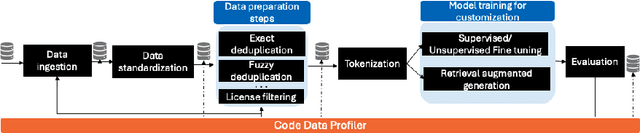
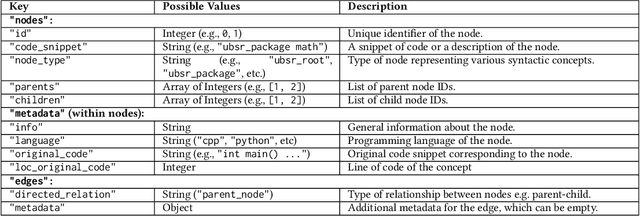
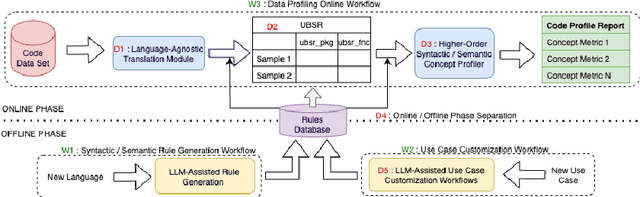

Data profiling is critical in machine learning for generating descriptive statistics, supporting both deeper understanding and downstream tasks like data valuation and curation. This work addresses profiling specifically in the context of code datasets for Large Language Models (code-LLMs), where data quality directly influences tasks such as code generation and summarization. Characterizing code datasets in terms of programming language concepts enables better insights and targeted data curation. Our proposed methodology decomposes code data profiling into two phases: (1) an offline phase where LLMs are leveraged to derive and learn rules for extracting syntactic and semantic concepts across various programming languages, including previously unseen or low-resource languages, and (2) an online deterministic phase applying these derived rules for efficient real-time analysis. This hybrid approach is customizable, extensible to new syntactic and semantic constructs, and scalable to multiple languages. Experimentally, our LLM-aided method achieves a mean accuracy of 90.33% for syntactic extraction rules and semantic classification accuracies averaging 80% and 77% across languages and semantic concepts, respectively.