 Add to Chrome
 Add to Firefox
 Add to Edge
Are Natural-Domain Foundation Models Effective for Accelerated Cardiac MRI Reconstruction?
Apr 24, 2026
The emergence of large-scale pretrained foundation models has transformed computer vision, enabling strong performance across diverse downstream tasks. However, their potential for physics-based inverse problems, such as accelerated cardiac MRI reconstruction, remains largely underexplored. In this work, we investigate whether natural-domain foundation models can serve as effective image priors for accelerated cardiac MRI reconstruction, and compare the performance obtained against domain-specific counterparts such as BiomedCLIP. We propose an unrolled reconstruction framework that incorporates pretrained, frozen visual encoders, such as CLIP, DINOv2, and BiomedCLIP, within each cascade to guide the reconstruction process. Through extensive experiments, we show that while task-specific state-of-the-art reconstruction models such as E2E-VarNet achieve superior performance in standard in-distribution settings, foundation-model-based approaches remain competitive. More importantly, in challenging cross-domain scenarios, where models are trained on cardiac MRI and evaluated on anatomically distinct knee and brain datasets--foundation models exhibit improved robustness, particularly under high acceleration factors and limited low-frequency sampling. We further observe that natural-image-pretrained models, such as CLIP, learn highly transferable structural representations, while domain-specific pretraining (BiomedCLIP) provides modest additional gains in more ill-posed regimes. Overall, our results suggest that pretrained foundation models offer a promising source of transferable priors, enabling improved robustness and generalization in accelerated MRI reconstruction.

Parameter-Free Bio-Inspired Channel Attention for Enhanced Cardiac MRI Reconstruction
May 29, 2025Attention is a fundamental component of the human visual recognition system. The inclusion of attention in a convolutional neural network amplifies relevant visual features and suppresses the less important ones. Integrating attention mechanisms into convolutional neural networks enhances model performance and interpretability. Spatial and channel attention mechanisms have shown significant advantages across many downstream tasks in medical imaging. While existing attention modules have proven to be effective, their design often lacks a robust theoretical underpinning. In this study, we address this gap by proposing a non-linear attention architecture for cardiac MRI reconstruction and hypothesize that insights from ecological principles can guide the development of effective and efficient attention mechanisms. Specifically, we investigate a non-linear ecological difference equation that describes single-species population growth to devise a parameter-free attention module surpassing current state-of-the-art parameter-free methods.
Accelerating Cardiac MRI Reconstruction with CMRatt: An Attention-Driven Approach
Apr 10, 2024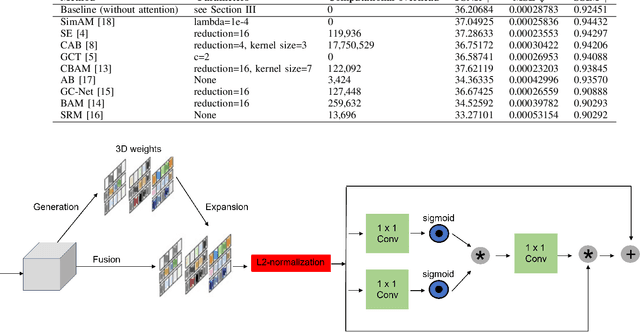
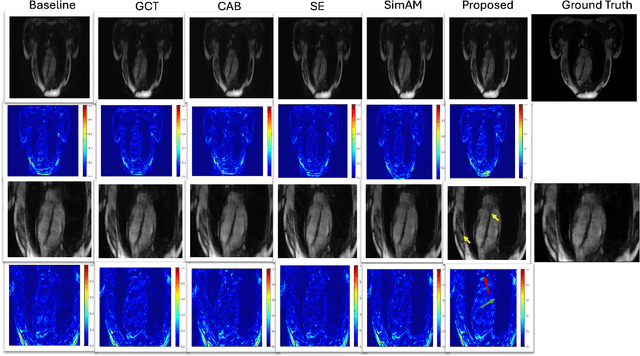
Cine cardiac magnetic resonance (CMR) imaging is recognised as the benchmark modality for the comprehensive assessment of cardiac function. Nevertheless, the acquisition process of cine CMR is considered as an impediment due to its prolonged scanning time. One commonly used strategy to expedite the acquisition process is through k-space undersampling, though it comes with a drawback of introducing aliasing effects in the reconstructed image. Lately, deep learning-based methods have shown remarkable results over traditional approaches in rapidly achieving precise CMR reconstructed images. This study aims to explore the untapped potential of attention mechanisms incorporated with a deep learning model within the context of the CMR reconstruction problem. We are motivated by the fact that attention has proven beneficial in downstream tasks such as image classification and segmentation, but has not been systematically analysed in the context of CMR reconstruction. Our primary goal is to identify the strengths and potential limitations of attention algorithms when integrated with a convolutional backbone model such as a U-Net. To achieve this, we benchmark different state-of-the-art spatial and channel attention mechanisms on the CMRxRecon dataset and quantitatively evaluate the quality of reconstruction using objective metrics. Furthermore, inspired by the best performing attention mechanism, we propose a new, simple yet effective, attention pipeline specifically optimised for the task of cardiac image reconstruction that outperforms other state-of-the-art attention methods. The layer and model code will be made publicly available.