 Add to Chrome
 Add to Firefox
 Add to Edge
Explainable Admission-Level Predictive Modeling for Prolonged Hospital Stay in Elderly Populations: Challenges in Low- and Middle-Income Countries
Jan 07, 2026
Prolonged length of stay (pLoS) is a significant factor associated with the risk of adverse in-hospital events. We develop and explain a predictive model for pLos using admission-level patient and hospital administrative data. The approach includes a feature selection method by selecting non-correlated features with the highest information value. The method uses features weights of evidence to select a representative within cliques from graph theory. The prognosis study analyzed the records from 120,354 hospital admissions at the Hospital Alma Mater de Antioquia between January 2017 and March 2022. After a cleaning process the dataset was split into training (67%), test (22%), and validation (11%) cohorts. A logistic regression model was trained to predict the pLoS in two classes: less than or greater than 7 days. The performance of the model was evaluated using accuracy, precision, sensitivity, specificity, and AUC-ROC metrics. The feature selection method returns nine interpretable variables, enhancing the models' transparency. In the validation cohort, the pLoS model achieved a specificity of 0.83 (95% CI, 0.82-0.84), sensitivity of 0.64 (95% CI, 0.62-0.65), accuracy of 0.76 (95% CI, 0.76-0.77), precision of 0.67 (95% CI, 0.66-0.69), and AUC-ROC of 0.82 (95% CI, 0.81-0.83). The model exhibits strong predictive performance and offers insights into the factors that influence prolonged hospital stays. This makes it a valuable tool for hospital management and for developing future intervention studies aimed at reducing pLoS.

Selecting Interpretability Techniques for Healthcare Machine Learning models
Jun 14, 2024In healthcare there is a pursuit for employing interpretable algorithms to assist healthcare professionals in several decision scenarios. Following the Predictive, Descriptive and Relevant (PDR) framework, the definition of interpretable machine learning as a machine-learning model that explicitly and in a simple frame determines relationships either contained in data or learned by the model that are relevant for its functioning and the categorization of models by post-hoc, acquiring interpretability after training, or model-based, being intrinsically embedded in the algorithm design. We overview a selection of eight algorithms, both post-hoc and model-based, that can be used for such purposes.
Active learning of Boltzmann samplers and potential energies with quantum mechanical accuracy
Jan 29, 2024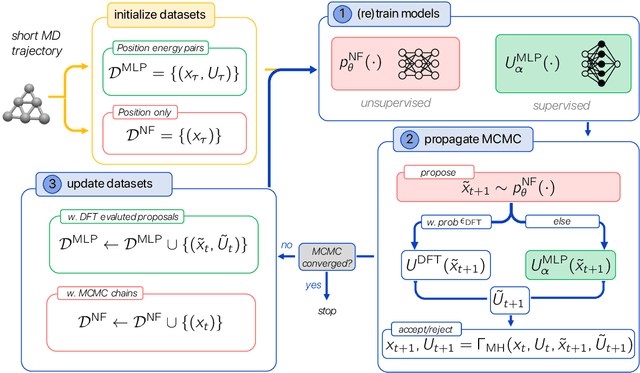
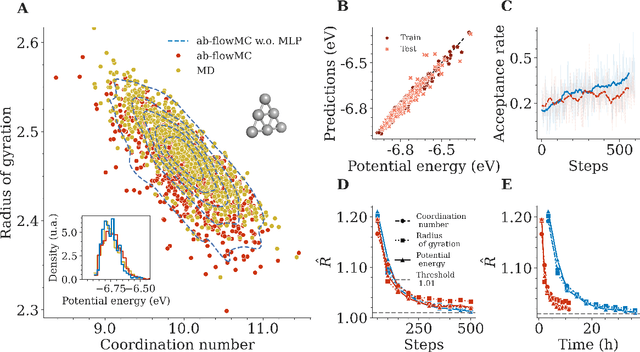
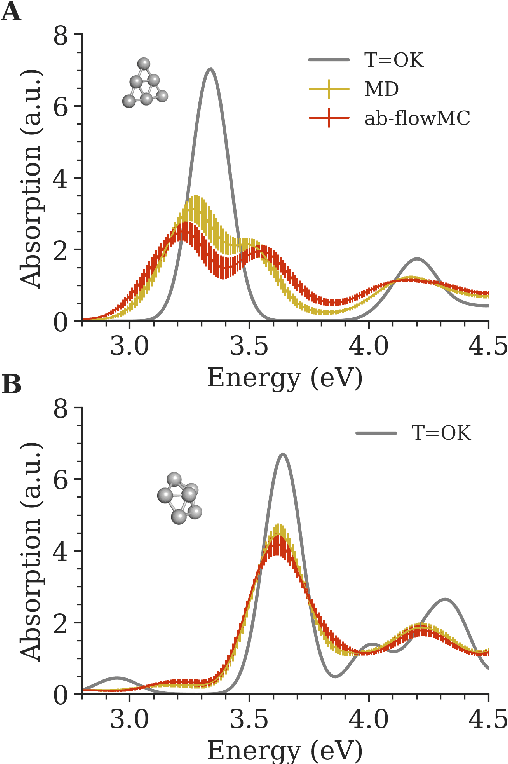
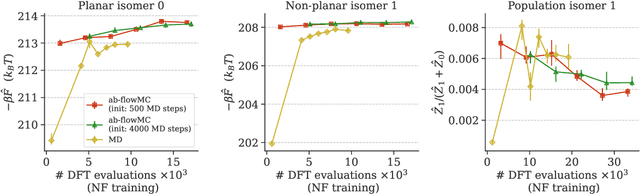
Extracting consistent statistics between relevant free-energy minima of a molecular system is essential for physics, chemistry and biology. Molecular dynamics (MD) simulations can aid in this task but are computationally expensive, especially for systems that require quantum accuracy. To overcome this challenge, we develop an approach combining enhanced sampling with deep generative models and active learning of a machine learning potential (MLP). We introduce an adaptive Markov chain Monte Carlo framework that enables the training of one Normalizing Flow (NF) and one MLP per state. We simulate several Markov chains in parallel until they reach convergence, sampling the Boltzmann distribution with an efficient use of energy evaluations. At each iteration, we compute the energy of a subset of the NF-generated configurations using Density Functional Theory (DFT), we predict the remaining configuration's energy with the MLP and actively train the MLP using the DFT-computed energies. Leveraging the trained NF and MLP models, we can compute thermodynamic observables such as free-energy differences or optical spectra. We apply this method to study the isomerization of an ultrasmall silver nanocluster, belonging to a set of systems with diverse applications in the fields of medicine and catalysis.