 Add to Chrome
 Add to Firefox
 Add to Edge
Assessing Privacy Preservation and Utility in Online Vision-Language Models
Apr 06, 2026
The increasing use of Online Vision Language Models (OVLMs) for processing images has introduced significant privacy risks, as individuals frequently upload images for various utilities, unaware of the potential for privacy violations. Images contain relationships that relate to Personally Identifiable Information (PII), where even seemingly harmless details can indirectly reveal sensitive information through surrounding clues. This paper explores the critical issue of PII disclosure in images uploaded to OVLMs and its implications for user privacy. We investigate how the extraction of contextual relationships from images can lead to direct (explicit) or indirect (implicit) exposure of PII, significantly compromising personal privacy. Furthermore, we propose methods to protect privacy while preserving the intended utility of the images in Vision Language Model (VLM)-based applications. Our evaluation demonstrates the efficacy of these techniques, highlighting the delicate balance between maintaining utility and protecting privacy in online image processing environments. Index Terms-Personally Identifiable Information (PII), Privacy, Utility, privacy concerns, sensitive information

Graph Pooling via Ricci Flow
Jul 05, 2024
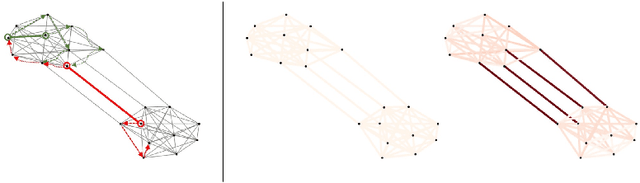

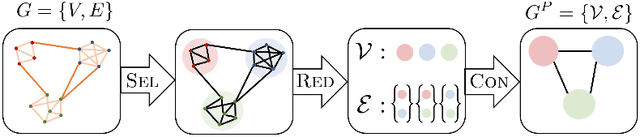
Graph Machine Learning often involves the clustering of nodes based on similarity structure encoded in the graph's topology and the nodes' attributes. On homophilous graphs, the integration of pooling layers has been shown to enhance the performance of Graph Neural Networks by accounting for inherent multi-scale structure. Here, similar nodes are grouped together to coarsen the graph and reduce the input size in subsequent layers in deeper architectures. In both settings, the underlying clustering approach can be implemented via graph pooling operators, which often rely on classical tools from Graph Theory. In this work, we introduce a graph pooling operator (ORC-Pool), which utilizes a characterization of the graph's geometry via Ollivier's discrete Ricci curvature and an associated geometric flow. Previous Ricci flow based clustering approaches have shown great promise across several domains, but are by construction unable to account for similarity structure encoded in the node attributes. However, in many ML applications, such information is vital for downstream tasks. ORC-Pool extends such clustering approaches to attributed graphs, allowing for the integration of geometric coarsening into Graph Neural Networks as a pooling layer.