 Add to Chrome
 Add to Firefox
 Add to Edge
Evaluating SAP RPT-1 for Enterprise Business Process Prediction: In-Context Learning vs. Traditional Machine Learning on Structured SAP Data
Feb 22, 2026
Tabular foundation models aim to make machine learning accessible for enterprise data without task-specific training. This paper presents the first independent evaluation of SAP's Retrieval Pretrained Transformer (RPT-1) from a practitioner perspective. RPT-1 is a compact 64.6 MB model pretrained on 1.34 TB of structured data across 3.1 million tables. We benchmark it against tuned gradient-boosted decision trees (XGBoost, LightGBM, CatBoost) on three SAP business scenarios: demand forecasting across SD/MM/PP modules, predictive data integrity in BC/MM/QM, and financial risk classification in FI/CO/AR. Across five-fold cross-validation on datasets ranging from 2,500 to 3,200 rows, RPT-1 reaches 91-96% of tuned GBDT accuracy without any training examples. The classification gap is modest at 3.6-4.1 percentage points on AUC-ROC, though regression tasks show wider gaps of 8.9-11.1 percentage points on R-squared. An interesting finding is a crossover at roughly 75-100 context rows where RPT-1 actually outperforms XGBoost under limited data. Based on these results, we propose a practical hybrid workflow: use RPT-1 for rapid screening, then train GBDT selectively where prediction accuracy justifies the effort. All experiments are reproducible through publicly available Hugging Face Spaces.

Kilovolt Pyroelectric Voltage Generation and Electrostatic Actuation With Fluidic Heating
Nov 04, 2024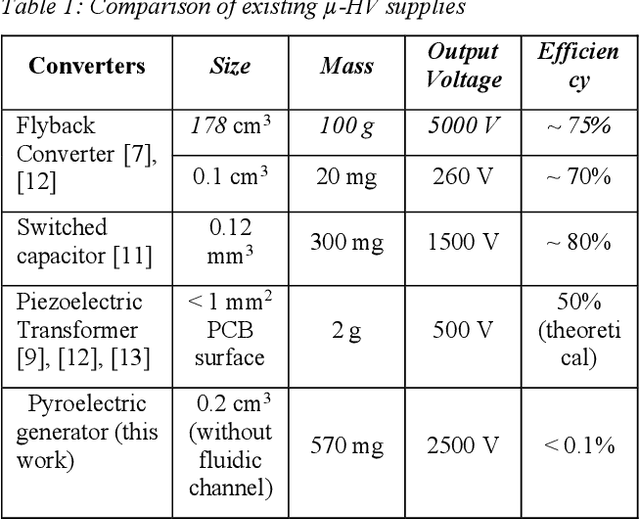
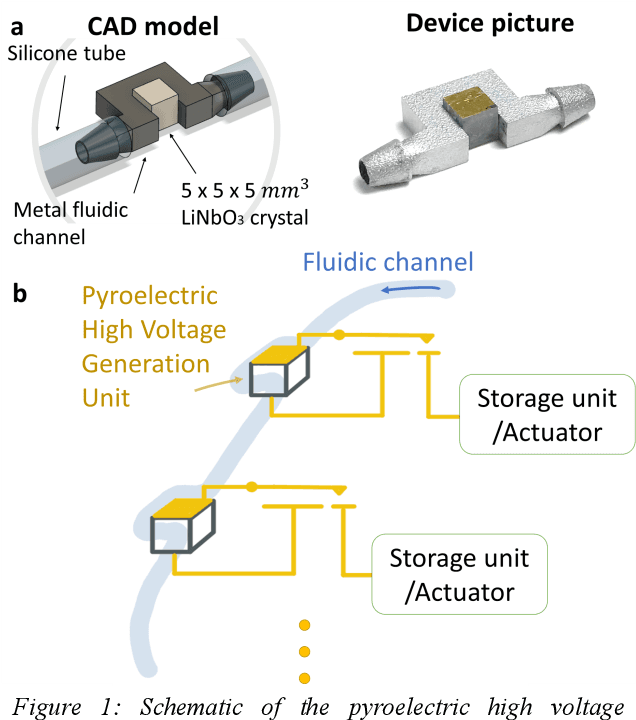
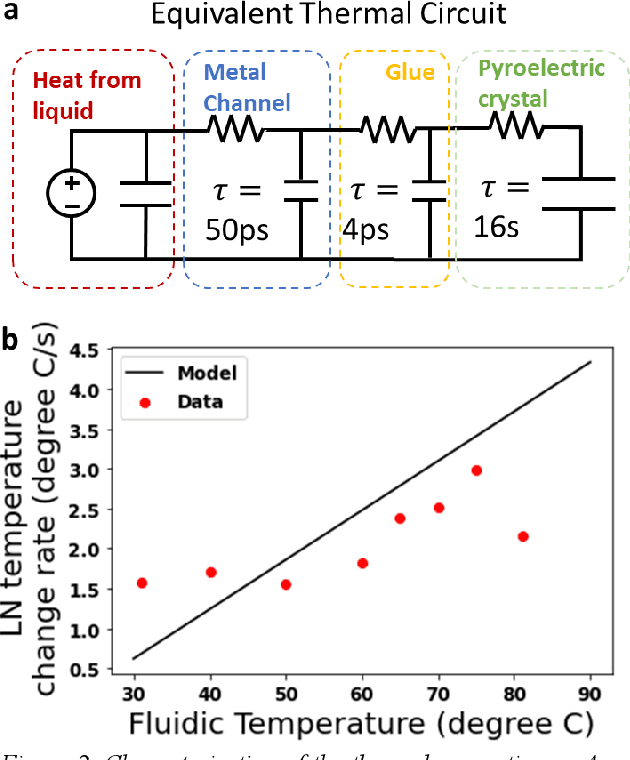
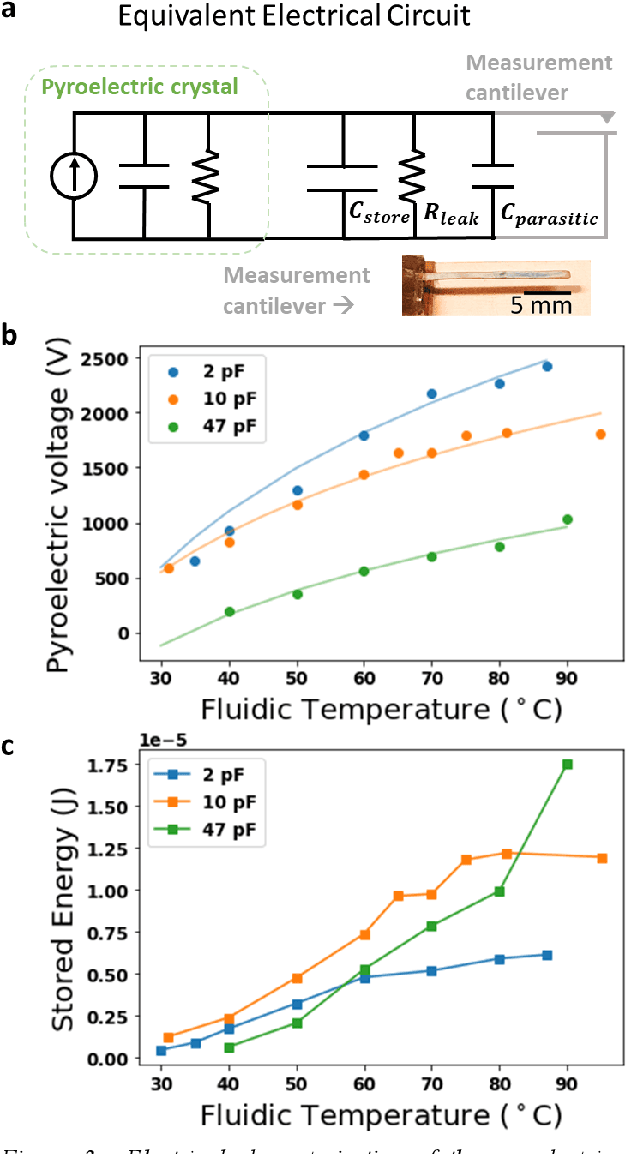
Integrated micro power generators are crucial components for micro robotic platforms to demonstrate untethered operation and to achieve autonomy. Current micro robotic electrostatic actuators typically require hundreds to thousands of voltages to output sufficient work. Pyroelectricity is one such source of high voltages that can be scaled to small form factors. This paper demonstrates a distributed pyroelectric high voltage generation mechanism to power kV actuators using alternating exposure of crystals to hot and cold water (300C to 900C water temperature). Using this fluidic temperature control, a pyroelectrically generated voltage of 2470 V was delivered to a 2 pF storage capacitor yielding a 6.10 {\mu}J stored energy. A maximum energy of 17.46 {\mu}J was delivered to a 47 pF capacitor at 861 V. The recirculating water can be used to heat a distributed array of converters to generate electricity in distant robotic actuator sections. The development of this distributed system would enable untethered micro-robot to be operated with a flexible body and free of battery recharging, which advances its applications in the real world.
Structured illumination microscopy image reconstruction algorithm
Feb 19, 2016
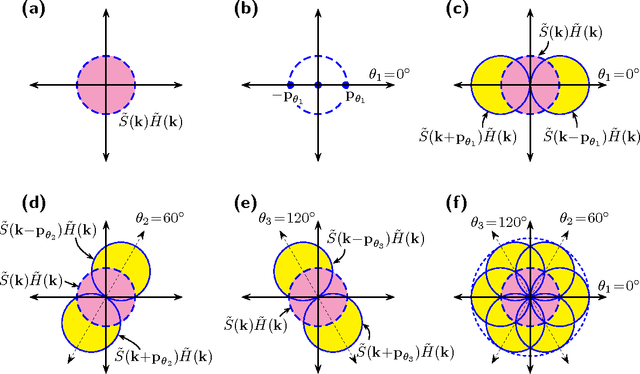
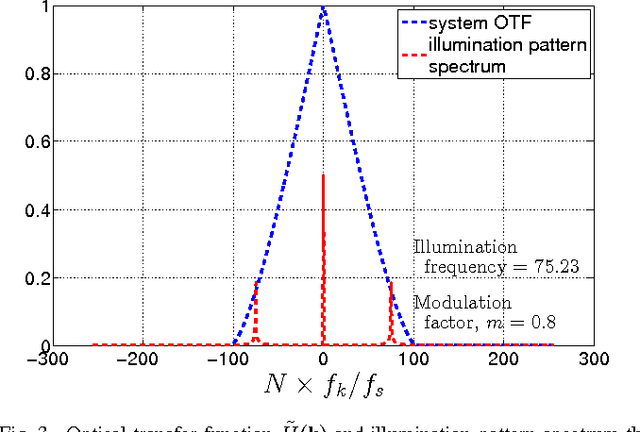
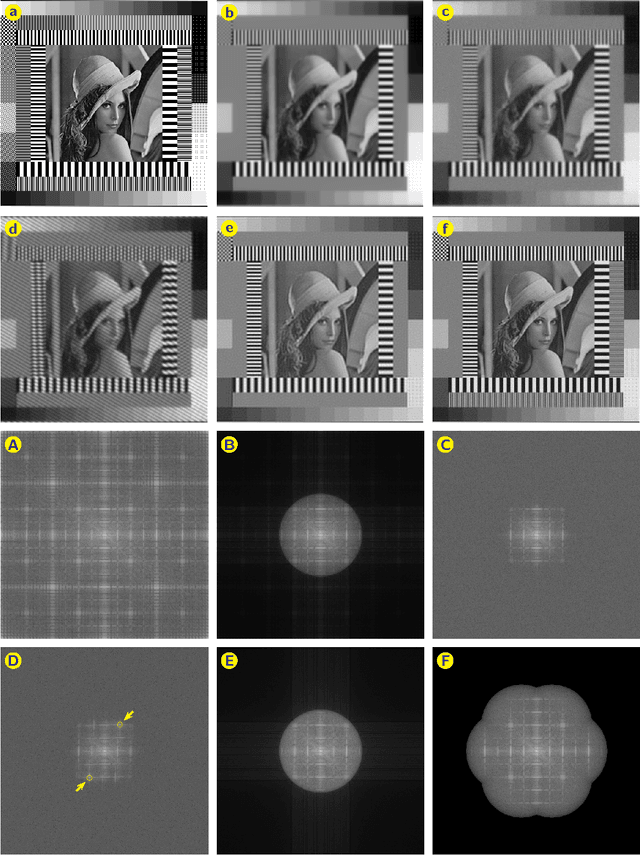
Structured illumination microscopy (SIM) is a very important super-resolution microscopy technique, which provides high speed super-resolution with about two-fold spatial resolution enhancement. Several attempts aimed at improving the performance of SIM reconstruction algorithm have been reported. However, most of these highlight only one specific aspect of the SIM reconstruction -- such as the determination of the illumination pattern phase shift accurately -- whereas other key elements -- such as determination of modulation factor, estimation of object power spectrum, Wiener filtering frequency components with inclusion of object power spectrum information, translocating and the merging of the overlapping frequency components -- are usually glossed over superficially. In addition, most of the work reported lie scattered throughout the literature and a comprehensive review of the theoretical background is found lacking. The purpose of the present work is two-fold: 1) to collect the essential theoretical details of SIM algorithm at one place, thereby making them readily accessible to readers for the first time; and 2) to provide an open source SIM reconstruction code (named OpenSIM), which enables users to interactively vary the code parameters and study it's effect on reconstructed SIM image.