 Add to Chrome
 Add to Firefox
 Add to Edge
Escaping Offline Pessimism: Vector-Field Reward Shaping for Safe Frontier Exploration
Mar 18, 2026
While offline reinforcement learning provides reliable policies for real-world deployment, its inherent pessimism severely restricts an agent's ability to explore and collect novel data online. Drawing inspiration from safe reinforcement learning, exploring near the boundary of regions well covered by the offline dataset and reliably modeled by the simulator allows an agent to take manageable risks--venturing into informative but moderate-uncertainty states while remaining close enough to familiar regions for safe recovery. However, naively rewarding this boundary-seeking behavior can lead to a degenerate parking behavior, where the agent simply stops once it reaches the frontier. To solve this, we propose a novel vector-field reward shaping paradigm designed to induce continuous, safe boundary exploration for non-adaptive deployed policies. Operating on an uncertainty oracle trained from offline data, our reward combines two complementary components: a gradient-alignment term that attracts the agent toward a target uncertainty level, and a rotational-flow term that promotes motion along the local tangent plane of the uncertainty manifold. Through theoretical analysis, we show that this reward structure naturally induces sustained exploratory behavior along the boundary while preventing degenerate solutions. Empirically, by integrating our proposed reward shaping with Soft Actor-Critic on a 2D continuous navigation task, we validate that agents successfully traverse uncertainty boundaries while balancing safe, informative data collection with primary task completion.

Provably Efficient RL for Linear MDPs under Instantaneous Safety Constraints in Non-Convex Feature Spaces
Feb 25, 2025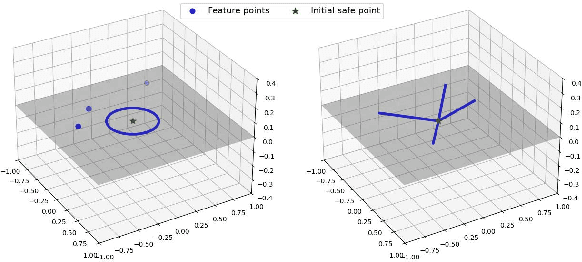
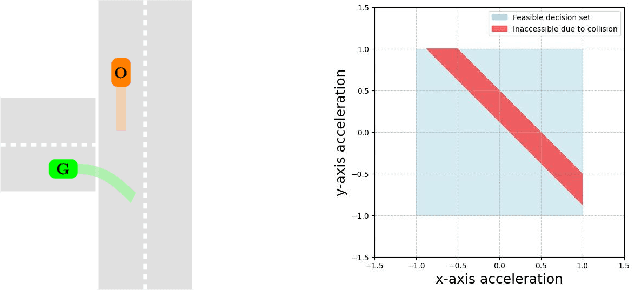
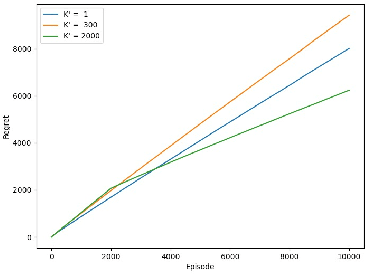
In Reinforcement Learning (RL), tasks with instantaneous hard constraints present significant challenges, particularly when the decision space is non-convex or non-star-convex. This issue is especially relevant in domains like autonomous vehicles and robotics, where constraints such as collision avoidance often take a non-convex form. In this paper, we establish a regret bound of $\tilde{\mathcal{O}}\bigl(\bigl(1 + \tfrac{1}{\tau}\bigr) \sqrt{\log(\tfrac{1}{\tau}) d^3 H^4 K} \bigr)$, applicable to both star-convex and non-star-convex cases, where $d$ is the feature dimension, $H$ the episode length, $K$ the number of episodes, and $\tau$ the safety threshold. Moreover, the violation of safety constraints is zero with high probability throughout the learning process. A key technical challenge in these settings is bounding the covering number of the value-function class, which is essential for achieving value-aware uniform concentration in model-free function approximation. For the star-convex setting, we develop a novel technique called Objective Constraint-Decomposition (OCD) to properly bound the covering number. This result also resolves an error in a previous work on constrained RL. In non-star-convex scenarios, where the covering number can become infinitely large, we propose a two-phase algorithm, Non-Convex Safe Least Squares Value Iteration (NCS-LSVI), which first reduces uncertainty about the safe set by playing a known safe policy. After that, it carefully balances exploration and exploitation to achieve the regret bound. Finally, numerical simulations on an autonomous driving scenario demonstrate the effectiveness of NCS-LSVI.