 Add to Chrome
 Add to Firefox
 Add to Edge
Evidence-Grounded Subspecialty Reasoning: Evaluating a Curated Clinical Intelligence Layer on the 2025 Endocrinology Board-Style Examination
Feb 17, 2026
Background: Large language models have demonstrated strong performance on general medical examinations, but subspecialty clinical reasoning remains challenging due to rapidly evolving guidelines and nuanced evidence hierarchies. Methods: We evaluated January Mirror, an evidence-grounded clinical reasoning system, against frontier LLMs (GPT-5, GPT-5.2, Gemini-3-Pro) on a 120-question endocrinology board-style examination. Mirror integrates a curated endocrinology and cardiometabolic evidence corpus with a structured reasoning architecture to generate evidence-linked outputs. Mirror operated under a closed-evidence constraint without external retrieval. Comparator LLMs had real-time web access to guidelines and primary literature. Results: Mirror achieved 87.5% accuracy (105/120; 95% CI: 80.4-92.3%), exceeding a human reference of 62.3% and frontier LLMs including GPT-5.2 (74.6%), GPT-5 (74.0%), and Gemini-3-Pro (69.8%). On the 30 most difficult questions (human accuracy less than 50%), Mirror achieved 76.7% accuracy. Top-2 accuracy was 92.5% for Mirror versus 85.25% for GPT-5.2. Conclusions: Mirror provided evidence traceability: 74.2% of outputs cited at least one guideline-tier source, with 100% citation accuracy on manual verification. Curated evidence with explicit provenance can outperform unconstrained web retrieval for subspecialty clinical reasoning and supports auditability for clinical deployment.

January Food Benchmark (JFB): A Public Benchmark Dataset and Evaluation Suite for Multimodal Food Analysis
Aug 13, 2025
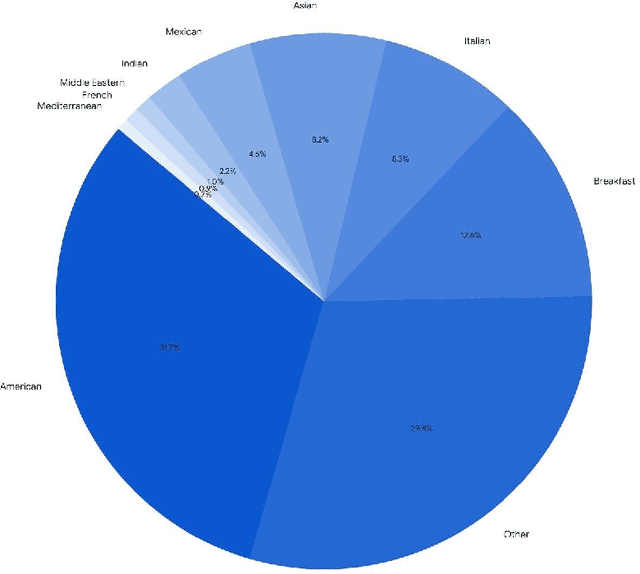
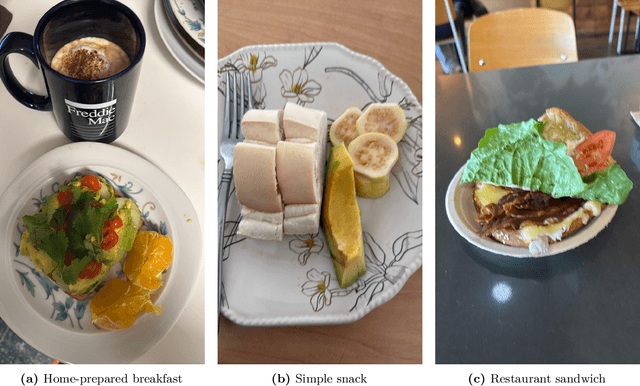
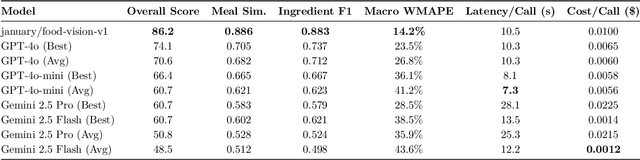
Progress in AI for automated nutritional analysis is critically hampered by the lack of standardized evaluation methodologies and high-quality, real-world benchmark datasets. To address this, we introduce three primary contributions. First, we present the January Food Benchmark (JFB), a publicly available collection of 1,000 food images with human-validated annotations. Second, we detail a comprehensive benchmarking framework, including robust metrics and a novel, application-oriented overall score designed to assess model performance holistically. Third, we provide baseline results from both general-purpose Vision-Language Models (VLMs) and our own specialized model, january/food-vision-v1. Our evaluation demonstrates that the specialized model achieves an Overall Score of 86.2, a 12.1-point improvement over the best-performing general-purpose configuration. This work offers the research community a valuable new evaluation dataset and a rigorous framework to guide and benchmark future developments in automated nutritional analysis.