 Add to Chrome
 Add to Firefox
 Add to Edge
GenAI-Driven Threat Detection with Microsoft Security Copilot
May 20, 2026
Defending against today's increasingly sophisticated cyberattacks requires security analysts to continuously translate evolving attacker tradecraft into detection logic. This places defenders in a reactive posture, requiring constantly updated expertise across an increasingly fragmented security landscape. We introduce the Dynamic Threat Detection Agent (DTDA), an always-on adaptive agent that continuously investigates security incidents across Microsoft Defender to uncover hidden threats and generate explainable detections when attack-story gaps are found. DTDA combines: (1) a unified activity timeline spanning alerts, events, user and entity behavior analytics, and threat intelligence; (2) versioned LLM prompt contracts with schema validation, grounding requirements, bounded retries, and fail-closed suppression; (3) a planner-executor investigation loop that generates attack-specific hypotheses and gathers supporting and refuting evidence; and (4) dynamic alert generation with a context-relevant title, severity, MITRE mappings, remediation guidance, implicated entities, and natural-language attack description. Integrated into Microsoft Security Copilot and deployed across tens of thousands of Defender customers, DTDA operates continuously at industry scale. In a 120-day online evaluation, DTDA achieves 80.1% precision from customer feedback while generating novel alerts for approximately 15% of investigated incidents. In offline evaluation, DTDA recovers hidden malicious activity with 0.78 F1 using GPT-5.4, improving over GPT-4.1 by 0.12 F1 and outperforming the baseline by 0.26 F1 points. Operationally, DTDA processes single-incident investigations end-to-end in a median of 28 minutes at a median token cost of USD 2.04, with a 0.38% job-level failure rate. These results demonstrate that autonomous agents can identify missed malicious activity at a production scale.

Web Scale Graph Mining for Cyber Threat Intelligence
Nov 09, 2024


Defending against today's increasingly sophisticated and large-scale cyberattacks demands accurate, real-time threat intelligence. Traditional approaches struggle to scale, integrate diverse telemetry, and adapt to a constantly evolving security landscape. We introduce Threat Intelligence Tracking via Adaptive Networks (TITAN), an industry-scale graph mining framework that generates cyber threat intelligence at unprecedented speed and scale. TITAN introduces a suite of innovations specifically designed to address the complexities of the modern security landscape, including: (1) a dynamic threat intelligence graph that maps the intricate relationships between millions of entities, incidents, and organizations; (2) real-time update mechanisms that automatically decay and prune outdated intel; (3) integration of security domain knowledge to bootstrap initial reputation scores; and (4) reputation propagation algorithms that uncover hidden threat actor infrastructure. Integrated into Microsoft Unified Security Operations Platform (USOP), which is deployed across hundreds of thousands of organizations worldwide, TITAN's threat intelligence powers key detection and disruption capabilities. With an impressive average macro-F1 score of 0.89 and a precision-recall AUC of 0.94, TITAN identifies millions of high-risk entities each week, enabling a 6x increase in non-file threat intelligence. Since its deployment, TITAN has increased the product's incident disruption rate by a remarkable 21%, while reducing the time to disrupt by a factor of 1.9x, and maintaining 99% precision, as confirmed by customer feedback and thorough manual evaluation by security experts--ultimately saving customers from costly security breaches.
AI-Driven Guided Response for Security Operation Centers with Microsoft Copilot for Security
Jul 12, 2024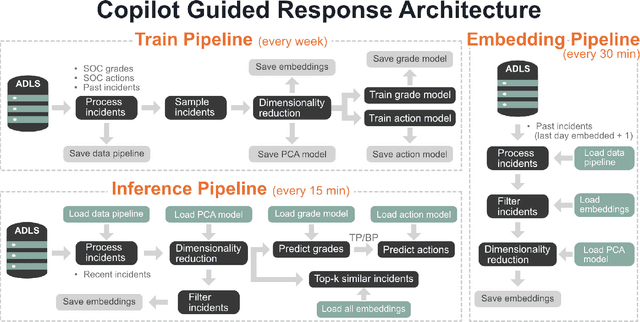
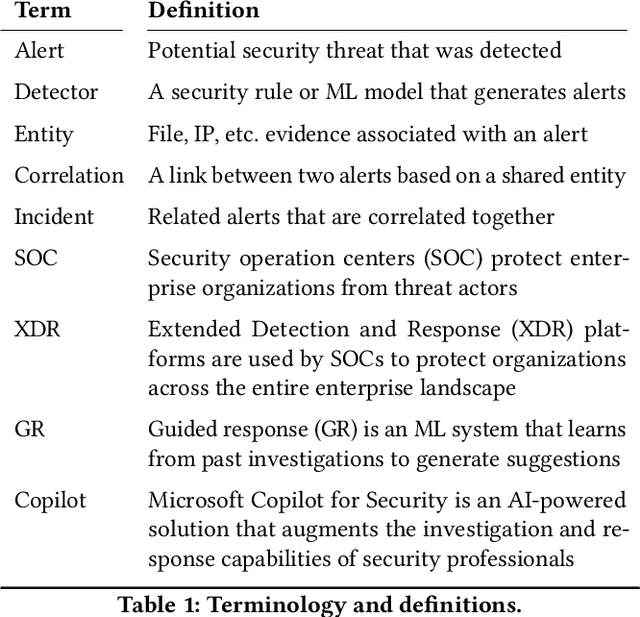


Security operation centers contend with a constant stream of security incidents, ranging from straightforward to highly complex. To address this, we developed Copilot Guided Response (CGR), an industry-scale ML architecture that guides security analysts across three key tasks -- (1) investigation, providing essential historical context by identifying similar incidents; (2) triaging to ascertain the nature of the incident -- whether it is a true positive, false positive, or benign positive; and (3) remediation, recommending tailored containment actions. CGR is integrated into the Microsoft Defender XDR product and deployed worldwide, generating millions of recommendations across thousands of customers. Our extensive evaluation, incorporating internal evaluation, collaboration with security experts, and customer feedback, demonstrates that CGR delivers high-quality recommendations across all three tasks. We provide a comprehensive overview of the CGR architecture, setting a precedent as the first cybersecurity company to openly discuss these capabilities in such depth. Additionally, we GUIDE, the largest public collection of real-world security incidents, spanning 13M evidences across 1M annotated incidents. By enabling researchers and practitioners to conduct research on real-world data, GUIDE advances the state of cybersecurity and supports the development of next-generation machine learning systems.