 Add to Chrome
 Add to Firefox
 Add to Edge
Implicit vs. Explicit Prompting Strategies for LVLMs in Referential Communication
Jun 17, 2026
Two recent studies (Jones et al. (2026); Zeng et al. (2026)) reach apparently contradictory conclusions about whether LVLMs can coordinate on efficient referring expressions. We control for task differences between the studies while directly comparing their prompting styles. We replicate the finding that models can coordinate efficient referring expressions when explicitly prompted to do so, suggesting that other task differences are not responsible for divergent results. However, we also find that the same models fail to infer the need for communicative efficiency from a more implicit prompt, highlighting critical differences between how humans and AI systems communicate.

Training LLMs to Recognize Hedges in Spontaneous Narratives
Aug 06, 2024
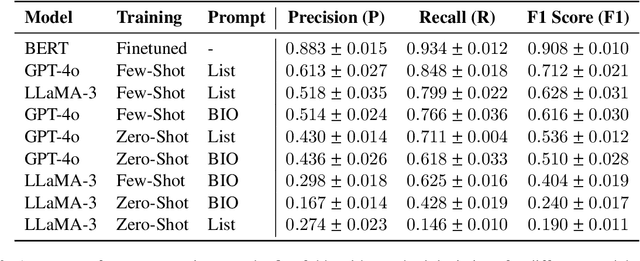
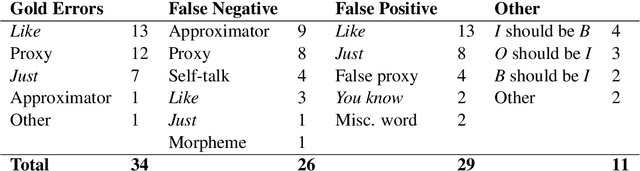
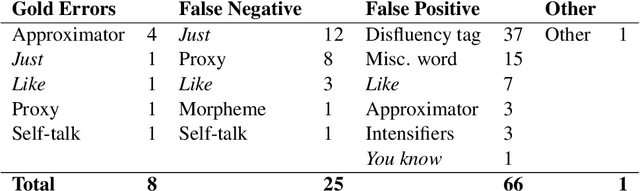
Hedges allow speakers to mark utterances as provisional, whether to signal non-prototypicality or "fuzziness", to indicate a lack of commitment to an utterance, to attribute responsibility for a statement to someone else, to invite input from a partner, or to soften critical feedback in the service of face-management needs. Here we focus on hedges in an experimentally parameterized corpus of 63 Roadrunner cartoon narratives spontaneously produced from memory by 21 speakers for co-present addressees, transcribed to text (Galati and Brennan, 2010). We created a gold standard of hedges annotated by human coders (the Roadrunner-Hedge corpus) and compared three LLM-based approaches for hedge detection: fine-tuning BERT, and zero and few-shot prompting with GPT-4o and LLaMA-3. The best-performing approach was a fine-tuned BERT model, followed by few-shot GPT-4o. After an error analysis on the top performing approaches, we used an LLM-in-the-Loop approach to improve the gold standard coding, as well as to highlight cases in which hedges are ambiguous in linguistically interesting ways that will guide future research. This is the first step in our research program to train LLMs to interpret and generate collateral signals appropriately and meaningfully in conversation.
* Amie Paige, Adil Soubki, and John Murzaku contributed equally to this study