 Add to Chrome
 Add to Firefox
 Add to Edge
Intelligent Road Condition Monitoring using 3D In-Air SONAR Sensing
Mar 30, 2026
In this paper, we investigate the capabilities of in-air 3D SONAR sensors for the monitoring of road surface conditions. Concretely, we consider two applications: Road material classification and Road damage detection and classification. While such tasks can be performed with other sensor modalities, such as camera sensors and LiDAR sensors, these sensor modalities tend to fail in harsh sensing conditions, such as heavy rain, smoke or fog. By using a sensing modality that is robust to such interference, we enable the creation of opportunistic sensing applications, where vehicles performing other tasks (garbage collection, mail delivery, etc.) can also be used to monitor the condition of the road. For these tasks, we use a single dataset, in which different types of damages are annotated, with labels including the material of the road surface. In the material classification task, we differentiate between three different road materials: Asphalt, Concrete and Element roads. In the damage detection and classification task, we determine if there is damage, and what type of damage (independent of material type), without localizing the damage. We are succesful in determining the road surface type from SONAR sensor data, with F1 scores approaching 90% on the test set, but find that for the detection of damages performace lags, with F1 score around 75%. From this, we conclude that SONAR sensing is a promising modality to include in opportunistic sensing-based pavement management systems, but that further research is needed to reach the desired accuracy.

Task Adaptation of Reinforcement Learning-based NAS Agents through Transfer Learning
Dec 02, 2024Recently, a novel paradigm has been proposed for reinforcement learning-based NAS agents, that revolves around the incremental improvement of a given architecture. We assess the abilities of such reinforcement learning agents to transfer between different tasks. We perform our evaluation using the Trans-NASBench-101 benchmark, and consider the efficacy of the transferred agents, as well as how quickly they can be trained. We find that pretraining an agent on one task benefits the performance of the agent in another task in all but 1 task when considering final performance. We also show that the training procedure for an agent can be shortened significantly by pretraining it on another task. Our results indicate that these effects occur regardless of the source or target task, although they are more pronounced for some tasks than for others. Our results show that transfer learning can be an effective tool in mitigating the computational cost of the initial training procedure for reinforcement learning-based NAS agents.
Designing a Classifier for Active Fire Detection from Multispectral Satellite Imagery Using Neural Architecture Search
Oct 07, 2024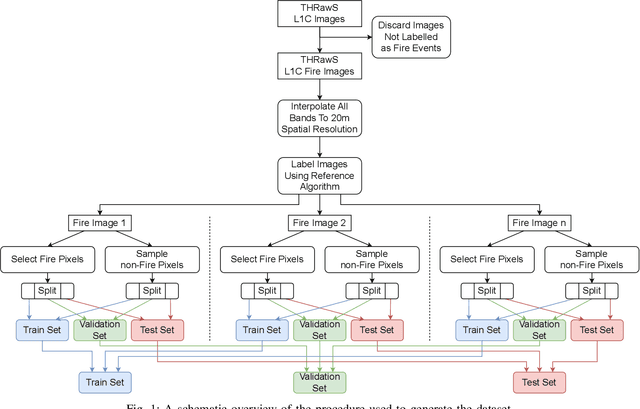
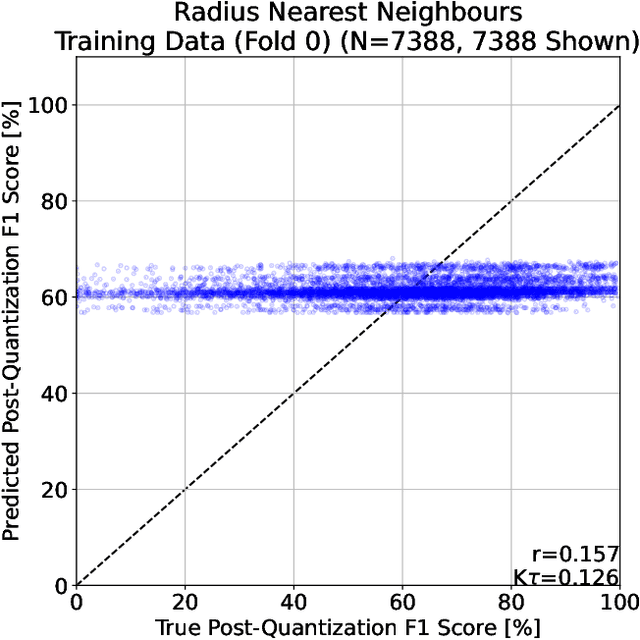
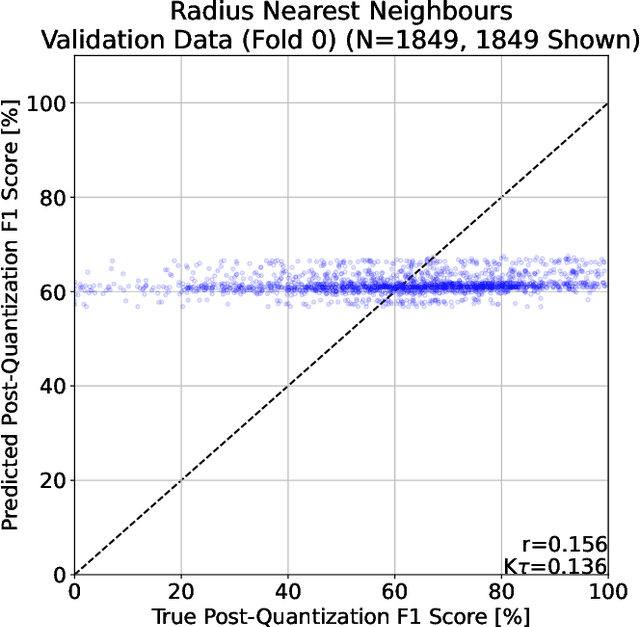
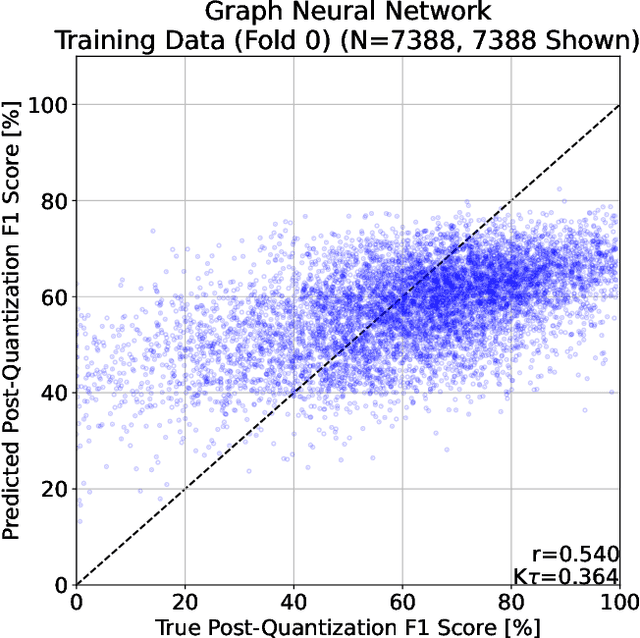
This paper showcases the use of a reinforcement learning-based Neural Architecture Search (NAS) agent to design a small neural network to perform active fire detection on multispectral satellite imagery. Specifically, we aim to design a neural network that can determine if a single multispectral pixel is a part of a fire, and do so within the constraints of a Low Earth Orbit (LEO) nanosatellite with a limited power budget, to facilitate on-board processing of sensor data. In order to use reinforcement learning, a reward function is needed. We supply this reward function in the shape of a regression model that predicts the F1 score obtained by a particular architecture, following quantization to INT8 precision, from purely architectural features. This model is trained by collecting a random sample of neural network architectures, training these architectures, and collecting their classification performance statistics. Besides the F1 score, we also include the total number of trainable parameters in our reward function to limit the size of the designed model and ensure it fits within the resource constraints imposed by nanosatellite platforms. Finally, we deployed the best neural network to the Google Coral Micro Dev Board and evaluated its inference latency and power consumption. This neural network consists of 1,716 trainable parameters, takes on average 984{\mu}s to inference, and consumes around 800mW to perform inference. These results show that our reinforcement learning-based NAS approach can be successfully applied to novel problems not tackled before.