 Add to Chrome
 Add to Firefox
 Add to Edge
Beyond Factual Grounding: The Case for Opinion-Aware Retrieval-Augmented Generation
Apr 13, 2026
RAG systems have transformed how LLMs access external knowledge, but we find that current implementations exhibit a bias toward factual, objective content, as evidenced by existing benchmarks and datasets that prioritize objective retrieval. This factual bias - treating opinions and diverse perspectives as noise rather than information to be synthesized - limits RAG systems in real-world scenarios involving subjective content, from social media discussions to product reviews. Beyond technical limitations, this bias poses risks to transparent and accountable AI: echo chamber effects that amplify dominant viewpoints, systematic underrepresentation of minority voices, and potential opinion manipulation through biased information synthesis. We formalize this limitation through the lens of uncertainty: factual queries involve epistemic uncertainty reducible through evidence, while opinion queries involve aleatoric uncertainty reflecting genuine heterogeneity in human perspectives. This distinction implies that factual RAG should minimize posterior entropy, whereas opinion-aware RAG must preserve it. Building on this theoretical foundation, we present an Opinion-Aware RAG architecture featuring LLM-based opinion extraction, entity-linked opinion graphs, and opinion-enriched document indexing. We evaluate our approach on e-commerce seller forum data, comparing an Opinion-Enriched knowledge base against a traditional baseline. Experiments demonstrate substantial improvements in retrieval diversity: +26.8% sentiment diversity, +42.7% entity match rate, and +31.6% author demographic coverage on entity-matched documents. Our results provide empirical evidence that treating subjectivity as a first-class citizen yields measurably more representative retrieval-a first step toward opinion-aware RAG. Future work includes joint optimization of retrieval and generation for distributional fidelity.

CiteFix: Enhancing RAG Accuracy Through Post-Processing Citation Correction
Apr 22, 2025Retrieval Augmented Generation (RAG) has emerged as a powerful application of Large Language Models (LLMs), revolutionizing information search and consumption. RAG systems combine traditional search capabilities with LLMs to generate comprehensive answers to user queries, ideally with accurate citations. However, in our experience of developing a RAG product, LLMs often struggle with source attribution, aligning with other industry studies reporting citation accuracy rates of only about 74% for popular generative search engines. To address this, we present efficient post-processing algorithms to improve citation accuracy in LLM-generated responses, with minimal impact on latency and cost. Our approaches cross-check generated citations against retrieved articles using methods including keyword + semantic matching, fine tuned model with BERTScore, and a lightweight LLM-based technique. Our experimental results demonstrate a relative improvement of 15.46% in the overall accuracy metrics of our RAG system. This significant enhancement potentially enables a shift from our current larger language model to a relatively smaller model that is approximately 12x more cost-effective and 3x faster in inference time, while maintaining comparable performance. This research contributes to enhancing the reliability and trustworthiness of AI-generated content in information retrieval and summarization tasks which is critical to gain customer trust especially in commercial products.
Contradiction Detection in RAG Systems: Evaluating LLMs as Context Validators for Improved Information Consistency
Mar 31, 2025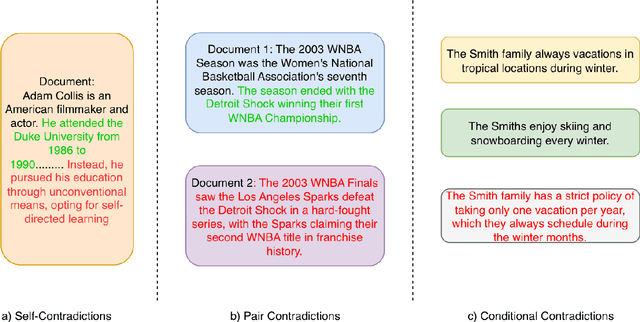
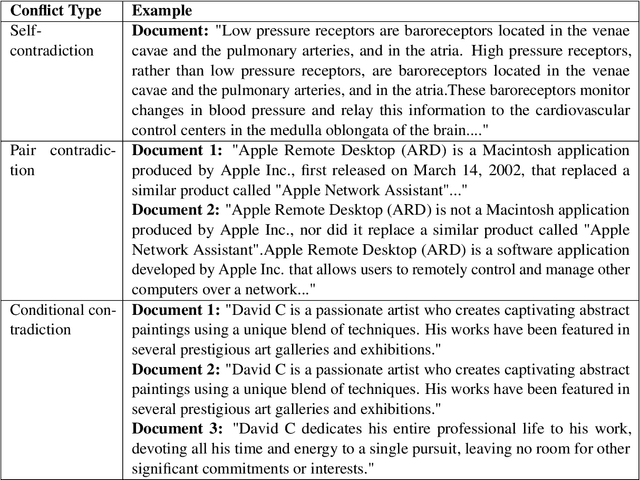
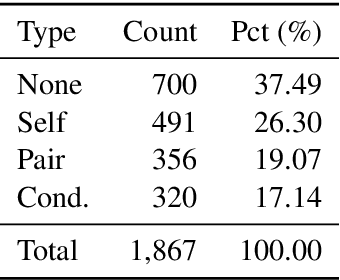
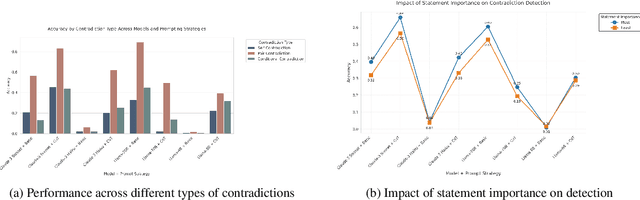
Retrieval Augmented Generation (RAG) systems have emerged as a powerful method for enhancing large language models (LLMs) with up-to-date information. However, the retrieval step in RAG can sometimes surface documents containing contradictory information, particularly in rapidly evolving domains such as news. These contradictions can significantly impact the performance of LLMs, leading to inconsistent or erroneous outputs. This study addresses this critical challenge in two ways. First, we present a novel data generation framework to simulate different types of contradictions that may occur in the retrieval stage of a RAG system. Second, we evaluate the robustness of different LLMs in performing as context validators, assessing their ability to detect contradictory information within retrieved document sets. Our experimental results reveal that context validation remains a challenging task even for state-of-the-art LLMs, with performance varying significantly across different types of contradictions. While larger models generally perform better at contradiction detection, the effectiveness of different prompting strategies varies across tasks and model architectures. We find that chain-of-thought prompting shows notable improvements for some models but may hinder performance in others, highlighting the complexity of the task and the need for more robust approaches to context validation in RAG systems.