 Add to Chrome
 Add to Firefox
 Add to Edge
Transformers with Physics-Informed Encodings and Simulation-Based Inference for Robust Detection of Eccentric Binary Black Holes in Pulsar Timing Array Data
Jul 04, 2026
Pulsar timing arrays (PTAs) provide a unique window into nanohertz gravitational waves (GWs), but extracting astrophysical parameters from noisy, long-baseline timing residuals remains computationally challenging with traditional Bayesian techniques due to the high dimensionality of the parameter space, complex and correlated noise models, and the cost of repeated likelihood evaluations. We introduce a Transformer with a physics-informed positional-encoding framework for the efficient inference of eccentric binary black holes in relativistic orbits from PTA data. Our approach embeds analytical GW phase evolution directly into the model through structured positional encodings, enabling the network to learn physically meaningful representations from raw PTA timing residuals. We then use generative models, including discrete and continuous conditional normalizing flows, to infer posterior distributions within a simulation-based inference framework. Across a range of signal-to-noise ratios, the proposed method achieves improved accuracy, sharper posteriors, and faster inference compared to physics-agnostic baselines. While presented for deterministic white-noise signals, the modular framework readily generalizes to realistic PTA analyses incorporating red noise and additional components. This work highlights the potential of physics-aware deep learning models as scalable alternatives to conventional inference pipelines for next-generation PTA datasets.

Learning Bayes' theorem with a neural network for gravitational-wave inference
Sep 23, 2019


We seek to achieve the Holy Grail of Bayesian inference for gravitational-wave astronomy: using deep-learning techniques to instantly produce the posterior $p(\theta|D)$ for the source parameters $\theta$, given the detector data $D$. To do so, we train a deep neural network to take as input a signal + noise data set (drawn from the astrophysical source-parameter prior and the sampling distribution of detector noise), and to output a parametrized approximation of the corresponding posterior. We rely on a compact representation of the data based on reduced-order modeling, which we generate efficiently using a separate neural-network waveform interpolant [A. J. K. Chua, C. R. Galley & M. Vallisneri, Phys. Rev. Lett. 122, 211101 (2019)]. Our scheme has broad relevance to gravitational-wave applications such as low-latency parameter estimation and characterizing the science returns of future experiments. Source code and trained networks are available online at https://github.com/vallis/truebayes.
ROMAN: Reduced-Order Modeling with Artificial Neurons
Nov 13, 2018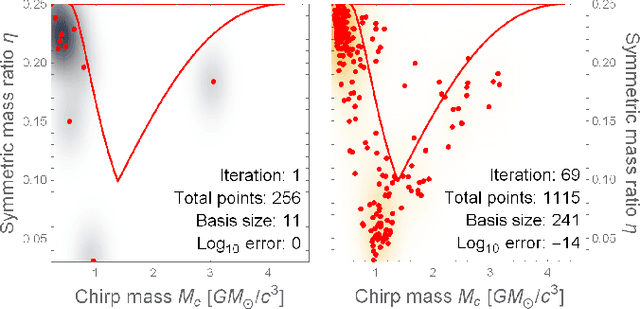
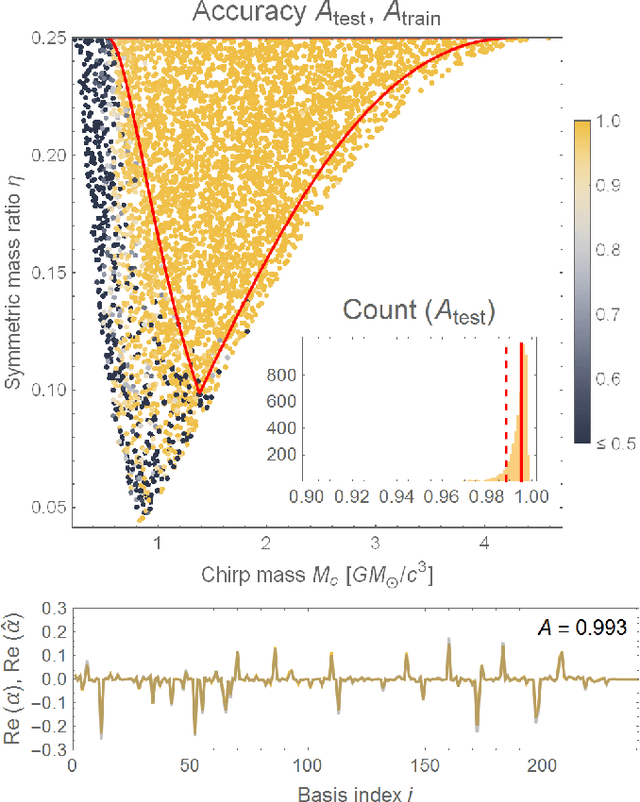
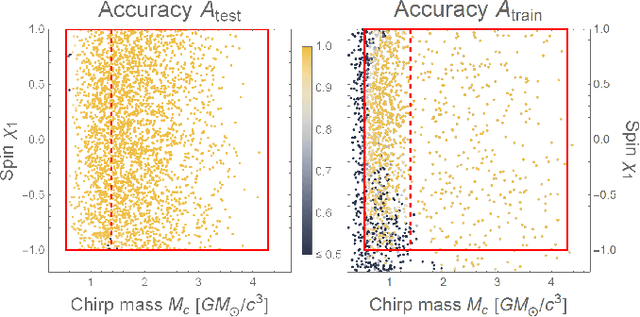

Gravitational-wave data analysis is rapidly absorbing techniques from deep learning, with a focus on convolutional networks and related methods that treat noisy time series as images. We pursue an alternative approach, in which waveforms are first represented as weighted sums over reduced bases (reduced-order modeling); we then train artificial neural networks to map gravitational-wave source parameters into basis coefficients. Statistical inference proceeds directly in coefficient space, where it is theoretically straightforward and computationally efficient. The neural networks also provide analytic waveform derivatives, which are useful for gradient-based sampling schemes. We demonstrate fast and accurate coefficient interpolation for the case of a four-dimensional binary-inspiral waveform family, and discuss promising applications of our framework in parameter estimation.
Fast methods for training Gaussian processes on large data sets
May 13, 2016


Gaussian process regression (GPR) is a non-parametric Bayesian technique for interpolating or fitting data. The main barrier to further uptake of this powerful tool rests in the computational costs associated with the matrices which arise when dealing with large data sets. Here, we derive some simple results which we have found useful for speeding up the learning stage in the GPR algorithm, and especially for performing Bayesian model comparison between different covariance functions. We apply our techniques to both synthetic and real data and quantify the speed-up relative to using nested sampling to numerically evaluate model evidences.
* Fixed missing references