 Add to Chrome
 Add to Firefox
 Add to Edge
Zipf's law for word frequencies: word forms versus lemmas in long texts
Jul 13, 2015
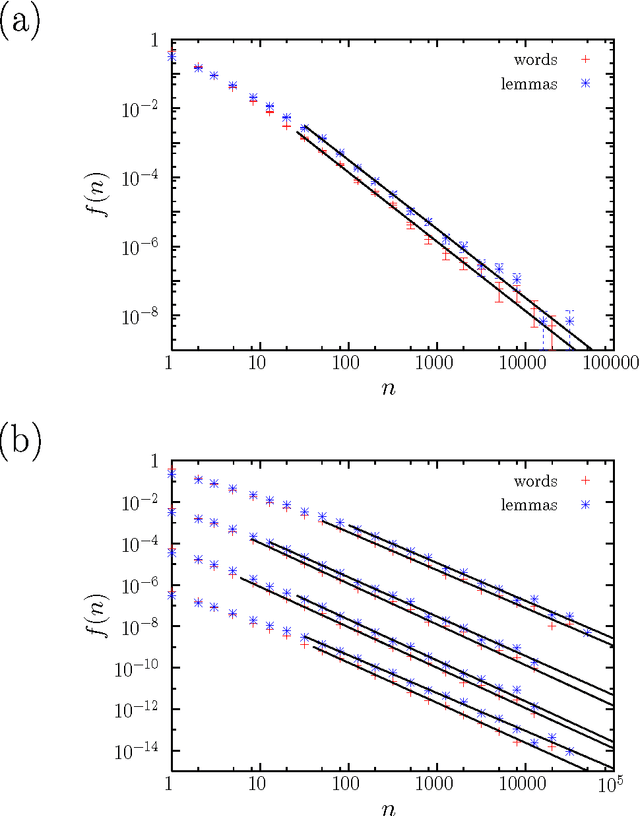

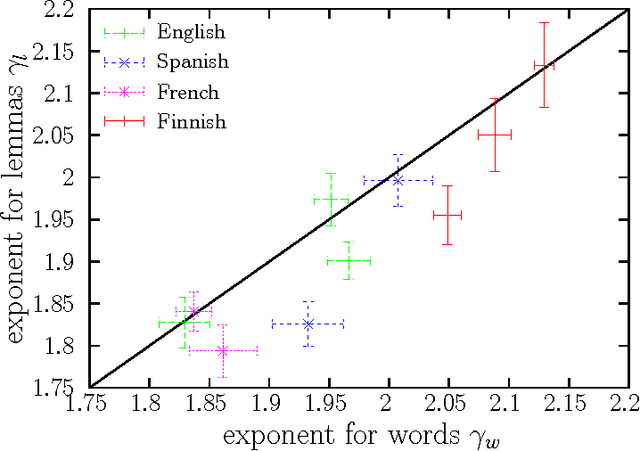

Zipf's law is a fundamental paradigm in the statistics of written and spoken natural language as well as in other communication systems. We raise the question of the elementary units for which Zipf's law should hold in the most natural way, studying its validity for plain word forms and for the corresponding lemma forms. In order to have as homogeneous sources as possible, we analyze some of the longest literary texts ever written, comprising four different languages, with different levels of morphological complexity. In all cases Zipf's law is fulfilled, in the sense that a power-law distribution of word or lemma frequencies is valid for several orders of magnitude. We investigate the extent to which the word-lemma transformation preserves two parameters of Zipf's law: the exponent and the low-frequency cut-off. We are not able to demonstrate a strict invariance of the tail, as for a few texts both exponents deviate significantly, but we conclude that the exponents are very similar, despite the remarkable transformation that going from words to lemmas represents, considerably affecting all ranges of frequencies. In contrast, the low-frequency cut-offs are less stable.

Universal Complex Structures in Written Language
Jan 19, 2009Quantitative linguistics has provided us with a number of empirical laws that characterise the evolution of languages and competition amongst them. In terms of language usage, one of the most influential results is Zipf's law of word frequencies. Zipf's law appears to be universal, and may not even be unique to human language. However, there is ongoing controversy over whether Zipf's law is a good indicator of complexity. Here we present an alternative approach that puts Zipf's law in the context of critical phenomena (the cornerstone of complexity in physics) and establishes the presence of a large scale "attraction" between successive repetitions of words. Moreover, this phenomenon is scale-invariant and universal -- the pattern is independent of word frequency and is observed in texts by different authors and written in different languages. There is evidence, however, that the shape of the scaling relation changes for words that play a key role in the text, implying the existence of different "universality classes" in the repetition of words. These behaviours exhibit striking parallels with complex catastrophic phenomena.