 Add to Chrome
 Add to Firefox
 Add to Edge
Improved MambdaBDA Framework for Robust Building Damage Assessment Across Disaster Domains
Mar 04, 2026
Reliable post-disaster building damage assessment (BDA) from satellite imagery is hindered by severe class imbalance, background clutter, and domain shift across disaster types and geographies. In this work, we address these problems and explore ways to improve the MambaBDA, the BDA network of ChangeMamba architecture, one of the most successful BDA models. The approach enhances the MambaBDA with three modular components: (i) Focal Loss to mitigate class imbalance damage classification, (ii) lightweight Attention Gates to suppress irrelevant context, and (iii) a compact Alignment Module to spatially warp pre-event features toward post-event content before decoding. We experiment on multiple satellite imagery datasets, including xBD, Pakistan Flooding, Turkey Earthquake, and Ida Hurricane, and conduct in-domain and crossdataset tests. The proposed modular enhancements yield consistent improvements over the baseline model, with 0.8% to 5% performance gains in-domain, and up to 27% on unseen disasters. This indicates that the proposed enhancements are especially beneficial for the generalization capability of the system.

VIDI: A Video Dataset of Incidents
May 26, 2022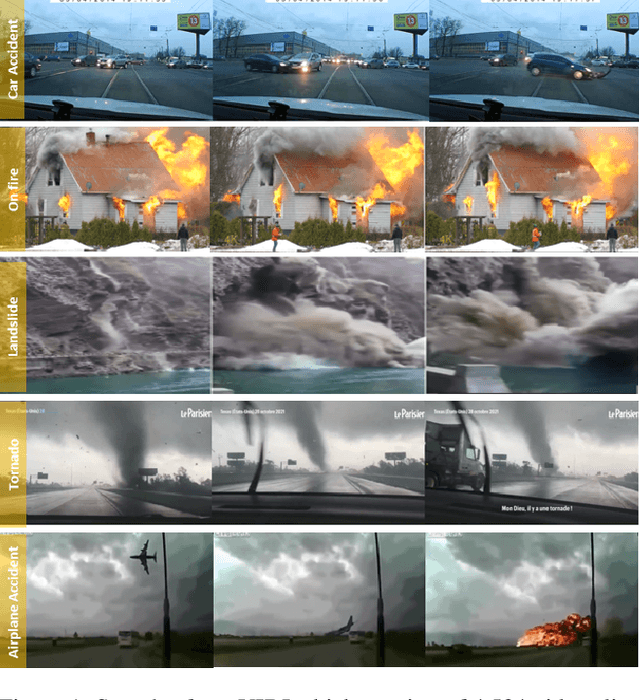
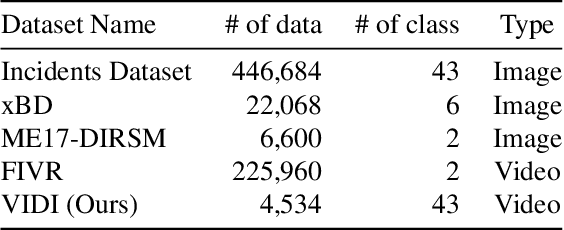
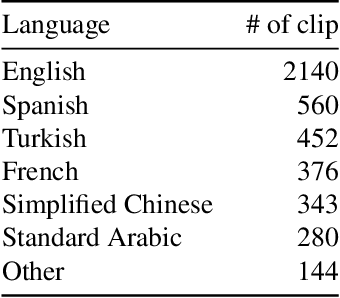
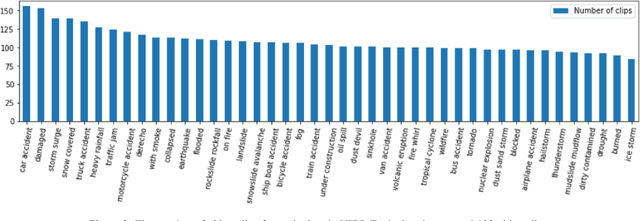
Automatic detection of natural disasters and incidents has become more important as a tool for fast response. There have been many studies to detect incidents using still images and text. However, the number of approaches that exploit temporal information is rather limited. One of the main reasons for this is that a diverse video dataset with various incident types does not exist. To address this need, in this paper we present a video dataset, Video Dataset of Incidents, VIDI, that contains 4,534 video clips corresponding to 43 incident categories. Each incident class has around 100 videos with a duration of ten seconds on average. To increase diversity, the videos have been searched in several languages. To assess the performance of the recent state-of-the-art approaches, Vision Transformer and TimeSformer, as well as to explore the contribution of video-based information for incident classification, we performed benchmark experiments on the VIDI and Incidents Dataset. We have shown that the recent methods improve the incident classification accuracy. We have found that employing video data is very beneficial for the task. By using the video data, the top-1 accuracy is increased to 76.56% from 67.37%, which was obtained using a single frame. VIDI will be made publicly available. Additional materials can be found at the following link: https://github.com/vididataset/VIDI.