 Add to Chrome
 Add to Firefox
 Add to Edge
Federated Few-Shot Learning for Epileptic Seizure Detection Under Privacy Constraints
Dec 09, 2025
Many deep learning approaches have been developed for EEG-based seizure detection; however, most rely on access to large centralized annotated datasets. In clinical practice, EEG data are often scarce, patient-specific distributed across institutions, and governed by strict privacy regulations that prohibit data pooling. As a result, creating usable AI-based seizure detection models remains challenging in real-world medical settings. To address these constraints, we propose a two-stage federated few-shot learning (FFSL) framework for personalized EEG-based seizure detection. The method is trained and evaluated on the TUH Event Corpus, which includes six EEG event classes. In Stage 1, a pretrained biosignal transformer (BIOT) is fine-tuned across non-IID simulated hospital sites using federated learning, enabling shared representation learning without centralizing EEG recordings. In Stage 2, federated few-shot personalization adapts the classifier to each patient using only five labeled EEG segments, retaining seizure-specific information while still benefiting from cross-site knowledge. Federated fine-tuning achieved a balanced accuracy of 0.43 (centralized: 0.52), Cohen's kappa of 0.42 (0.49), and weighted F1 of 0.69 (0.74). In the FFSL stage, client-specific models reached an average balanced accuracy of 0.77, Cohen's kappa of 0.62, and weighted F1 of 0.73 across four sites with heterogeneous event distributions. These results suggest that FFSL can support effective patient-adaptive seizure detection under realistic data-availability and privacy constraints.

Sustainability Through Cognition Aware Safety Systems -- Next Level Human-Machine-Interaction
Oct 13, 2021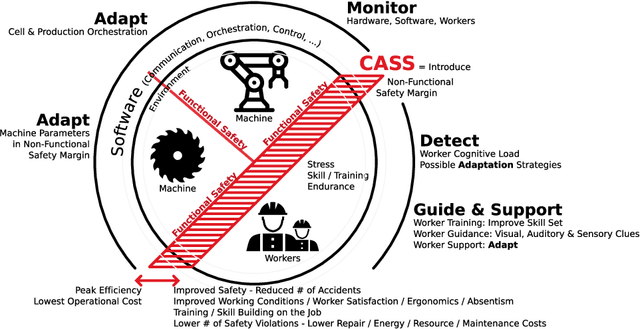
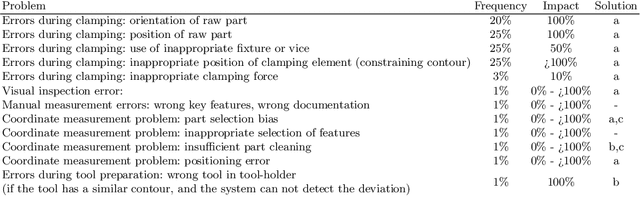
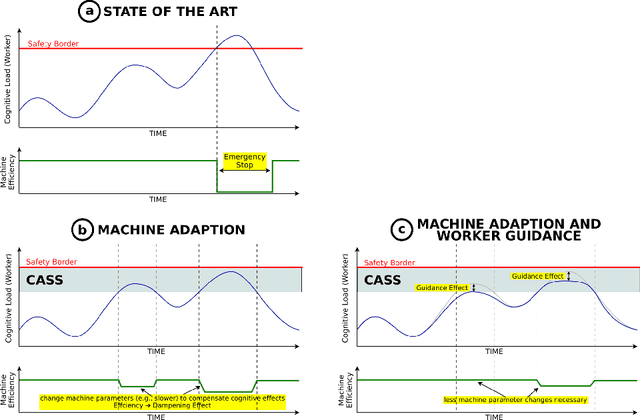
Industrial Safety deals with the physical integrity of humans, machines and the environment when they interact during production scenarios. Industrial Safety is subject to a rigorous certification process that leads to inflexible settings, in which all changes are forbidden. With the progressing introduction of smart robotics and smart machinery to the factory floor, combined with an increasing shortage of skilled workers, it becomes imperative that safety scenarios incorporate a flexible handling of the boundary between humans, machines and the environment. In order to increase the well-being of workers, reduce accidents, and compensate for different skill sets, the configuration of machines and the factory floor should be dynamically adapted, while still enforcing functional safety requirements. The contribution of this paper is as follows: (1) We present a set of three scenarios, and discuss how industrial safety mechanisms could be augmented through dynamic changes to the work environment in order to decrease potential accidents, and thus increase productivity. (2) We introduce the concept of a Cognition Aware Safety System (CASS) and its architecture. The idea behind CASS is to integrate AI based reasoning about human load, stress, and attention with AI based selection of actions to avoid the triggering of safety stops. (3) And finally, we will describe the required performance measurement dimensions for a quantitative performance measurement model to enable a comprehensive (triple bottom line) impact assessment of CASS. Additionally we introduce a detailed guideline for expert interviews to explore the feasibility of the approach for given scenarios.