 Add to Chrome
 Add to Firefox
 Add to Edge
Through the LENS: Local Geometric Decomposition of Vision-Language Model Representations
Aug 01, 2026
Vision-language models (VLMs) process image patches and text tokens in a shared residual stream, but the local geometry through which the two modalities interact remains poorly understood. Most interpretability methods identify global linear directions, which may miss representations that are globally high-dimensional but locally low-dimensional. We introduce LENS (Local Explanation of Neighborhood Subspaces), a method that decomposes VLM activations into local low-rank Gaussian neighborhoods using a Mixture of Factor Analyzers. Applied to LLaVA-1.5-7B and Qwen3-VL-8B, LENS reveals distinct depth-dependent fusion trajectories consistent with each model's fusion mechanism: LLaVA progressively mixes modalities at later layers, whereas Qwen3-VL mixes them early, partially re-segregates them, and recombines them near the output. An automated multimodal labeling pipeline assigns concise semantic descriptions to these neighborhoods. Interpolating activations toward neighborhood centroids causally redirects generation within and across modalities and outperforms difference-in-means and VL-SAE in most evaluated conditions; in one LLaVA vision-to-vision setting, MFA achieves 5.7 times the VL-SAE score. Human evaluation finds MFA steering competitive with prompting and substantially stronger than the other intervention baselines. Finally, the MFA coefficient space improves Qwen3-VL image-to-rendered-text retrieval at the deepest evaluated layer from 14.9% to 48.6% R@1. Ablations show that the reported fusion trajectories are stable across component counts, local ranks, and modality-purity thresholds. These results support local geometric neighborhoods as useful interpretable and causal units for analyzing cross-modal representations in the evaluated VLMs.

Fortify the Guardian, Not the Treasure: Resilient Adversarial Detectors
Apr 18, 2024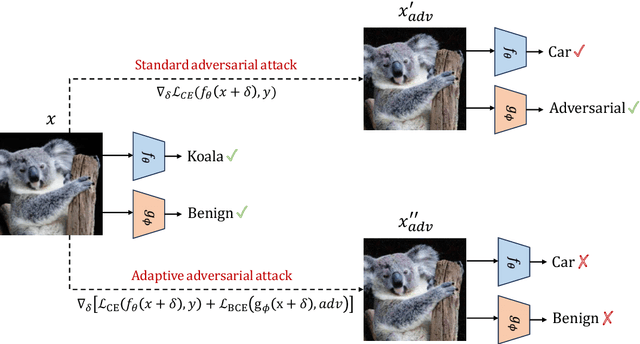
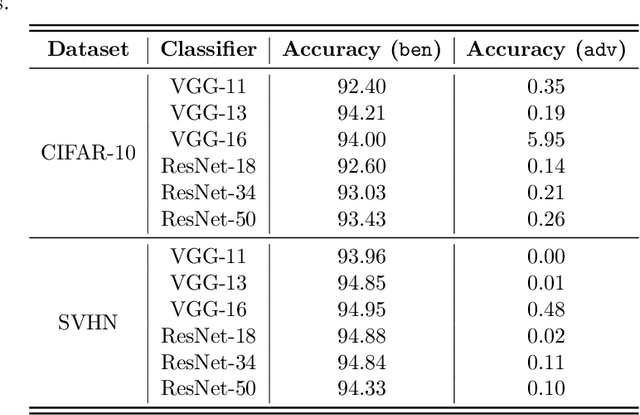
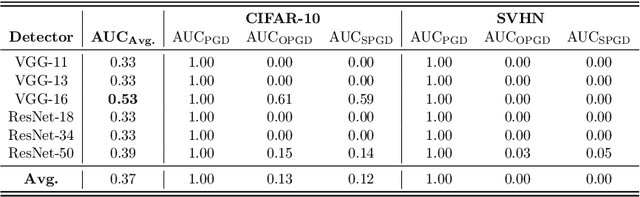
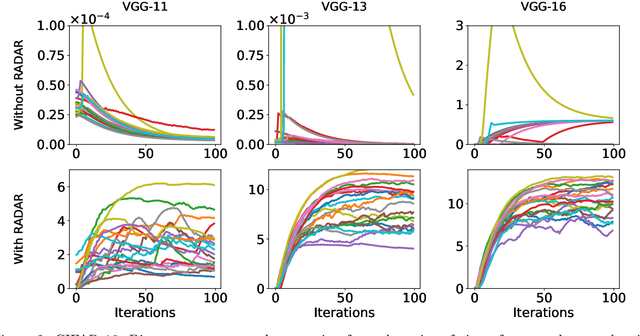
This paper presents RADAR-Robust Adversarial Detection via Adversarial Retraining-an approach designed to enhance the robustness of adversarial detectors against adaptive attacks, while maintaining classifier performance. An adaptive attack is one where the attacker is aware of the defenses and adapts their strategy accordingly. Our proposed method leverages adversarial training to reinforce the ability to detect attacks, without compromising clean accuracy. During the training phase, we integrate into the dataset adversarial examples, which were optimized to fool both the classifier and the adversarial detector, enabling the adversarial detector to learn and adapt to potential attack scenarios. Experimental evaluations on the CIFAR-10 and SVHN datasets demonstrate that our proposed algorithm significantly improves a detector's ability to accurately identify adaptive adversarial attacks -- without sacrificing clean accuracy.