 Add to Chrome
 Add to Firefox
 Add to Edge
Academic League of Artificial Intelligence - An Integrative Perspective of Teaching, Research, and Extension
Aug 13, 2026
Academic leagues have become important mechanisms for promoting extracurricular education and strengthening the integration between universities and society. This paper presents the organizational framework adopted by the Academic League of Artificial Intelligence (LIA) at the Federal University of Santa Catarina (UFSC), designed to integrate teaching, research, and university extension through a student-centered, project-based approach. The framework combines democratic governance, collaborative learning, and dynamic project organization to foster both technical and transversal competencies. The framework is illustrated through representative initiatives, including competition teams, study groups, open lectures, knowledge repositories, and AI-powered applications with social impact. These projects demonstrate how diverse educational, scientific, and extension activities can be developed within a common organizational structure while promoting leadership, scientific production, community engagement, and knowledge preservation. The reported experience indicates that the proposed framework provides a flexible and replicable model for integrating the three university pillars into engineering and computing education, offering practical guidance for academic leagues and similar student organizations.

Who Thinks Best Depends on How Long You Let Them: Budget-Dependent Rankings in LLM Evaluation
Aug 12, 2026Standard evaluation of large language models assumes stable model rankings across inference conditions. We challenge this assumption by varying the token generation budget, i.e., the maximum tokens a model may produce, across seven levels (64--4,096), evaluating four models on three reasoning benchmarks (56,476 inferences). We report four findings: (i) 3--19% of items exhibit non-monotone behavior (accuracy decreasing with more budget), even after controlling for truncation, and this phenomenon is model-specific (cross-model overlap: 6--14%). (ii) Model rankings reverse across budgets on all benchmarks ($p {<} 0.01$, McNemar). (iii) Oracle analysis reveals model complementarity up to $+27.8$pp, most pronounced at constrained budgets. (iv) A budget-aware router captures 14.1% of the oracle gap cross-domain; budget features help within-domain ($+1.6$ to $+5.7$pp) but are domain-specific and hurt transfer ($-1.2$pp). These results argue for budget-conditioned evaluation protocols.
RV4JaCa -- Runtime Verification for Multi-Agent Systems
Jul 20, 2022
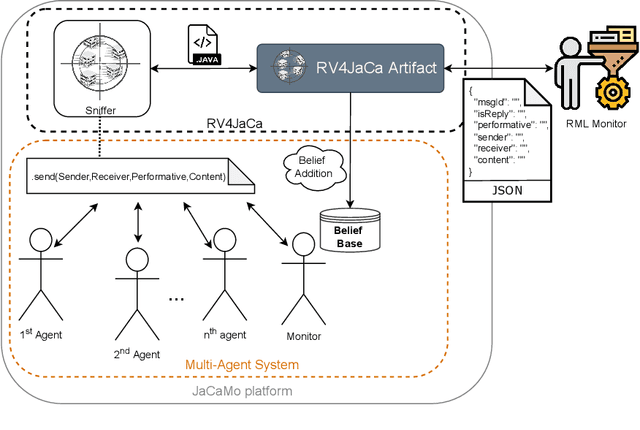
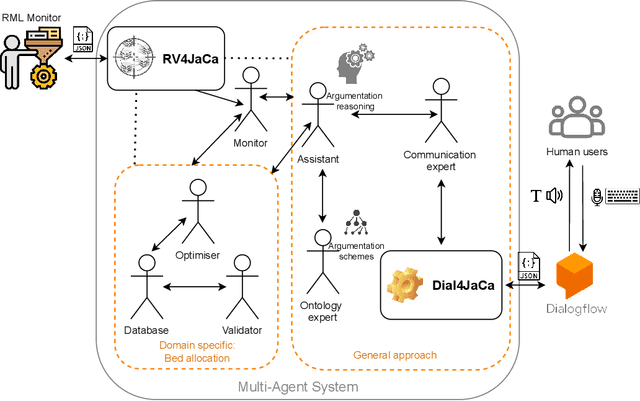
This paper presents a Runtime Verification (RV) approach for Multi-Agent Systems (MAS) using the JaCaMo framework. Our objective is to bring a layer of security to the MAS. This layer is capable of controlling events during the execution of the system without needing a specific implementation in the behaviour of each agent to recognise the events. MAS have been used in the context of hybrid intelligence. This use requires communication between software agents and human beings. In some cases, communication takes place via natural language dialogues. However, this kind of communication brings us to a concern related to controlling the flow of dialogue so that agents can prevent any change in the topic of discussion that could impair their reasoning. We demonstrate the implementation of a monitor that aims to control this dialogue flow in a MAS that communicates with the user through natural language to aid decision-making in hospital bed allocation.
* In Proceedings AREA 2022, arXiv:2207.09058