 Add to Chrome
 Add to Firefox
 Add to Edge
Climbing the label tree: Hierarchy-preserving contrastive learning for medical imaging
Nov 05, 2025
Medical image labels are often organized by taxonomies (e.g., organ - tissue - subtype), yet standard self-supervised learning (SSL) ignores this structure. We present a hierarchy-preserving contrastive framework that makes the label tree a first-class training signal and an evaluation target. Our approach introduces two plug-in objectives: Hierarchy-Weighted Contrastive (HWC), which scales positive/negative pair strengths by shared ancestors to promote within-parent coherence, and Level-Aware Margin (LAM), a prototype margin that separates ancestor groups across levels. The formulation is geometry-agnostic and applies to Euclidean and hyperbolic embeddings without architectural changes. Across several benchmarks, including breast histopathology, the proposed objectives consistently improve representation quality over strong SSL baselines while better respecting the taxonomy. We evaluate with metrics tailored to hierarchy faithfulness: HF1 (hierarchical F1), H-Acc (tree-distance-weighted accuracy), and parent-distance violation rate. We also report top-1 accuracy for completeness. Ablations show that HWC and LAM are effective even without curvature, and combining them yields the most taxonomy-aligned representations. Taken together, these results provide a simple, general recipe for learning medical image representations that respect the label tree and advance both performance and interpretability in hierarchy-rich domains.

Shadow: A Novel Loss Function for Efficient Training in Siamese Networks
Nov 23, 2023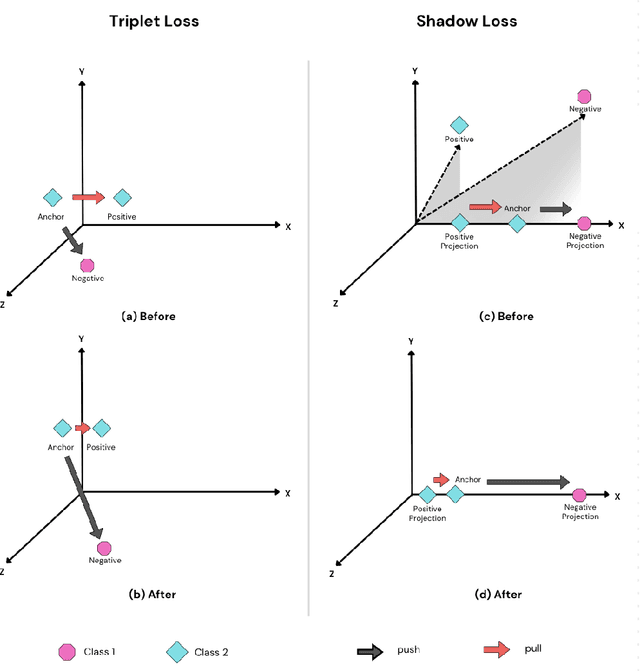

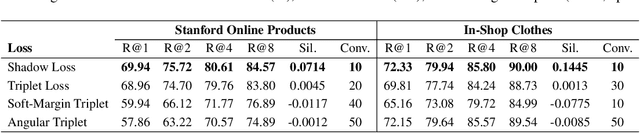
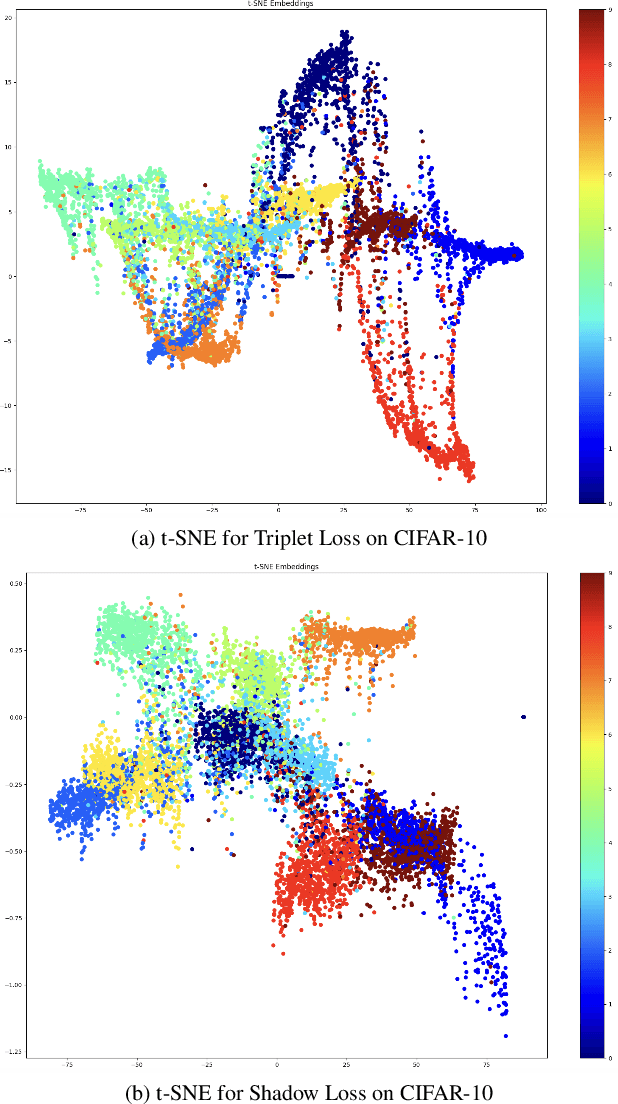
Despite significant recent advances in similarity detection tasks, existing approaches pose substantial challenges under memory constraints. One of the primary reasons for this is the use of computationally expensive metric learning loss functions such as Triplet Loss in Siamese networks. In this paper, we present a novel loss function called Shadow Loss that compresses the dimensions of an embedding space during loss calculation without loss of performance. The distance between the projections of the embeddings is learned from inputs on a compact projection space where distances directly correspond to a measure of class similarity. Projecting on a lower-dimension projection space, our loss function converges faster, and the resulting classified image clusters have higher inter-class and smaller intra-class distances. Shadow Loss not only reduces embedding dimensions favoring memory constraint devices but also consistently performs better than the state-of-the-art Triplet Margin Loss by an accuracy of 5\%-10\% across diverse datasets. The proposed loss function is also model agnostic, upholding its performance across several tested models. Its effectiveness and robustness across balanced, imbalanced, medical, and non-medical image datasets suggests that it is not specific to a particular model or dataset but demonstrates superior performance consistently while using less memory and computation.