 Add to Chrome
 Add to Firefox
 Add to Edge
Adaptive Confidence-weighted Expansion for Trustworthy Multi-Omics Multimodal Fusion
Jul 22, 2026
Multimodal learning is a robust approach to improve predictive performance in applications such as medical prognosis. However, the clinical applicability of models that use multimodal learning is hampered by their poor performance under noisy or uninformative data streams. Present fusion approaches often lack robust mechanisms for the dynamic assessment of data quality and for the provision of a trustable confidence score on the final prediction. This dissuades their deployment in safety-critical settings. To address these limitations, we introduce Adaptive Confidence-weighted Expansion (ACE), a novel framework to enhance the trustworthiness of multimodal fusion models. ACE first enhances the multimodal space by generating new, complementary modalities from intra-modality correlations. It then employs a dual-level confidence mechanism that (1) adaptively reweighs all modalities by their reliability before fusion and (2) estimates a global trust score over the fused, final decision. To evaluate ACE, we used four challenging multi-omics datasets (BRCA, KIPAN, LGG, and ROSMAP). ACE significantly outperforms existing state-of-the-art algorithms in both classification performance and confidence calibration. Our framework provides a more stable and robust data fusion method that facilitates the use of multimodal learning in addressing high-stakes problems.

Multi-Template Temporal Siamese Network for Long-Term Object Tracking
Nov 24, 2022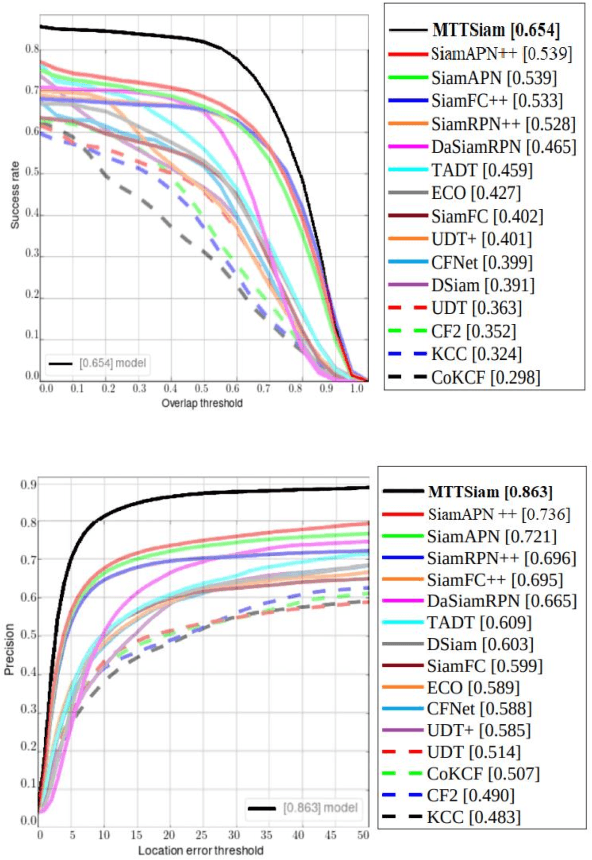
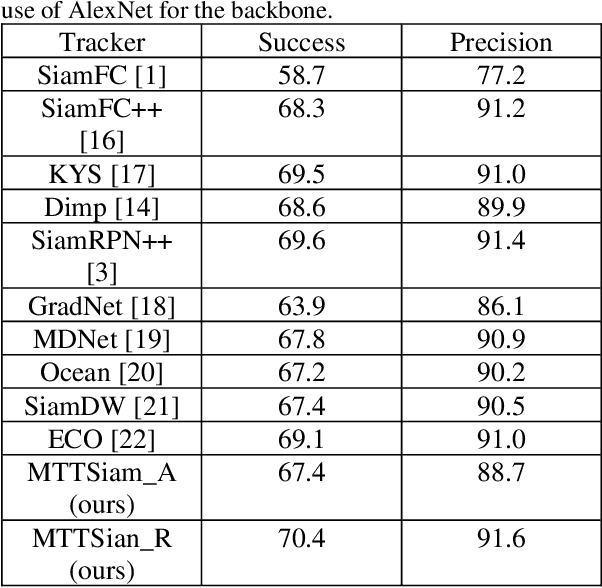
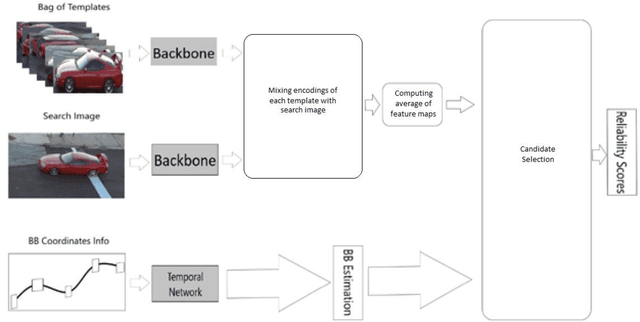
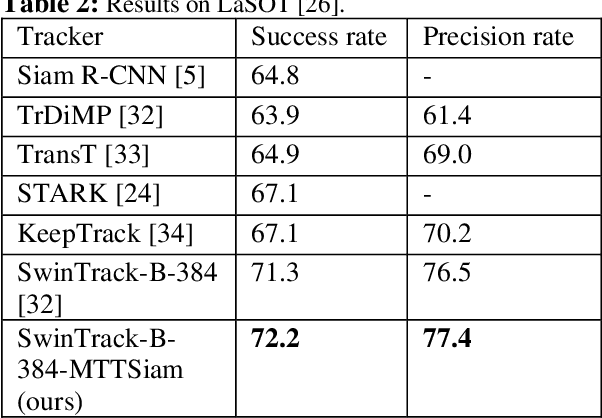
Siamese Networks are one of most popular visual object tracking methods for their high speed and high accuracy tracking ability as long as the target is well identified. However, most Siamese Network based trackers use the first frame as the ground truth of an object and fail when target appearance changes significantly in next frames. They also have dif iculty distinguishing the target from similar other objects in the frame. We propose two ideas to solve both problems. The first idea is using a bag of dynamic templates, containing diverse, similar, and recent target features and continuously updating it with diverse target appearances. The other idea is to let a network learn the path history and project a potential future target location in a next frame. This tracker achieves state-of-the-art performance on the long-term tracking dataset UAV20L by improving the success rate by a large margin of 15% (65.4 vs 56.6) compared to the state-of-the-art method, HiFT. The of icial python code of this paper is publicly available.